 Back
BackChapter 4: Carbon and the Molecular Diversity of Life
Study Guide - Smart Notes
 Tailored notes based on your materials, expanded with key definitions, examples, and context.
Carbon and Organic Molecules: The Molecular Diversity of Life
Introduction to Carbon in Biology
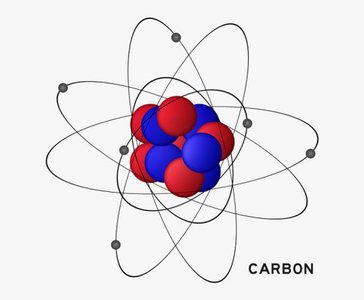
Carbon is the foundational element for all known life, forming the backbone of organic molecules. Its unique chemical properties allow it to create a vast diversity of stable, complex, and large molecules essential for biological processes. Proteins, DNA, carbohydrates, and lipids are all examples of organic compounds built primarily from carbon atoms.
Background and Significance of Carbon
Abundance: Living organisms are composed largely of carbon-based compounds.
Versatility: Carbon's ability to form four covalent bonds enables the construction of molecules with various shapes and functions.
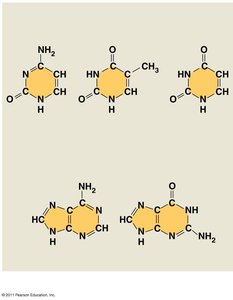
Examples: Nitrogenous bases in DNA and RNA, as well as amino acids and sugars, are all carbon-based.
Carbon Structure and Bonding Properties
Electron Configuration and Bonding
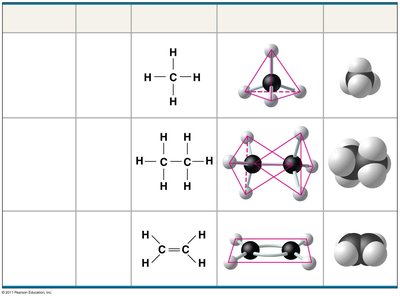
The electron configuration of carbon (1s2 2s2 2p2) allows it to form four covalent bonds with other atoms, resulting in a tetrahedral geometry. This property is crucial for the diversity of organic molecules.
Single Bonds: Tetrahedral shape, as in methane (CH4).
Double Bonds: Planar shape, as in ethene (C2H4).
Bonding Partners: Commonly bonds with hydrogen, oxygen, and nitrogen.
Why Carbon, Not Silicon?
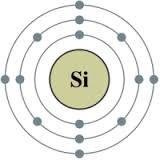
Although silicon shares a similar valence structure, carbon's smaller atomic size and ability to form stable, diverse, and flexible bonds make it uniquely suited as the backbone of life.
Rules of Covalent Bonding
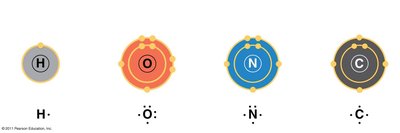
Hydrogen: Forms 1 bond
Oxygen: Forms 2 bonds
Nitrogen: Forms 3 bonds
Carbon: Forms 4 bonds
Carbon and Molecular Diversity
Variation in Carbon Skeletons
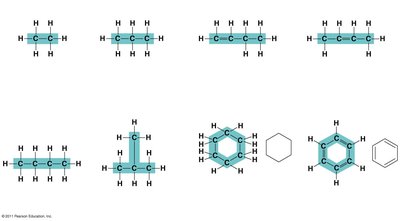
The diversity and properties of organic molecules are largely determined by variations in their carbon skeletons and the chemical groups attached to them. These variations include:
Length: Number of carbon atoms in the chain
Branching: Presence of side chains
Double Bond Position: Location and number of double bonds
Rings: Presence or absence of ring structures
Hydrocarbons
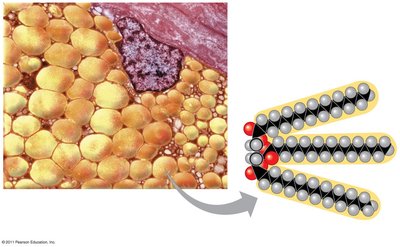
Hydrocarbons are organic molecules consisting only of carbon and hydrogen. They are nonpolar, hydrophobic, and serve as energy-rich components in biological molecules such as fats.
Isomers
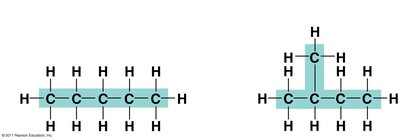
Isomers are compounds with the same molecular formula but different structures and properties. Types of isomers include:
Structural Isomers: Differ in covalent arrangement of atoms (e.g., straight vs. branched chains).
Cis-Trans Isomers: Same covalent bonds but differ in spatial arrangement due to double bonds.
Enantiomers: Mirror images of each other, not superimposable; often only one is biologically active.
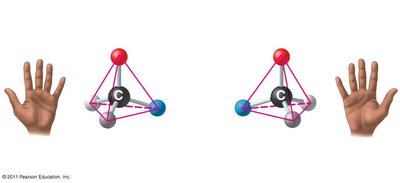
Biological Importance of Isomers
Enantiomers are especially significant in biology and pharmacology, as different enantiomers of a drug can have drastically different effects in organisms.
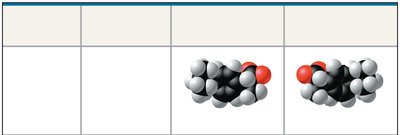
Biologically Important Chemical Groups (Functional Groups)
Overview of Functional Groups
Functional groups are specific groups of atoms attached to carbon skeletons that determine the characteristic chemical reactions of those molecules. The seven most important functional groups in biological chemistry are:
Hydroxyl (–OH)
Carbonyl (C=O)
Carboxyl (–COOH)
Amino (–NH2)
Sulfhydryl (–SH)
Phosphate (–OPO32–)
Methyl (–CH3)
Table: Functional Groups, Structure, and Properties
Functional Group | Structure | Example | Properties |
|---|---|---|---|
Hydroxyl | –OH | Ethanol | Polar, forms hydrogen bonds, increases solubility in water |
Carbonyl | C=O | Acetone (ketone), Propanal (aldehyde) | Found in sugars, increases reactivity |
Carboxyl | –COOH | Acetic acid | Acts as an acid, donates H+ |
Amino | –NH2 | Glycine | Acts as a base, accepts H+ |
Sulfhydryl | –SH | Cysteine | Forms disulfide bonds, stabilizes protein structure |
Phosphate | –OPO32– | Glycerol phosphate | Contributes negative charge, energy transfer |
Methyl | –CH3 | 5-Methyl cytidine | Affects gene expression, shape, and function of molecules |
Examples of Functional Groups in Biomolecules
Glucose: Contains both hydroxyl and carbonyl groups.
DNA: Methylation of DNA affects gene expression.
ATP: Contains phosphate groups, crucial for energy transfer.
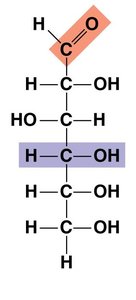
Review Questions and Applications
Which hydrocarbon has a double bond in its carbon skeleton? C2H4 (Ethene)
Why are hydrocarbons insoluble in water? Because their bonds are nonpolar covalent carbon-to-hydrogen linkages.
How many functional groups are studied in this chapter? Seven
What type of isomer can a given molecule form? Structural, cis-trans, or enantiomer, depending on its structure.
Take Home Message
The versatility of carbon, due to its covalent compatibility and ability to form diverse skeletons and functional groups, is the foundation for the molecular diversity of life. The structure and reactivity of organic molecules are determined by variations in their carbon skeletons and the functional groups attached to them.
