 Back
BackChapter 4: Carbon and the Molecular Diversity of Life – Study Notes
Study Guide - Smart Notes
 Tailored notes based on your materials, expanded with key definitions, examples, and context.
Carbon: The Backbone of Life
Importance of Carbon in Biological Molecules
Carbon is a fundamental element in biological systems, forming the backbone of the major macromolecules found in living organisms. Its unique electron configuration allows it to form four covalent bonds, enabling the construction of large, complex, and diverse molecules essential for life.
Organic chemistry is the study of carbon-containing compounds.
Organic molecules always contain at least carbon and hydrogen, and often oxygen, nitrogen, or sulfur.
Major biological molecules—proteins, DNA, carbohydrates—are all carbon-based.
Carbon atoms can bond to other carbons, forming chains, branches, and rings, which increases molecular diversity.
In molecules with multiple carbons, each carbon bonded to four other atoms has a tetrahedral shape; double bonds between carbons create a flat shape.
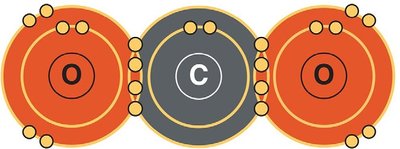
Additional info: The tetrahedral geometry of carbon allows for the formation of isomers and complex three-dimensional structures.
Hydrocarbons
Definition and Biological Significance
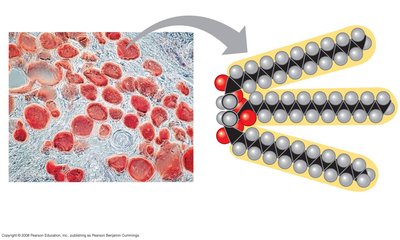
Hydrocarbons are organic molecules consisting entirely of carbon and hydrogen. They are nonpolar, hydrophobic, and can store significant amounts of energy, making them important in biological molecules such as fats.
Hydrocarbons are found in many biological molecules, especially lipids.
They can undergo reactions that release large amounts of energy (e.g., in metabolism or combustion).
Examples include fatty acid chains and gasoline.
Isomers
Types and Biological Importance
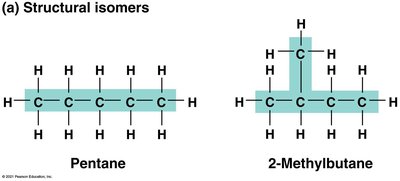
Isomers are compounds with the same molecular formula but different structures and properties. The three main types are:
Structural isomers: Differ in the covalent arrangement of atoms.
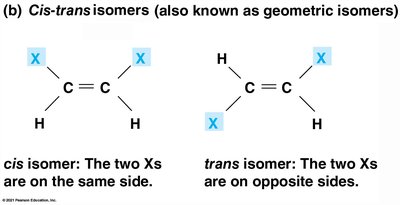
Geometric (cis-trans) isomers: Have the same covalent bonds but differ in spatial arrangements around a double bond.
Enantiomers: Are mirror images of each other and cannot be superimposed; important in pharmaceuticals as only one enantiomer may be biologically active.
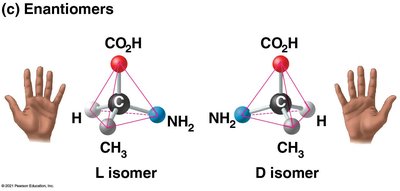
Example: Ibuprofen and albuterol are drugs where only one enantiomer is effective in the body.
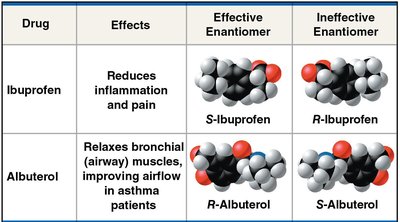
Additional info: The specificity of biological systems for certain isomers underlies the importance of molecular shape in biochemistry.
Functional Groups
The Seven Key Functional Groups in Biological Molecules
Functional groups are specific groups of atoms attached to carbon skeletons that give molecules distinctive chemical properties. The seven most important functional groups in biology are:
Chemical Group | Compound Name | Examples |
|---|---|---|
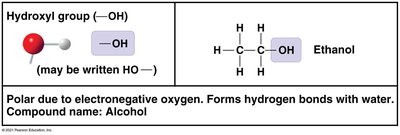
Hydroxyl (–OH) | Alcohol | Ethanol |
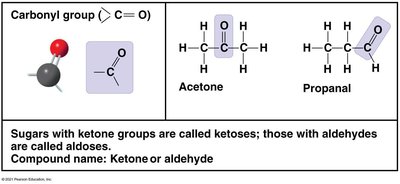
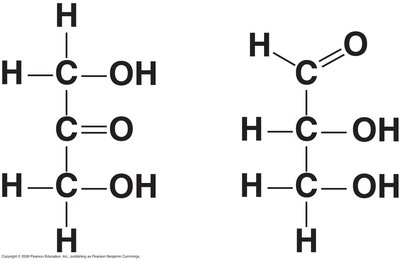
Carbonyl (>C=O) | Ketone or Aldehyde | Acetone, Propanal |
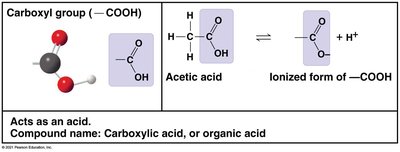
Carboxyl (–COOH) | Carboxylic acid, or organic acid | Acetic acid |
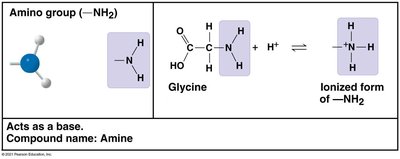
Amino (–NH2) | Amine | Glycine |
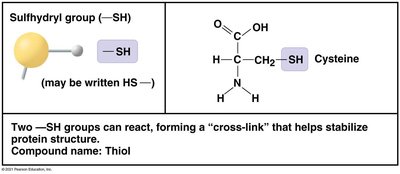
Sulfhydryl (–SH) | Thiol | Cysteine |
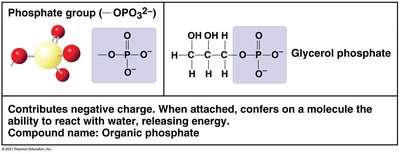
Phosphate (–OPO32–) | Organic phosphate | Glycerol phosphate |
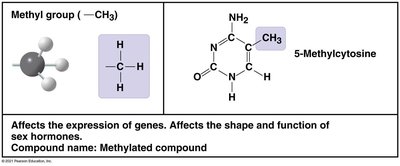
Methyl (–CH3) | Methylated compound | 5-Methylcytosine |
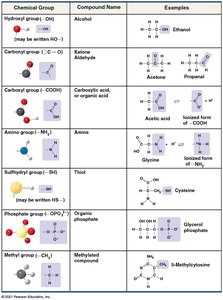
Each functional group confers specific chemical properties, such as polarity, acidity, or the ability to form hydrogen bonds, which are critical for the function of biological molecules.
Hydroxyl: Polar, forms hydrogen bonds, increases solubility in water.
Carbonyl: Found in sugars; can be a ketone or aldehyde.
Carboxyl: Acts as an acid, can donate H+.
Amino: Acts as a base, can accept H+.
Sulfhydryl: Forms disulfide bonds, stabilizing protein structure.
Phosphate: Contributes negative charge, involved in energy transfer (e.g., ATP).
Methyl: Affects gene expression and molecular shape.
Practice: Identifying Functional Groups
Application in Biological Molecules
Recognizing functional groups in complex molecules is essential for understanding their chemical behavior and biological function. Practice by identifying and circling functional groups in various organic compounds.
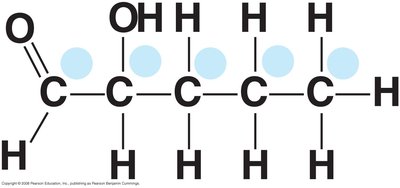
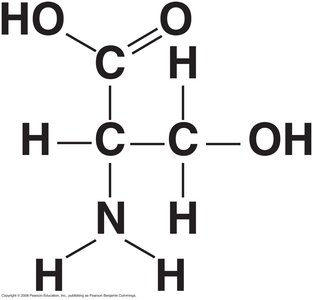
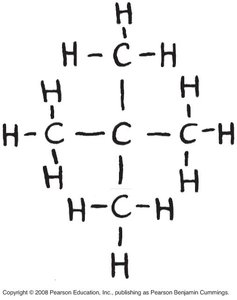
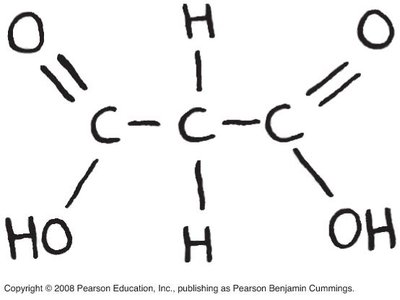
Additional info: Mastery of functional group identification is foundational for advanced studies in biochemistry and molecular biology.
