 Back
Chapter 4: Carbon and the Molecular Diversity of Life – Study Notes
Study Guide - Smart Notes
 Tailored notes based on your materials, expanded with key definitions, examples, and context.
Carbon and the Molecular Diversity of Life
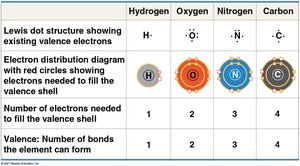
The Tetravalence of Carbon
Carbon is a unique element in biology due to its ability to form four covalent bonds, allowing for a vast diversity of stable organic molecules. This tetravalence is a direct result of carbon having four unpaired electrons in its outer shell, making it highly versatile in forming single, double, or triple bonds with other atoms.
Tetravalence: Carbon can bond with up to four other atoms, including hydrogen, oxygen, nitrogen, and other carbons.
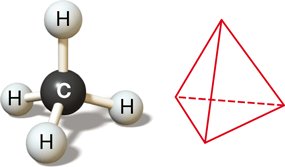
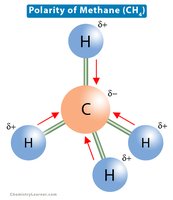
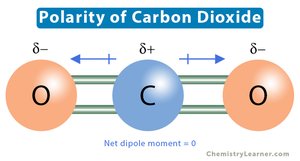
Single, Double, and Triple Bonds: Carbon forms single bonds (as in methane), double bonds (as in carbon dioxide), and triple bonds (as in hydrogen cyanide), each affecting molecular geometry and reactivity.
Hydrocarbons: The simplest carbon structures are linear hydrocarbons, which can be further modified by branching, ring formation, and the presence of double or triple bonds.
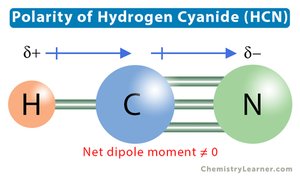
Structural Diversity of Carbon Compounds
Carbon's bonding versatility leads to a variety of molecular shapes and structures, including chains, branches, and rings. This diversity is the foundation for the complexity of biological molecules.
Length and Branching: Carbon chains can vary in length and may be branched or unbranched.
Double Bond Position: The position of double bonds can vary, affecting the molecule's properties.
Rings: Carbon atoms can form ring structures, such as cyclohexane and benzene.
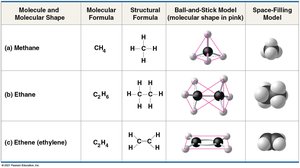
Nomenclature of Hydrocarbons
The naming of hydrocarbons depends on the types of bonds present:
Alkanes: Only single bonds (e.g., methane, ethane).
Alkenes: At least one double bond (e.g., ethene).
Alkynes: At least one triple bond (not shown but implied).
Isomers
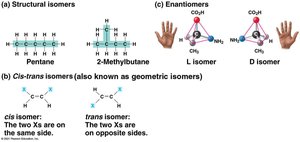
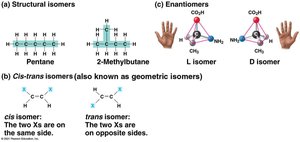
Isomers are compounds with the same molecular formula but different structures, leading to different properties. There are three main types:
Structural Isomers: Differ in the covalent arrangement of atoms.
Geometric (cis-trans) Isomers: Differ in spatial arrangement around a double bond.
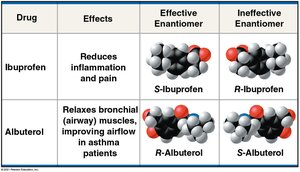
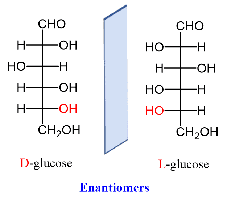
Enantiomers: Mirror images due to an asymmetric carbon; important in biology as only one enantiomer may be biologically active.
Functional Groups and Molecular Function
Functional groups are specific groups of atoms within molecules that determine the chemical reactivity and properties of those molecules. There are seven major functional groups in biological molecules:
Hydroxyl (-OH): Found in alcohols; polar and increases solubility in water.
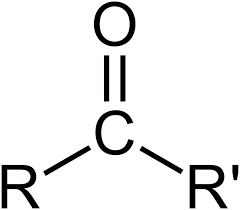
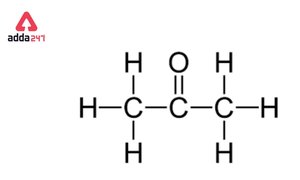
Carbonyl (C=O): Found in aldehydes and ketones; important in sugars.
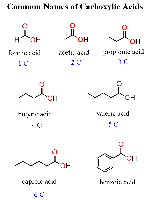
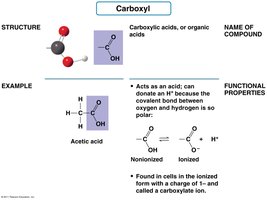
Carboxyl (-COOH): Acts as a weak acid; always terminal.
Amino (-NH2): Acts as a weak base; found in amino acids.
Sulfhydryl (-SH): Found in thiols; important for protein structure (disulfide bonds).
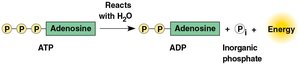
Phosphate (-OPO32-): Involved in energy transfer (e.g., ATP).
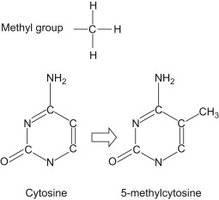
Methyl (-CH3): Non-polar; affects gene expression and molecular interactions.
Hydroxyl Group
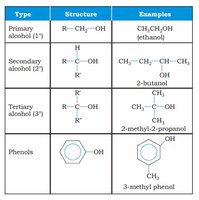
Also known as alcohols (names end in -ol).
Polar due to electronegative oxygen.
Increases solubility of molecules in water.
Carbonyl Group
Includes aldehydes (at the end of a carbon skeleton) and ketones (within the skeleton).
Important in sugars: aldoses and ketoses.
Carboxyl Group
Acts as a weak acid (can donate H+).
Always found at the end of a molecule (terminal).
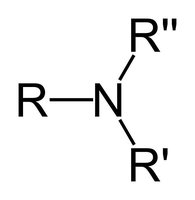
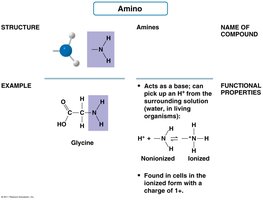
Amino Group
Acts as a weak base (can accept H+).
Always involves nitrogen; found in amino acids.
Sulfhydryl Group
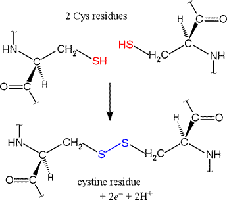
Also known as thiols; contains sulfur.
Important for stabilizing protein structure via disulfide bonds.
Phosphate Group
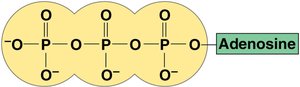
Contains phosphorus bonded to four oxygen atoms.
Imparts negative charge; crucial in energy transfer (e.g., ATP).
Methyl Group
Non-polar; addition decreases solubility in water.
Can affect gene expression when added to DNA.
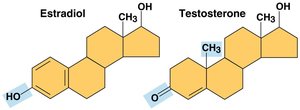
Functional Groups in Biological Molecules
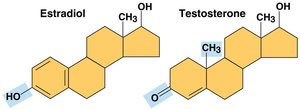
The presence and arrangement of functional groups determine the function of biological molecules, such as hormones. For example, estradiol and testosterone differ only in the functional groups attached to their carbon skeletons, yet have vastly different biological effects.
Summary of Major Points
Carbon's tetravalence allows for a wide variety of molecular structures.
Hydrocarbon chains form the backbone of most biological molecules.
Isomers have the same molecular formula but different structures and properties.
Seven major functional groups define the chemical behavior of biological molecules.
Practice Exercises
Identify functional groups in given molecules.
Fill in missing functional groups in molecular structures.
