 Back
Chapter 4: Carbon and the Molecular Diversity of Life – Study Notes
Study Guide - Smart Notes
 Tailored notes based on your materials, expanded with key definitions, examples, and context.
Carbon: Backbone of Life
Importance of Carbon in Living Organisms
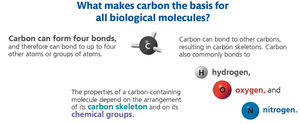
Carbon is the fundamental element in the structure of biological molecules. Its unique ability to form four covalent bonds allows for the creation of large, complex, and diverse molecules essential for life, such as proteins, DNA, carbohydrates, and lipids.
Key Point 1: Carbon can form four bonds, enabling it to bond with a variety of atoms and create complex molecular structures.
Key Point 2: The arrangement of carbon atoms (carbon skeleton) and attached chemical groups determine the properties of organic molecules.
Example: All major macromolecules in living organisms are carbon-based.
Organic Chemistry
Definition and Scope
Organic chemistry is the study of compounds containing carbon. Organic compounds range from simple molecules to large, complex structures. The major elements of life—carbon (C), hydrogen (H), oxygen (O), nitrogen (N), sulfur (S), and phosphorus (P)—are consistently found in living organisms.
Key Point 1: Organic compounds are defined by the presence of carbon atoms.
Key Point 2: The uniformity of elemental composition across organisms highlights the universality of organic chemistry in biology.
The Formation of Bonds with Carbon
Bonding and Molecular Shape
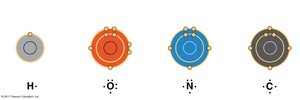
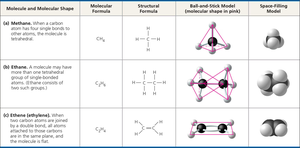
Carbon's four valence electrons allow it to form four covalent bonds, resulting in a tetrahedral molecular shape when bonded to four other atoms. When two carbons are joined by a double bond, the atoms attached to them lie in the same plane.
Key Point 1: Tetrahedral geometry is characteristic of carbon atoms with four single bonds.
Key Point 2: Double bonds alter the geometry, creating planar structures.
Molecule and Molecular Shape | Molecular Formula | Structural Formula | Ball-and-Stick Model | Space-Filling Model |
|---|---|---|---|---|
Methane | CH4 | H | H–C–H | H | Tetrahedral | Tetrahedral |
Ethane | C2H6 | H–C–C–H | Tetrahedral | Tetrahedral |
Ethene (ethylene) | C2H4 | H2C=CH2 | Planar | Planar |
Variation in Carbon Skeletons
Length, Branching, Double Bonds, and Rings
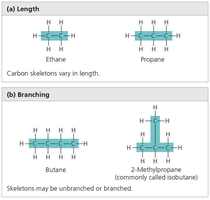
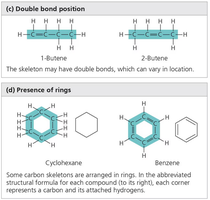
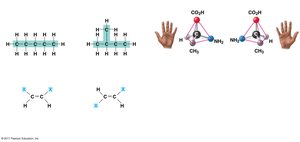
Carbon chains form the skeletons of most organic molecules. These skeletons can vary in length, branching, position of double bonds, and presence of rings, contributing to molecular diversity.
Key Point 1: Carbon skeletons may be straight, branched, or arranged in rings.
Key Point 2: The position of double bonds and the presence of rings further diversify organic molecules.
Example: Butane and isobutane are structural isomers with different branching.
Diversity of Carbon-Based Molecules
Hydrocarbons
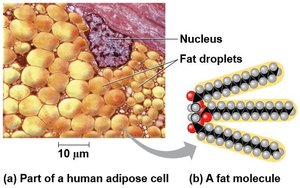
Hydrocarbons are organic molecules consisting only of carbon and hydrogen. They are hydrophobic and can store large amounts of energy, as seen in fats.
Key Point 1: Hydrocarbons are nonpolar and do not dissolve in water.
Key Point 2: They are important energy sources in biological systems.
Example: Fat molecules are largely composed of hydrocarbon chains.
Isomers
Types of Isomers
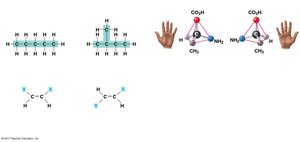
Isomers are compounds with the same molecular formula but different structures and properties. The three main types are structural isomers, cis-trans (geometric) isomers, and enantiomers (stereoisomers).
Key Point 1: Structural isomers differ in the covalent arrangement of atoms.
Key Point 2: Cis-trans isomers have the same covalent bonds but differ in spatial arrangement around a double bond.
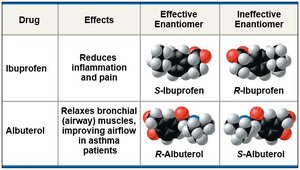
Key Point 3: Enantiomers are mirror images of each other and often only one is biologically active.
Example: Ibuprofen and albuterol have effective and ineffective enantiomers, impacting their biological activity.
Drug | Effects | Effective Enantiomer | Ineffective Enantiomer |
|---|---|---|---|
Ibuprofen | Reduces inflammation and pain | S-Ibuprofen | R-Ibuprofen |
Albuterol | Relaxes bronchial muscles | R-Albuterol | S-Albuterol |
Functional Groups
Definition and Importance
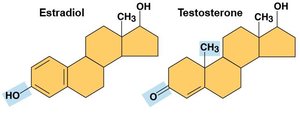
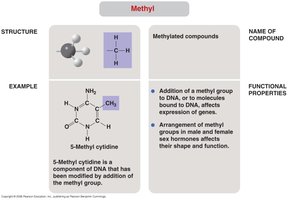
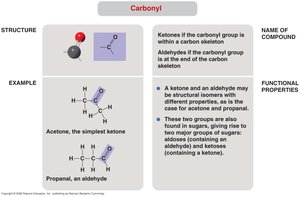
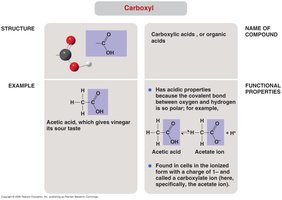
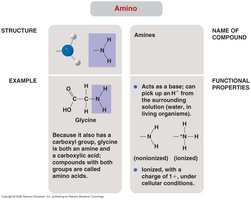
Functional groups are specific chemical groups attached to carbon skeletons that are commonly involved in chemical reactions. The number and arrangement of functional groups give each molecule unique properties.
Key Point 1: Functional groups determine the chemical reactivity and physical properties of organic molecules.
Key Point 2: Seven functional groups are most important in the chemistry of life: hydroxyl, methyl, carbonyl, carboxyl, amino, sulfhydryl, and phosphate.
Example: Estradiol and testosterone differ only in their functional groups, resulting in distinct biological functions.
Overview of Functional Groups
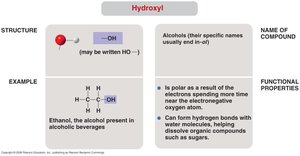
Hydroxyl group (-OH): Found in alcohols; polar and can form hydrogen bonds.
Methyl group (-CH3): Nonpolar; affects gene expression and hormone function.
Carbonyl group (-C=O): Found in ketones and aldehydes; contributes to isomerism.
Carboxyl group (-COOH): Acidic; found in organic acids.
Amino group (-NH2): Basic; found in amino acids.
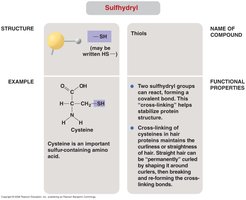
Sulfhydryl group (-SH): Forms disulfide bonds; important in protein structure.
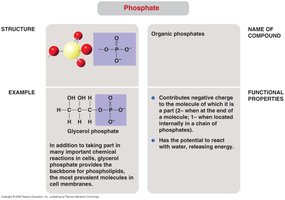
Phosphate group (-OPO32-): Contributes negative charge; involved in energy transfer.
ATP: Important Source of Energy for Cells
Structure and Function of ATP
ATP (adenosine triphosphate) is a key organic phosphate that stores and transfers energy in cells. It consists of adenosine attached to three phosphate groups. ATP can react with water, releasing energy used by the cell.
Key Point 1: ATP hydrolysis releases energy for cellular processes.
Key Point 2: The reaction is:
Example: ATP powers muscle contraction, active transport, and biosynthesis.

Chapter 4 Overview
Summary and Key Learning Objectives
Define: Hydrocarbons, functional groups
Explain: Why carbon is important in living organisms (structure variations, valence electrons)
Distinguish: Types of isomers (structural, cis-trans, enantiomers)
Identify: Seven functional groups most important to chemistry of life
Write: ATP hydrolysis reaction
