 Back
Chapter 4: Nucleic Acids and an RNA World – Study Notes
Study Guide - Smart Notes
 Tailored notes based on your materials, expanded with key definitions, examples, and context.
Chapter 4: Nucleic Acids and an RNA World
Introduction to Nucleic Acids and the RNA World
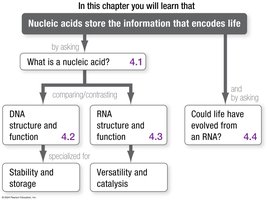
Nucleic acids are fundamental biomolecules that store and transmit genetic information, enabling life to evolve and persist. The RNA world hypothesis proposes that RNA was once both the genetic material and the catalyst for biochemical reactions, preceding the evolution of DNA and proteins.
Chemical evolution led to the production of molecules capable of self-replication.
DNA stores genetic information and is replicated with the help of proteins.
RNA world hypothesis: Suggests a period in evolutionary history when RNA both stored genetic information and catalyzed its own replication.
Once self-replicating molecules evolved, biological evolution began.
What is a Nucleic Acid?
Nucleotide Structure
Nucleic acids are polymers made of nucleotide monomers. Each nucleotide consists of three components:
Phosphate group
Five-carbon sugar (ribose in RNA, deoxyribose in DNA)
Nitrogenous base (purines or pyrimidines)
The phosphate group and nitrogenous base are bonded to the sugar molecule.
Types of Nucleotides
Ribonucleotides: Monomers of RNA; contain ribose as their sugar.
Deoxyribonucleotides: Monomers of DNA; contain deoxyribose (lacking an oxygen atom at the 2' carbon).
Both sugars have a hydroxyl group bonded to the 3' carbon.
Nitrogenous Bases
Purines: Two-ring structure; adenine (A) and guanine (G).
Pyrimidines: One-ring structure; cytosine (C), uracil (U, only in RNA), thymine (T, only in DNA).
Mnemonic: "C U T of Py" for pyrimidines.
Formation and Polymerization of Nucleic Acids
Chemical Evolution and Nucleotide Synthesis
Simulations suggest that nitrogenous bases and sugars could be synthesized under early Earth conditions. Deep-sea hydrothermal vent minerals may have played a role in concentrating ribose.
Polymerization of Nucleotides
Nucleic acids polymerize via condensation reactions.
Phosphodiester linkage: Bond between the phosphate group on the 5' carbon of one nucleotide and the hydroxyl group on the 3' carbon of another.
Polymerization produces RNA or DNA, depending on the monomers used.
Directionality of Nucleic Acid Strands
Phosphodiester linkages form a sugar–phosphate backbone that is directional.
One end has an unlinked 5' phosphate group; the other has an unlinked 3' hydroxyl group.
Primary structure is written as a sequence of bases using single-letter abbreviations (e.g., ATCG).
Energy Requirements for Polymerization
Polymerization requires energy, often provided by nucleoside triphosphates (e.g., ATP).
Energy is released when activated nucleotides polymerize, making the reaction spontaneous.
DNA Structure and Function
Secondary Structure of DNA
Early research revealed clues to DNA's secondary structure:
DNA polymerizes through phosphate linkages, forming a sugar–phosphate backbone.
Number of purines equals number of pyrimidines (Chargaff's rules).
X-ray crystallography predicted a helical structure.
Antiparallel Double Helix
Watson and Crick determined that two DNA strands are held together by hydrogen bonds between complementary bases (A-T, C-G).
Strands are antiparallel and twist to form a double helix.
Sugar–phosphate backbone faces the exterior; nitrogenous bases face the interior.
DNA has major and minor grooves, important for protein binding.
Tertiary Structure of DNA
DNA forms compact three-dimensional structures in cells.
Supercoiling occurs when DNA is wound too tightly or loosely.
DNA wraps around histone proteins to form nucleosomes.
DNA as an Information-Containing Molecule
DNA stores information required for growth and reproduction.
Information is encoded in the sequence of four nitrogenous bases.
DNA replication involves separation of strands, complementary base pairing, and formation of new phosphodiester linkages.
Stability of the DNA Double Helix
Double helix is stabilized by phosphodiester linkages, hydrogen bonds, and hydrophobic interactions.
DNA is highly stable and resistant to degradation, making it an effective information-storage molecule.
No evidence supports the hypothesis that the first life form consisted of DNA alone.
RNA Structure and Function
Primary Structure of RNA
RNA contains ribose and uracil (instead of deoxyribose and thymine).
The hydroxyl group on ribose is more reactive, making RNA less stable than DNA.
Secondary Structure of RNA
RNA forms secondary structures via complementary base pairing (A-U, G-C).
Bases typically form hydrogen bonds with complementary bases on the same strand, creating hairpin structures.
Strands are antiparallel within these structures.
Tertiary Structure of RNA
Secondary structures fold into complex tertiary shapes.
RNA is more diverse in size, shape, and reactivity than DNA.
Table: Comparison of DNA and RNA Structure
Feature | DNA | RNA |
|---|---|---|
Sugar | Deoxyribose | Ribose |
Base | Thymine | Uracil |
Stability | Stable | Less stable |
Structure | Double helix | Single strand, hairpins, complex shapes |
Function | Information storage | Information transfer, catalysis |
RNA's Versatility
RNA folds into complex three-dimensional shapes, allowing diverse functions.
Messenger RNA (mRNA) transmits information from DNA to protein synthesis machinery.
RNA regulates gene expression and can catalyze reactions.
RNA as a Catalytic Molecule
Ribozymes: RNA molecules that catalyze biochemical reactions.
Three-dimensional structure is vital for catalytic activity.
Ribozymes can catalyze phosphodiester bond formation, suggesting RNA could replicate itself.
Origin of Life and the RNA World
Theory of Chemical Evolution
Life began as a naked self-replicator, a molecule capable of copying itself without a membrane.
The first living molecule needed to provide a template and polymerize monomers into a copy.
RNA is capable of both templating and catalysis, supporting the RNA world hypothesis.
Experimental Evidence for the RNA World
Studies have isolated ribozymes capable of catalyzing RNA replication and nucleotide addition.
Modern ribozymes are essential for protein production, indicating RNA preceded proteins.
The evolution of protein enzymes likely ended the RNA world.
Characteristics of Life Established in the RNA World
Information processing
Replication of hereditary information
Evolution by random changes in nucleic acids
Additional info: Expanded explanations and context were added to clarify the structure, function, and evolutionary significance of nucleic acids, as well as the RNA world hypothesis.
