 Back
BackChapter 4: Nucleic Acids and the RNA World – Study Notes
Study Guide - Smart Notes
 Tailored notes based on your materials, expanded with key definitions, examples, and context.
Introduction to Nucleic Acids and the RNA World
Chemical Evolution and the Origin of Self-Replicating Molecules
Chemical evolution led to the production of molecules capable of self-replication, marking the beginning of biological evolution. Deoxyribonucleic acid (DNA) stores genetic information and is replicated with the help of proteins. The RNA world hypothesis proposes that early in evolution, RNA both stored genetic information and catalyzed its own replication. Once self-replicating molecules evolved, the process of evolution began.
Structure of Nucleic Acids
What is a Nucleic Acid?
Nucleic acids are polymers composed of nucleotide monomers. Each nucleotide consists of three components:
Phosphate group
Five-carbon sugar
Nitrogenous base
The phosphate group and nitrogenous base are bonded to the sugar molecule.

Types of Nucleotides: DNA vs. RNA
Ribonucleotides are the monomers of RNA and contain ribose as their sugar.
Deoxyribonucleotides are the monomers of DNA and contain deoxyribose (lacking an oxygen atom).
Both sugars have a phosphate group bonded to the 5' carbon.
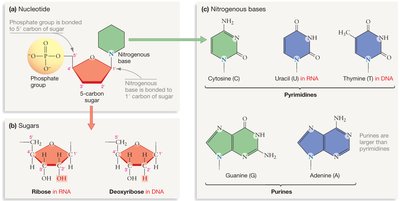
Nitrogenous Bases: Purines and Pyrimidines
Purines (two rings, nine atoms): Adenine (A) and Guanine (G)
Pyrimidines (one ring, six atoms): Cytosine (C), Uracil (U) (RNA only), Thymine (T) (DNA only)
Mnemonic: "CUT the Py" for pyrimidines (C, U, T).
Polymerization of Nucleic Acids
Condensation Reactions and Phosphodiester Linkages
Nucleic acids polymerize via condensation reactions, forming phosphodiester linkages between the phosphate group on the 5' carbon of one nucleotide and the hydroxyl group on the 3' carbon of another.

Directionality of DNA and RNA Strands
Phosphodiester linkages create a sugar–phosphate backbone that is directional:
One end has an unlinked 5' phosphate group
The other end has an unlinked 3' hydroxyl group
The primary structure of DNA is written as a sequence of bases (5' to 3' direction).

Energy Requirements for Polymerization
Polymerization requires energy, which is provided by nucleoside triphosphates (activated nucleotides). For example, ATP (adenosine triphosphate) is an activated ribonucleotide. Energy is released when activated nucleotides polymerize, making the reaction spontaneous.

DNA Structure
Secondary Structure: The Double Helix
Early data revealed that DNA is polymerized through phosphate linkages and has a sugar–phosphate backbone. The number of purines equals the number of pyrimidines, and X-ray crystallography predicted a helical structure. Watson and Crick determined that:
Two strands are held together by hydrogen bonds between complementary bases (A-T, C-G)
DNA strands are antiparallel and twist to form a double helix
Sugar–phosphate backbones face the exterior; nitrogenous base pairs face the interior


Tertiary Structure: Supercoiling and Histones
DNA forms more compact three-dimensional structures in cells:
Supercoiling occurs when DNA is wound too tightly or loosely
DNA wraps around DNA-binding proteins called histones
DNA as an Information-Containing Molecule
DNA stores information required for organismal growth and reproduction. The sequence of nucleotides encodes information, similar to the order of letters in a word.
DNA Replication
DNA replication involves three steps:
Strand separation by breaking hydrogen bonds
Free deoxyribonucleotides form hydrogen bonds with complementary bases on the template strand
Phosphodiester linkages form to create a new complementary strand
Complementary base pairing allows each strand to be copied exactly, producing two identical daughter molecules.

Stability of the DNA Double Helix
The double helix is highly structured and stable, held together by phosphodiester linkages, hydrogen bonds, and hydrophobic interactions. This stability is key to DNA's effectiveness as a reliable information-storage molecule.
RNA Structure and Function
Primary Structure of RNA
RNA's primary structure consists of four types of nitrogenous bases extending from a sugar–phosphate backbone. RNA differs from DNA in three ways:
Contains ribose instead of deoxyribose
Contains uracil instead of thymine
The hydroxyl group on ribose is more reactive, making RNA less stable than DNA
Secondary Structure: Hairpin Formation
RNA's secondary structure results from complementary base pairing (A-U, G-C) within the same strand. The strand folds over, forming a hairpin structure with antiparallel regions.

Tertiary Structure and Diversity
RNA molecules can fold into complex tertiary structures, making RNA more diverse in size, shape, and reactivity than DNA. Secondary structures fold into a wide variety of three-dimensional shapes.


RNA's Versatility and Catalytic Function
RNA is highly versatile, capable of folding into complex shapes and performing many tasks. mRNA transmits information between DNA and protein, while some RNAs (ribozymes) can catalyze reactions. Ribozymes have active sites and can catalyze phosphodiester bond formation, supporting the possibility that RNA could replicate itself.
Comparison of DNA and RNA Structure
Summary Table: DNA vs. RNA Structure
Level of Structure | DNA | RNA |
|---|---|---|
Primary | Sequence of deoxyribonucleotides; bases are A, T, G, C | Sequence of ribonucleotides; bases are A, U, G, C |
Secondary | Two antiparallel strands twist into a double helix, stabilized by hydrogen bonding, hydrophobic interactions, and van der Waals interactions | Most commonly, a single strand folds back on itself to form a double-helical stem and an unpaired "loop" |
Tertiary | Double helical DNA forms compact structures by wrapping around histone proteins and/or twisting into supercoils | Secondary structures fold to form a wide variety of distinctive three-dimensional shapes |
Key Terms and Concepts
Nucleic acid: Polymer of nucleotide monomers
Nucleotide: Monomer consisting of a phosphate group, five-carbon sugar, and nitrogenous base
Phosphodiester linkage: Bond between the phosphate group on the 5' carbon of one nucleotide and the hydroxyl group on the 3' carbon of another
Antiparallel: Two strands running in opposite directions
Complementary base pairing: Specific hydrogen bonding between A-T (or A-U in RNA) and C-G
Ribozyme: RNA molecule capable of catalyzing chemical reactions
----------------------------------------
