 Back
Chapter 4: Nucleic Acids – Structure, Function, and Diversity
Study Guide - Smart Notes
 Tailored notes based on your materials, expanded with key definitions, examples, and context.
Chapter Overview: Nucleic Acids Store the Information That Encodes Life
Introduction
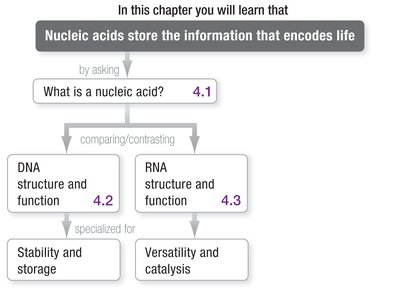
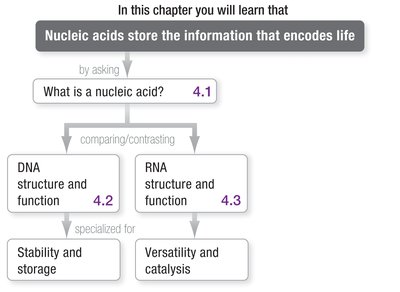
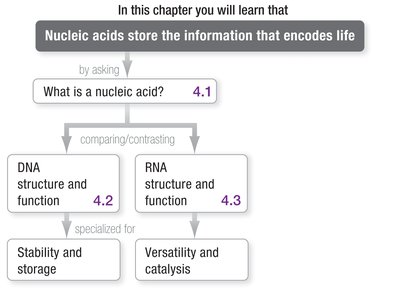
Nucleic acids are essential biomolecules that store and transmit genetic information in all living organisms. This chapter explores the structure and function of nucleic acids, focusing on DNA and RNA, their monomers, and their roles in heredity and cellular processes.

What is a Nucleic Acid?
Nucleotide Structure
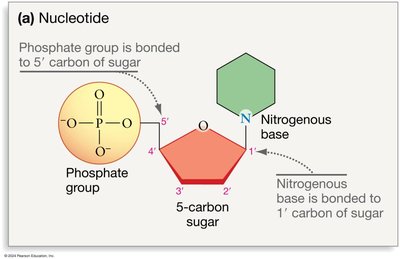
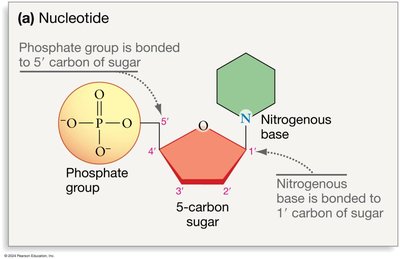
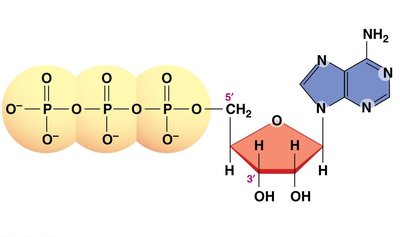
Nucleic acids are polymers made up of nucleotide monomers. Each nucleotide consists of three components:
Five-carbon sugar (ribose in RNA, deoxyribose in DNA)
Phosphate group (one or more)
Nitrogenous base (purine or pyrimidine)
Drawing Nucleotides
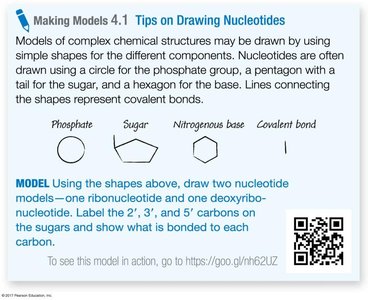
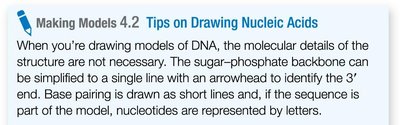
Simple shapes can be used to model nucleotide components: circles for phosphate, pentagons for sugar, hexagons for base, and lines for covalent bonds. This helps visualize the molecular structure.
Nucleotide Nomenclature
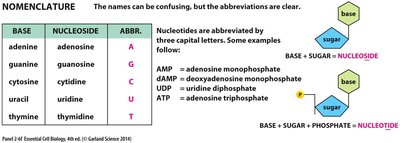
Nucleotides are abbreviated by three capital letters, such as AMP (adenosine monophosphate), GTP (guanosine triphosphate), ATP (adenosine triphosphate), etc.
Types of Nucleotides: DNA vs. RNA
Ribonucleotides and Deoxyribonucleotides
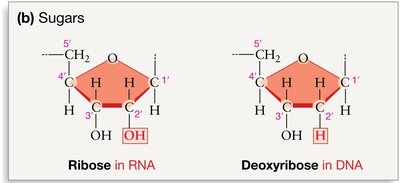
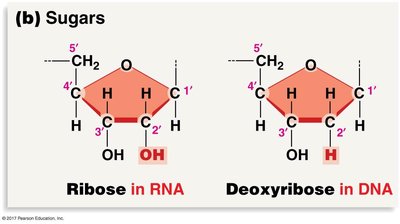
Ribonucleotides are the monomers of RNA, containing ribose sugar. Deoxyribonucleotides are the monomers of DNA, containing deoxyribose sugar (lacking an oxygen atom at the 2' carbon).
Ribose has a hydroxyl group (-OH) at the 2' carbon.
Deoxyribose has a hydrogen atom (H) at the 2' carbon.
Nitrogenous Bases
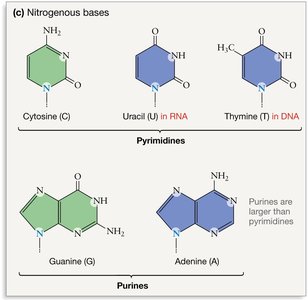
Nitrogenous bases are classified as purines (adenine, guanine) or pyrimidines (cytosine, thymine in DNA, uracil in RNA).
Pyrimidines: Cytosine (C), Thymine (T, in DNA), Uracil (U, in RNA)
Purines: Adenine (A), Guanine (G)
Polymerization of Nucleic Acids
Condensation Reactions and Phosphodiester Bonds
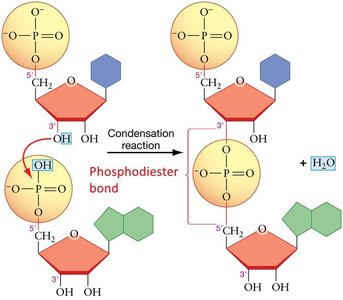
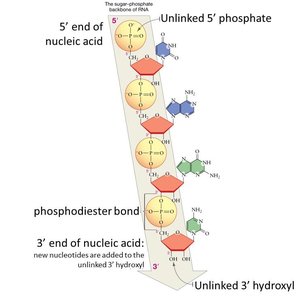
Nucleotides polymerize via condensation reactions, forming phosphodiester bonds between the 5' phosphate group of one nucleotide and the 3' hydroxyl group of another. This creates a sugar-phosphate backbone.
Phosphodiester linkage: Covalent bond joining nucleotides
Directionality: Nucleic acids have structural polarity, written from 5' to 3'
Activated Nucleotides and Energy
Nucleoside Triphosphates (NTPs)
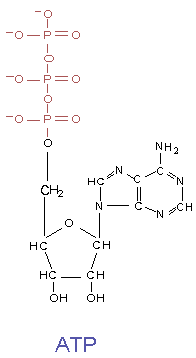
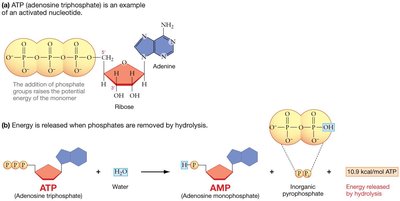
Nucleoside triphosphates, such as ATP, are activated molecules with high potential energy due to their phosphate groups. Hydrolysis of these bonds releases energy, driving polymerization reactions.
ATP: Adenosine triphosphate, a key energy carrier
Exergonic reaction: Energy released when phosphoanhydride bonds are broken
Base Pairing and DNA Structure
Complementary Base Pairing
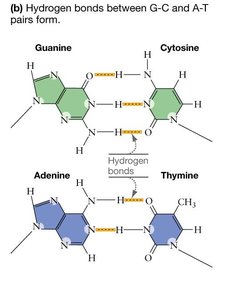
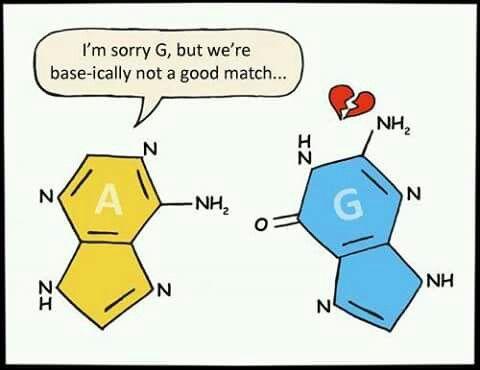
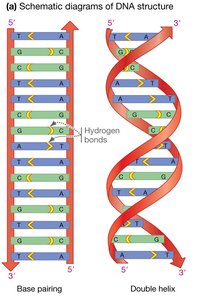
Base pairing in DNA is based on hydrogen bonding:
Guanine (G) pairs with Cytosine (C)
Adenine (A) pairs with Thymine (T)
DNA Secondary Structure: Double Helix
DNA consists of two antiparallel strands forming a double helix, stabilized by hydrogen bonds between complementary bases. The strands run in opposite directions (5' to 3' and 3' to 5').
The Central Dogma: Flow of Genetic Information
Genes and Chromosomes
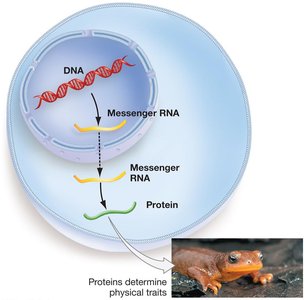
Genes are segments of DNA that contain hereditary information and are located on chromosomes. The central dogma describes the flow of information in cells: DNA → RNA → Protein.
Transcription: DNA is transcribed into messenger RNA (mRNA)
Translation: mRNA is translated into protein
RNA Structure and Function
Primary and Secondary Structure
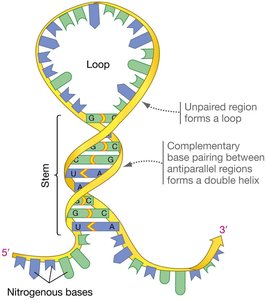
RNA, like DNA, has a sugar-phosphate backbone and four types of nitrogenous bases (A, U, C, G). Most RNA molecules have secondary structure, often forming hairpin loops due to complementary base pairing.
A-U base pairing: Adenine pairs with Uracil in RNA
Structural differences: RNA contains ribose and uracil, is less stable than DNA
Structural Differences Between RNA and DNA
RNA contains ribose; DNA contains deoxyribose
RNA has uracil; DNA has thymine
RNA is less stable due to the 2' OH group
Tertiary Structure and RNA Versatility
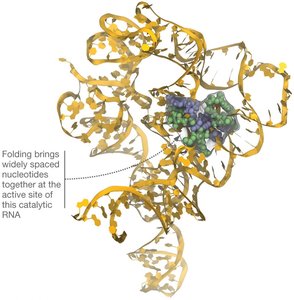
RNA molecules can fold into complex tertiary structures, making them highly versatile. Some RNA molecules, called ribozymes, can catalyze chemical reactions.
Comparison of DNA and RNA Structures
Table: DNA vs. RNA Structure
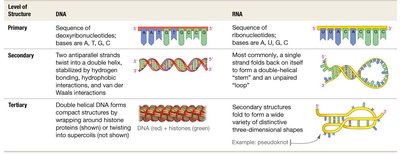
The following table summarizes the primary, secondary, and tertiary structures of DNA and RNA:
Level of Structure | DNA | RNA |
|---|---|---|
Primary | Sequence of deoxyribonucleotides; bases are A, T, G, C | Sequence of ribonucleotides; bases are A, U, G, C |
Secondary | Two antiparallel strands twist into a double helix, stabilized by hydrogen bonding, hydrophobic interactions, and van der Waals interactions | Most commonly, a single strand folds to form a double helix stem and an unpaired "loop" |
Tertiary | Double helical DNA forms compact structures by wrapping around histone proteins (not shown) or twisting into supercoils | Secondary structures fold to form a wide variety of distinctive three-dimensional shapes (example: pseudoknot) |
Summary
Nucleic acids are fundamental to life, encoding genetic information and enabling its expression. DNA provides stability and storage, while RNA offers versatility and catalysis. Understanding their structure and function is essential for studying molecular biology and genetics.
----------------------------------------
