 Back
Chapter 5
Study Guide - Smart Notes
 Tailored notes based on your materials, expanded with key definitions, examples, and context.
Chapter Overview: The Role of Carbohydrates in Life
Introduction
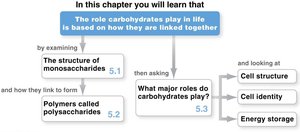
Carbohydrates are essential biomolecules that play critical roles in energy storage, cell structure, and cell identity. Their function is determined by how their monomers are linked together, forming diverse structures and polymers.
5.1 Sugars as Monomers
Carbohydrate Basics
Carbohydrates, also known as sugars, are organic molecules with the general formula (CH2O)n. They are classified based on the number of sugar units: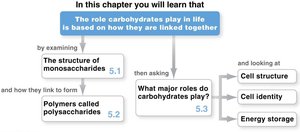
Monosaccharides: Single sugar units (e.g., glucose, ribose)
Oligosaccharides: Short chains of monosaccharides
Polysaccharides: Long chains of monosaccharides (e.g., starch, cellulose)

Structural Variability in Simple Sugars
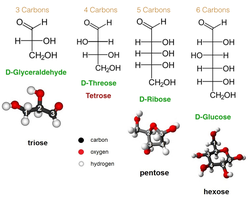
Monosaccharides vary structurally in four main ways, resulting in unique properties and functions:
Number of Carbon Atoms: Triose (3C), tetrose (4C), pentose (5C), hexose (6C)
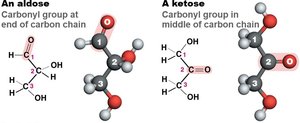
Location of the Carbonyl Group:
Aldose: Carbonyl group at the end of the carbon chain (Aldose, ald sounds like end)
Ketose: Carbonyl group in the middle of the carbon chain
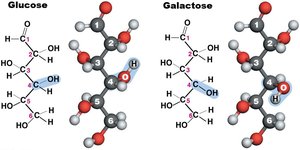
Arrangement of Hydroxyl Groups: The spatial arrangement of –OH groups distinguishes sugars like glucose and galactose.
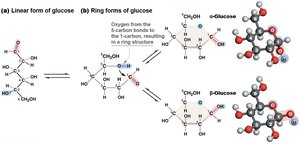
Linear and Ring Forms: Sugars can exist in both linear and ring forms, with ring formation occurring in aqueous solutions.
Carbohydrates in Nucleic Acids
Ribonucleotides: Monomers of RNA, contain ribose (OH at 2' carbon)
Deoxyribonucleotides: Monomers of DNA, contain deoxyribose (H at 2' carbon)
Both types polymerize to form nucleic acids, with an –OH group at the 3' carbon. 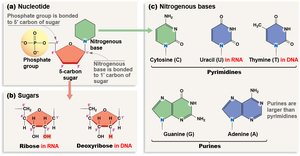
Origin of Monosaccharides
Monosaccharides can be synthesized under early Earth conditions, and have been found on meteorites, suggesting they may have formed in space and contributed to chemical evolution. 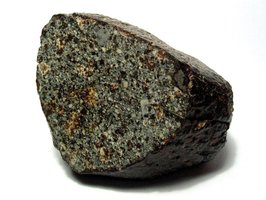

5.2 The Structure of Polysaccharides
Polysaccharide Formation
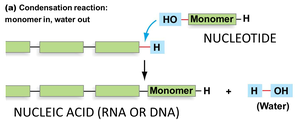
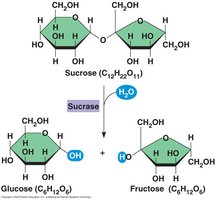
Polysaccharides are polymers of monosaccharide monomers. Two sugars linked together form a disaccharide.
Condensation Reaction (lose water): Occurs between two hydroxyl groups, forming a covalent bond called a glycosidic linkage (α-1,4 or β-1,4).
Hydrolysis Reaction (gains water): Breaks glycosidic linkages, releasing monosaccharides.
Structural Diversity and Function
The arrangement of hydroxyl groups and glycosidic linkages determines the structure and function of polysaccharides.
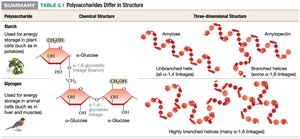
Starch: Energy storage in plants, composed of α-glucose
Glycogen: Energy storage in animals, composed of α-glucose
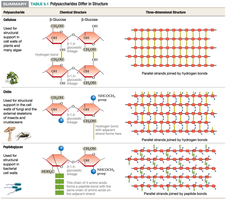
Cellulose: Structural support in plants, composed of β-glucose
Chitin: Structural support in fungi and arthropods
Peptidoglycan: Structural support in bacterial cell walls
Polysaccharide | Chemical Structure | Three-dimensional Structure |
|---|---|---|
Starch | α-glucose, α-1,4 linkage | Unbranched helix (amylose), branched helix (amylopectin) |
Glycogen | α-glucose, α-1,4 and α-1,6 linkages | Highly branched helices |
Cellulose | β-glucose, β-1,4 linkage | Parallel strands joined by hydrogen bonds |
Chitin | N-acetylglucosamine, β-1,4 linkage | Parallel strands joined by hydrogen bonds |
Peptidoglycan | N-acetylmuramic acid and N-acetylglucosamine, β-1,4 linkage | Parallel strands joined by peptide bonds |
Polysaccharides and Chemical Evolution
Polysaccharides likely played little role in the origin of life because their polymerization requires specialized enzymes, and they do not catalyze reactions or store information for self-replication.
5.3 What Do Carbohydrates Do?
Carbohydrates and Structural Support
Cellulose, chitin, and peptidoglycan form long strands organized into fibers or sheets, providing structural support.
These linkages are difficult to hydrolyze, and most organisms lack the necessary enzymes.
Dietary fiber from carbohydrates is important for digestive health.
Carbohydrates and Cell Identity
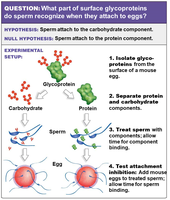
Carbohydrates display information on the cell surface, attached to proteins (glycoproteins) or lipids (glycolipids). They are key molecules in:
Cell–cell recognition: Identifying cells as "self"
Cell–cell signaling: Communication between cells
Example: Fertilization
Carbohydrates are required for cellular recognition and attachment during fertilization. 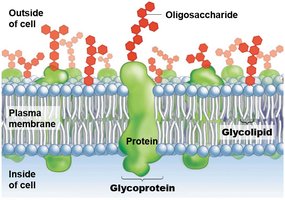
Carbohydrates and Energy Storage
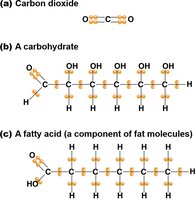
Plants harvest energy from sunlight and store it in carbohydrate bonds during photosynthesis.
Carbohydrates contain more energy than CO2 due to their chemical bonds.
Starch and glycogen are easily hydrolyzed because of their α-glycosidic linkages.
Enzymes such as phosphorylase (glycogen) and amylase (starch) release glucose for energy.
Energy Stored in Glucose Is Used to Make ATP
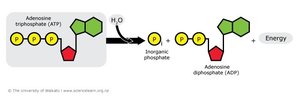
When cells need energy, they break down glucose, and the captured energy is used to synthesize ATP, which powers cellular work.
ATP (Adenosine Triphosphate): The primary energy carrier in cells
Energy released from glucose breakdown is used to drive endergonic reactions
Summary Table: Carbohydrate Functions
Function | Example | Key Structure |
|---|---|---|
Energy Storage | Starch (plants), Glycogen (animals) | α-glycosidic linkages |
Structural Support | Cellulose (plants), Chitin (fungi/arthropods), Peptidoglycan (bacteria) | β-glycosidic linkages, hydrogen/peptide bonds |
Cell Identity | Glycoproteins, Glycolipids | Oligosaccharide chains on cell surface |
Key Terms and Concepts
Monosaccharide: Simple sugar, basic unit of carbohydrates
Disaccharide: Two monosaccharides linked by glycosidic bond
Polysaccharide: Polymer of monosaccharides
Glycosidic linkage: Covalent bond joining two sugars
Cellulose: Structural polysaccharide in plants
Glycogen: Storage polysaccharide in animals
Chitin: Structural polysaccharide in fungi and arthropods
Peptidoglycan: Structural polysaccharide in bacteria
Glycoprotein: Protein with carbohydrate attached, important for cell identity
ATP: Cellular energy currency
Conclusion
Carbohydrates are fundamental to life, serving as energy sources, structural materials, and mediators of cell identity. Their diverse structures and linkages underpin their varied biological functions, making them a central topic in general biology.
