 Back
Chapter 5: An Introduction to Carbohydrates – Structure, Function, and Biological Roles
Study Guide - Smart Notes
 Tailored notes based on your materials, expanded with key definitions, examples, and context.
An Introduction to Carbohydrates
Overview of Carbohydrates
Carbohydrates are essential biomolecules that play critical roles in cell structure, cell identity, and energy storage. They are classified based on their size and complexity, ranging from simple sugars (monosaccharides) to large polymers (polysaccharides).
Monosaccharides: Single sugar units (e.g., glucose, ribose).
Oligosaccharides: Short chains of monosaccharides.
Polysaccharides: Long chains of monosaccharides, forming complex carbohydrates.
Chapter Roadmap
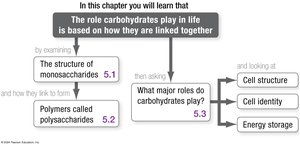
This chapter explores the structure of monosaccharides, the formation and structure of polysaccharides, and the major roles carbohydrates play in living organisms, including cell structure, cell identity, and energy storage.
5.1 Sugars as Monomers
Monosaccharides: Structure and Diversity
Monosaccharides are the fundamental building blocks of carbohydrates. Their structural diversity arises from variations in the location of the carbonyl group, the number of carbon atoms, the spatial arrangement of atoms, and the formation of ring structures in aqueous solutions.
Location of Carbonyl Group: At the end (aldose) or in the middle (ketose).
Number of Carbon Atoms: Triose (3), pentose (5), hexose (6).
Spatial Arrangement: Different configurations of hydroxyl groups.
Ring Formation: Sugars often form rings in solution, affecting their function.
Example: Ribose is a pentose sugar essential for nucleotide formation in RNA.
5.2 The Structure of Polysaccharides
Formation of Polysaccharides
Polysaccharides are formed by linking monosaccharide monomers through condensation reactions, resulting in covalent bonds known as glycosidic linkages. These linkages can be broken by hydrolysis reactions.
Disaccharides: Two monosaccharides linked together.
Glycosidic Linkages: Bonds formed between hydroxyl groups of sugars; common linkages include α-1,4 and α-1,6.
Types of Polysaccharides and Their Functions
Starch: Storage polysaccharide in plants; composed of amylose (unbranched, α-1,4 linkages) and amylopectin (branched, α-1,6 linkages).
Glycogen: Storage polysaccharide in animals; highly branched, stored in liver and muscle cells.
Cellulose: Structural polysaccharide in plants; β-1,4 linkages, forms linear strands with hydrogen bonds.
Chitin: Structural polysaccharide in fungi and animals; monomer is N-acetylglucosamine, similar structure to cellulose.
Peptidoglycan: Structural polysaccharide in bacteria; alternating monosaccharides with peptide bonds between strands.
Comparison of Polysaccharide Structures
Polysaccharide | Monomer | Linkage Type | Function |
|---|---|---|---|
Starch | α-glucose | α-1,4 and α-1,6 | Energy storage in plants |
Glycogen | α-glucose | α-1,4 and α-1,6 | Energy storage in animals |
Cellulose | β-glucose | β-1,4 | Structural support in plants |
Chitin | N-acetylglucosamine | β-1,4 | Structural support in fungi and animals |
Peptidoglycan | Alternating monosaccharides | β-1,4 + peptide bonds | Structural support in bacteria |
5.3 What Do Carbohydrates Do?
Functions of Carbohydrates in Cells
Carbohydrates serve multiple functions in living organisms, including acting as precursors for other molecules, providing structural support, indicating cell identity, and storing chemical energy.
Structural Support: Cellulose, chitin, and peptidoglycan form strong fibers and sheets, giving cells strength and elasticity. Their linkages are resistant to hydrolysis, making them durable.
Cell Identity: Carbohydrates on cell surfaces (glycoproteins and glycolipids) are crucial for cell-cell recognition and signaling. They help identify cells as "self" and facilitate communication.
Energy Storage: Carbohydrates store energy in their chemical bonds. Plants synthesize carbohydrates during photosynthesis, and animals break down glycogen for energy.
Carbohydrates and Energy Storage
Carbohydrates contain high-energy bonds, especially in C-H and C-C linkages. When cells need energy, enzymes hydrolyze starch and glycogen to release glucose, which is then used to produce ATP.
Enzymes: Phosphorylase breaks down glycogen; amylase breaks down starch.
ATP Production: Glucose is metabolized to generate ATP, the cell's energy currency.
Equation: The general formula for carbohydrates is , where n can range from 3 to over a thousand.
Example: Dietary fiber, composed of indigestible carbohydrates, is important for digestive health.
Human Angle: Glycobiology and Cancer Therapy
Glycans in Health and Disease
Glycobiology is the study of glycans and their biological functions. Altered glycosylation patterns on cancer cells can be targeted by protein therapies, offering new approaches for cancer treatment.
Glycoproteins: Proteins with attached carbohydrates, important for cell recognition.
Therapeutic Application: Targeting altered glycosylation on cancer cells for selective therapy.
Discussion Question
How could therapies targeting altered glycosylation on cancer cells work? Such therapies may recognize and bind to unique glycan patterns on cancer cells, enabling selective targeting and destruction of malignant cells while sparing normal cells.
Multiple Choice Question
Glycoproteins are found on the external surface of animal cells. What is an important function of glycoproteins in animal cells?
a. Glycoproteins serve as energy storage
b. Glycoproteins catalyze metabolic reactions
c. Glycoproteins contribute to the hydrophobicity of the membrane
d. Glycoproteins are important in cell-cell recognition
Additional info: Academic context was added to clarify the structure and function of carbohydrates, the types of glycosidic linkages, and the biological significance of glycans in health and disease.
