 Back
Chapter 5: The Macromolecules of Life – Study Guide
Study Guide - Smart Notes
 Tailored notes based on your materials, expanded with key definitions, examples, and context.
Macromolecules: The Building Blocks of Life
Introduction to Macromolecules
Macromolecules are large, complex molecules essential for life, composed of thousands of covalently connected atoms. They are typically polymers, which are long chains of repeating units called monomers. The four major classes of biological macromolecules are carbohydrates, proteins, nucleic acids, and lipids (though lipids are not true polymers).
Polymer: A molecule made of many similar or identical monomers linked together.
Monomer: The basic building block of a polymer (e.g., amino acids for proteins).
Macromolecule: A very large molecule, often a polymer, essential for biological structure and function.

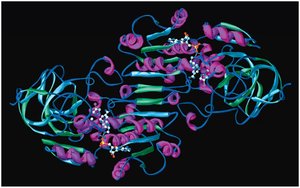
Synthesis and Breakdown of Polymers
Polymers are synthesized and broken down by specific chemical reactions:
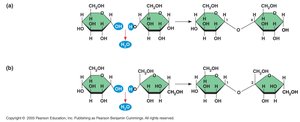
Dehydration Reaction: Joins two monomers by removing a water molecule, forming a new covalent bond.
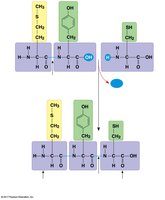
Hydrolysis: Breaks a polymer into monomers by adding a water molecule, cleaving the bond.
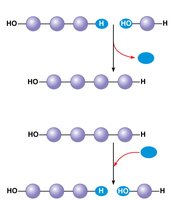
Example: Formation and breakdown of proteins and carbohydrates in cells.
Carbohydrates
Monosaccharides and Classification
Carbohydrates serve as fuel and structural material. The simplest carbohydrates are monosaccharides (single sugars), which can combine to form polysaccharides (complex carbohydrates).
Monosaccharide: Basic unit of carbohydrates, usually with a formula of (CH2O)n.
Classification: Based on the location of the carbonyl group (aldose or ketose) and the number of carbon atoms (triose, pentose, hexose).
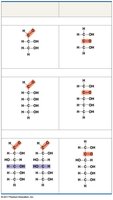
Glucose and Ribose: Structure and Ring Formation
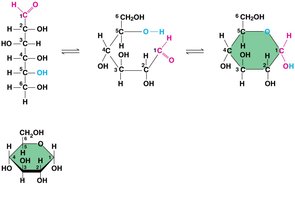
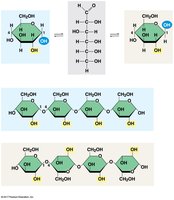
Glucose and ribose are key monosaccharides. In aqueous solutions, many sugars form ring structures, which are more stable than linear forms.
Glucose: Most common monosaccharide; can exist in linear or ring form.
Ribose: Five-carbon sugar found in RNA.
Ring Formation: Occurs via dehydration synthesis, forming hemi-acetal structures.
Disaccharides and Glycosidic Linkages
Disaccharides are formed when two monosaccharides join via a dehydration reaction, creating a glycosidic linkage.
Disaccharide: Two monosaccharides joined by a glycosidic bond (e.g., maltose, sucrose).
Glycosidic Linkage: Covalent bond formed between sugar monomers.
Polysaccharides: Storage and Structural Roles
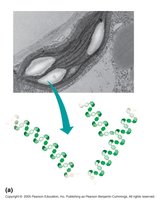
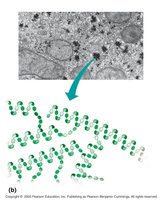
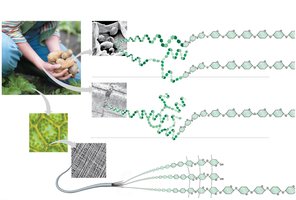
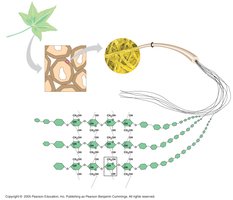
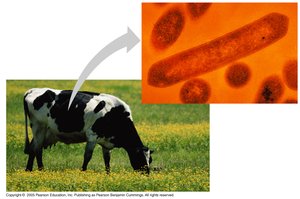
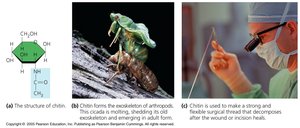
Polysaccharides are polymers of sugars with storage (e.g., starch, glycogen) or structural (e.g., cellulose, chitin) functions.
Starch: Storage polysaccharide in plants, composed of glucose monomers (amylose and amylopectin).
Glycogen: Storage polysaccharide in animals, stored in liver and muscle cells.
Cellulose: Structural polysaccharide in plant cell walls, composed of β-glucose monomers.
Chitin: Structural polysaccharide in arthropod exoskeletons and fungal cell walls.
Lipids
Structure and Types of Lipids
Lipids are hydrophobic molecules that do not form true polymers. They include fats, phospholipids, and steroids.
Fat: Constructed from glycerol and fatty acids; used for energy storage.
Phospholipid: Major component of cell membranes; contains hydrophilic head and hydrophobic tails.
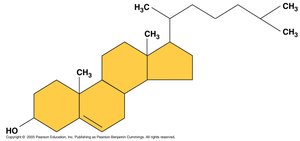
Steroid: Lipid with four fused rings; includes cholesterol and hormones.
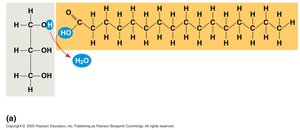
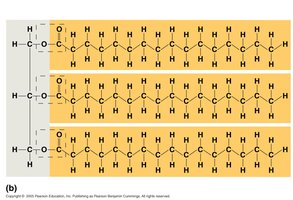
Saturated vs. Unsaturated Fats
Fatty acids can be saturated (no double bonds) or unsaturated (one or more double bonds). Saturated fats are solid at room temperature, while unsaturated fats are liquid.
Saturated Fat: Maximum hydrogen atoms, no double bonds; typically animal fats.
Unsaturated Fat: One or more double bonds; typically plant and fish fats.
Trans Fat: Unsaturated fat with trans double bonds, often produced by hydrogenation.
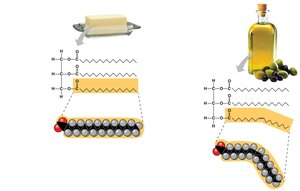
Phospholipids and Cell Membranes
Phospholipids form bilayers in water, with hydrophobic tails inward and hydrophilic heads outward, making them essential for cell membrane structure.
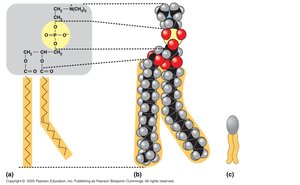
Steroids
Steroids are lipids with a characteristic four-ring structure. Cholesterol is a key steroid in animal cell membranes.
Proteins
Functions of Proteins
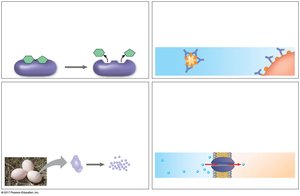
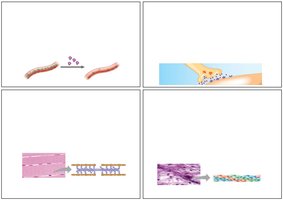
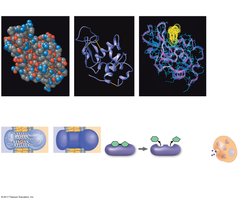
Proteins are diverse macromolecules with many functions, including catalysis, defense, storage, transport, signaling, movement, and structural support.
Enzymatic Proteins: Catalyze chemical reactions (e.g., digestive enzymes).
Defensive Proteins: Protect against disease (e.g., antibodies).
Storage Proteins: Store amino acids (e.g., casein in milk).
Transport Proteins: Move substances (e.g., hemoglobin).
Hormonal Proteins: Coordinate activities (e.g., insulin).
Receptor Proteins: Respond to chemical stimuli.
Contractile and Motor Proteins: Enable movement (e.g., actin, myosin).
Structural Proteins: Provide support (e.g., collagen, keratin).
Amino Acids and Polypeptides
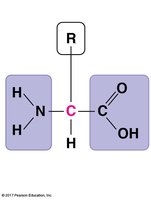
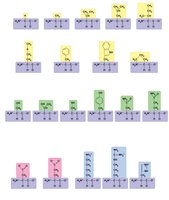
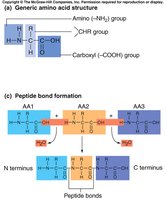
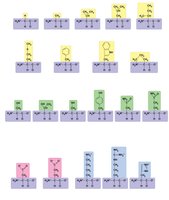
Amino acids are the monomers of proteins, each with a central carbon, amino group, carboxyl group, and unique side chain (R group). Proteins are polymers of amino acids, linked by peptide bonds.
Polypeptide: A chain of amino acids linked by peptide bonds.
Protein: One or more polypeptides folded into a specific shape.
Protein Structure
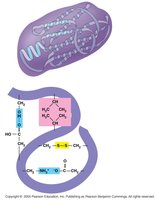
Proteins have four levels of structure:
Primary Structure: Unique sequence of amino acids.
Secondary Structure: Coils and folds (α-helix, β-sheet) due to hydrogen bonding.
Tertiary Structure: Three-dimensional shape formed by interactions among R groups (hydrogen bonds, ionic bonds, hydrophobic interactions, van der Waals forces, disulfide bridges).
Quaternary Structure: Association of multiple polypeptide chains.
Sickle-Cell Disease: Protein Structure and Function
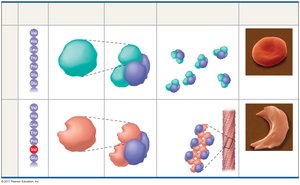
A single amino acid change in hemoglobin can cause sickle-cell disease, affecting protein function and cell shape.
Protein Denaturation and Folding
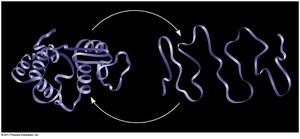
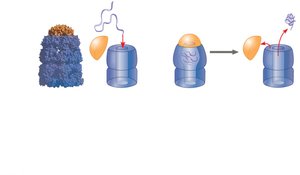
Proteins can lose their structure (denature) due to changes in pH, temperature, or other conditions, rendering them inactive. Chaperonins assist in proper protein folding.
Determining Protein Structure
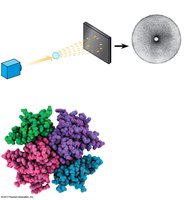
Techniques such as X-ray crystallography and NMR spectroscopy are used to determine protein structure. Bioinformatics helps predict structure from amino acid sequences.
Nucleic Acids
Functions and Types
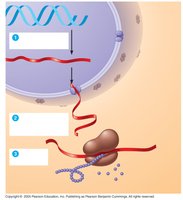
Nucleic acids store, transmit, and express hereditary information. The two main types are DNA and RNA.
DNA: Deoxyribonucleic acid; stores genetic information.
RNA: Ribonucleic acid; involved in protein synthesis.
Nucleotide Structure
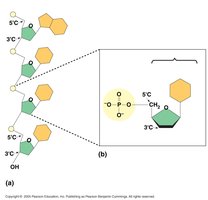
Nucleic acids are polymers of nucleotides, each consisting of a nitrogenous base, a pentose sugar, and a phosphate group.
Nucleotide: Monomer of nucleic acids; includes base, sugar, and phosphate.
Nucleoside: Nucleotide without the phosphate group.
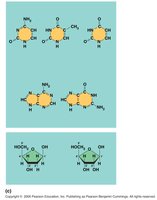
Nucleotide Polymerization and DNA Structure
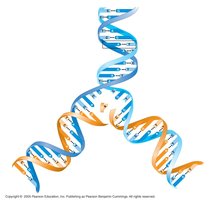
Nucleotides are joined by phosphodiester bonds, forming a sugar-phosphate backbone. DNA is a double helix with antiparallel strands and complementary base pairing (A-T, G-C).
Phosphodiester Bond: Covalent bond between 3' OH and 5' phosphate.
Antiparallel: Strands run in opposite directions.
Base Pairing: Hydrogen bonds between specific bases.
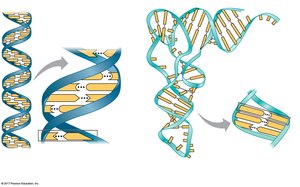
DNA and Proteins in Evolution
The sequence of nucleotides in DNA is inherited and can be used to assess evolutionary relationships between species.
Macromolecule | Monomer | Polymer | Function |
|---|---|---|---|
Carbohydrate | Monosaccharide | Polysaccharide | Energy, structure |
Protein | Amino acid | Polypeptide | Catalysis, structure, transport, etc. |
Nucleic Acid | Nucleotide | Polynucleotide | Genetic information |
Lipid | Fatty acid, glycerol | Not true polymer | Energy storage, membranes, hormones |
Additional info: This guide expands on brief points with academic context, definitions, and examples to ensure completeness and clarity for exam preparation.
