 Back
Chapter 5: The Structure and Function of Large Biological Molecules
Study Guide - Smart Notes
 Tailored notes based on your materials, expanded with key definitions, examples, and context.
Macromolecules: Structure and Function
Overview of Macromolecules
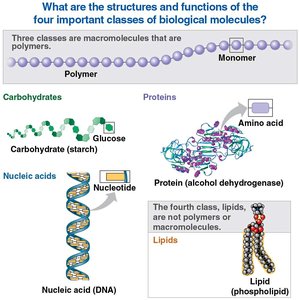
Large biological molecules, known as macromolecules, are essential for life and include carbohydrates, proteins, nucleic acids, and lipids. Most macromolecules are polymers, constructed from repeating units called monomers. The diversity and complexity of these molecules arise from the arrangement and types of monomers used.
Polymer: A long molecule made of many similar or identical building blocks (monomers).
Monomer: The repeating unit that serves as the building block of a polymer.
Enzymes: Specialized macromolecules that catalyze the synthesis and breakdown of polymers.
Synthesis and Breakdown of Polymers
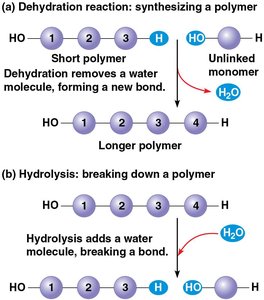
Polymers are synthesized and broken down by specific chemical reactions:
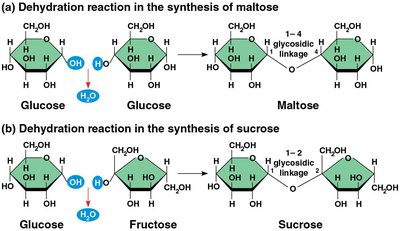
Dehydration Reaction: Joins two monomers by removing a water molecule, forming a new bond.
Hydrolysis: Breaks a polymer into monomers by adding a water molecule, breaking a bond.
Carbohydrates
Monosaccharides: Simple Sugars
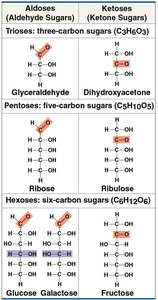
Carbohydrates include sugars and their polymers. The simplest carbohydrates are monosaccharides, which serve as fuel and building material. They generally have molecular formulas that are multiples of CH2O. Glucose (C6H12O6) is the most common monosaccharide.
Classification: Based on the location of the carbonyl group (aldose or ketose) and the number of carbons in the skeleton.
Structure and Function of Monosaccharides
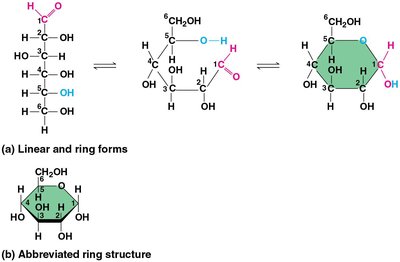
Monosaccharides can exist in linear or ring forms, especially in aqueous solutions. They are major fuel for cells and serve as raw material for building other molecules.
Disaccharides and Glycosidic Linkages
A disaccharide is formed when two monosaccharides are joined by a dehydration reaction, creating a covalent bond called a glycosidic linkage.
Polysaccharides: Storage and Structural Roles
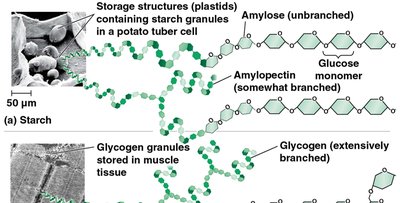
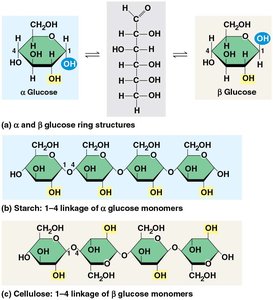
Polysaccharides are polymers of sugars with storage and structural functions. Their properties depend on the types of monomers and the positions of glycosidic linkages.
Starch: Storage polysaccharide in plants, composed of glucose monomers. Stored in plastids as granules.
Glycogen: Storage polysaccharide in animals, stored mainly in liver and muscle cells.

Structural Polysaccharides
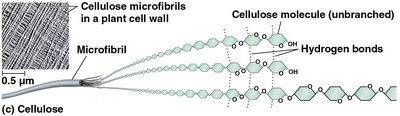
Cellulose is a major component of plant cell walls. It is a polymer of glucose, but differs from starch in the type of glycosidic linkage (β instead of α). Cellulose molecules are straight and unbranched, allowing hydrogen bonding between parallel molecules.
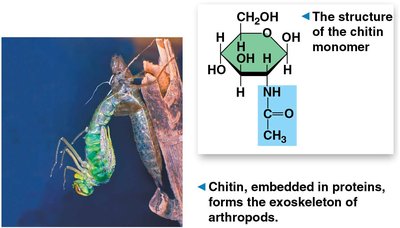
Chitin: Structural polysaccharide found in the exoskeleton of arthropods and cell walls of fungi.
Lipids
Overview of Lipids
Lipids are a diverse group of hydrophobic molecules that do not form true polymers. They consist mostly of hydrocarbon regions and include fats, phospholipids, and steroids.
Fats: Constructed from glycerol and fatty acids.
Phospholipids: Major component of cell membranes.
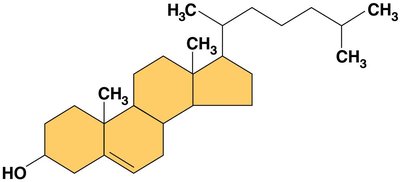
Steroids: Characterized by a carbon skeleton with four fused rings.
Fats: Structure and Function
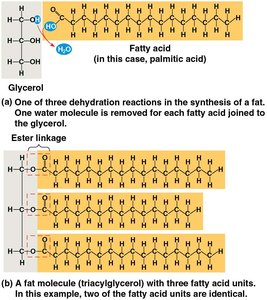
Fats are formed by joining three fatty acids to glycerol via ester linkages, creating a triacylglycerol (triglyceride). Fatty acids vary in length and in the number and location of double bonds.
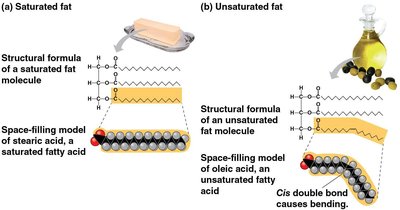
Saturated Fatty Acids: No double bonds, solid at room temperature.
Unsaturated Fatty Acids: One or more double bonds, liquid at room temperature.
Phospholipids
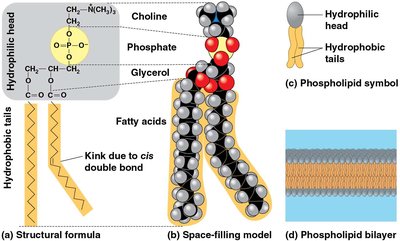
Phospholipids have two fatty acid tails (hydrophobic) and a phosphate group (hydrophilic head) attached to glycerol. When added to water, they self-assemble into bilayers, forming the boundary of cells.
Steroids
Steroids are lipids with a four-ring carbon skeleton. Cholesterol is an important steroid in animal cell membranes and a precursor for other steroids.
Proteins
Functions of Proteins
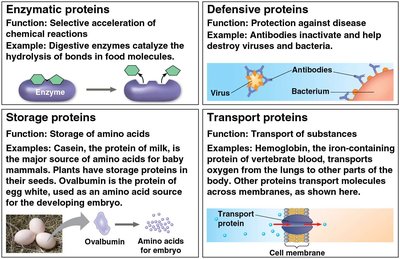
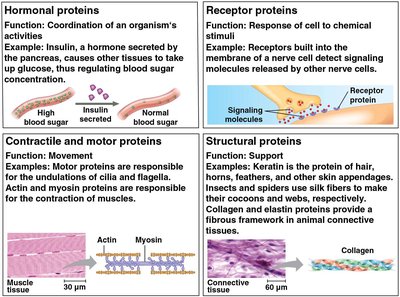
Proteins are the most versatile macromolecules, accounting for more than 50% of the dry mass of most cells. They serve as enzymes, defense molecules, storage, transport, communication, movement, and structural support.
Enzymatic proteins: Catalyze reactions.
Defensive proteins: Protect against disease.
Storage proteins: Store amino acids.
Transport proteins: Move substances.
Hormonal proteins: Coordinate activities.
Receptor proteins: Respond to stimuli.
Contractile and motor proteins: Enable movement.
Structural proteins: Provide support.
Amino Acids and Polypeptides
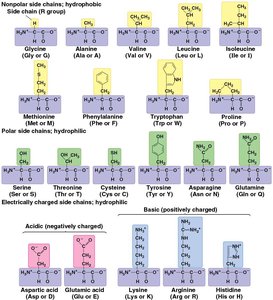
Proteins are polymers of amino acids, linked by peptide bonds. Each protein has a unique sequence of amino acids, which determines its structure and function.
Amino Acid: Organic molecule with amino and carboxyl groups, differing by side chains (R groups).
Polypeptide: Polymer of amino acids.
Protein Structure
Protein function depends on its three-dimensional structure, which is organized into four levels:
Primary Structure: Unique sequence of amino acids.
Secondary Structure: Coils and folds (α helix, β pleated sheet) due to hydrogen bonding.
Tertiary Structure: Overall shape from interactions among R groups.
Quaternary Structure: Multiple polypeptide chains forming one macromolecule.
Protein Structure and Disease
A change in primary structure can affect protein function. For example, sickle-cell disease results from a single amino acid substitution in hemoglobin, causing abnormal cell shape and function.
Denaturation and Protein Folding
Physical and chemical conditions (pH, salt, temperature) can cause proteins to lose their native structure, a process called denaturation. Denatured proteins are biologically inactive. Protein folding is complex and misfolding is associated with diseases such as Alzheimer's and Parkinson's.
Nucleic Acids
Roles of Nucleic Acids
Nucleic acids store, transmit, and help express hereditary information. There are two types: DNA (deoxyribonucleic acid) and RNA (ribonucleic acid). DNA directs its own replication and the synthesis of messenger RNA (mRNA), which controls protein synthesis (gene expression).
Structure of Nucleic Acids
Nucleic acids are polymers called polynucleotides, made of monomers called nucleotides. Each nucleotide consists of a nitrogenous base, a pentose sugar, and one or more phosphate groups. Nitrogenous bases are classified as pyrimidines (cytosine, thymine, uracil) or purines (adenine, guanine).
Nucleotide Polymers and DNA Structure
Nucleotides are linked by phosphodiester bonds, forming a sugar-phosphate backbone. DNA molecules have two polynucleotide strands forming a double helix, with antiparallel backbones. Base pairing is specific: adenine pairs with thymine, guanine pairs with cytosine.
Genomics and Proteomics
Genomics and Proteomics in Biology
Genomics is the study of whole sets of genes and their interactions, while proteomics is the study of large sets of proteins. Advances in sequencing technology have enabled the analysis of genomes and proteomes, transforming biological inquiry and applications.
DNA and Proteins as Tape Measures of Evolution
Sequences of genes and their protein products document the hereditary background of organisms and can be used to study evolutionary relationships between species.
Summary Table: Classes of Biological Molecules
Class | Monomer | Polymer | Main Function |
|---|---|---|---|
Carbohydrates | Monosaccharide | Polysaccharide | Energy storage, structural support |
Proteins | Amino acid | Polypeptide | Catalysis, structure, transport, defense |
Nucleic Acids | Nucleotide | Polynucleotide | Information storage and transmission |
Lipids | Fatty acid (not a true monomer) | None (not a true polymer) | Energy storage, membrane structure, signaling |
Key Equations and Formulas
General formula for monosaccharides:
Dehydration reaction:
Hydrolysis reaction:
