 Back
BackChapter 5: The Working Cell – Membrane Structure, Transport, and Enzyme Function
Study Guide - Smart Notes
 Tailored notes based on your materials, expanded with key definitions, examples, and context.
Membrane Structure and Function
Fluid Mosaic Model of Membranes
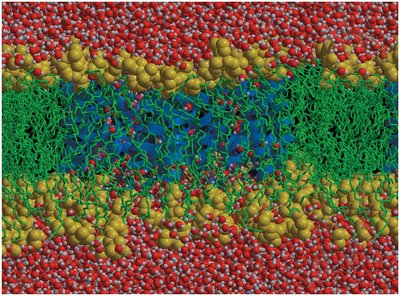
The fluid mosaic model describes the structure of the plasma membrane as a mosaic of diverse protein molecules embedded in a fluid bilayer of phospholipids. This structure allows for flexibility and the dynamic movement of components within the membrane.
Selective permeability: The plasma membrane controls the movement of substances in and out of the cell, allowing some molecules to pass while restricting others.
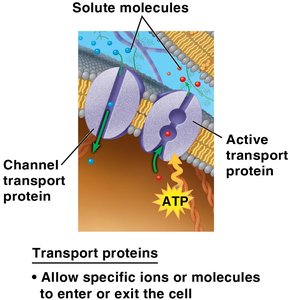
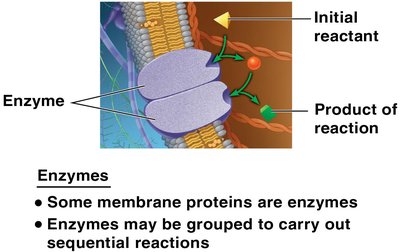
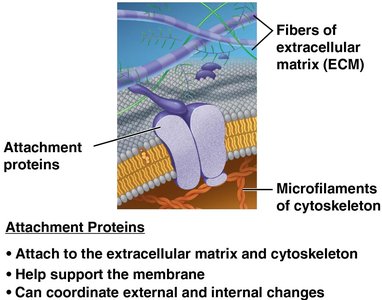
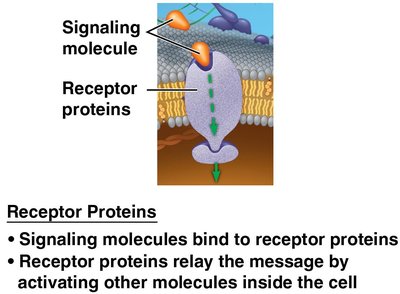
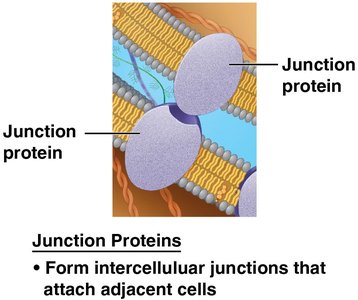
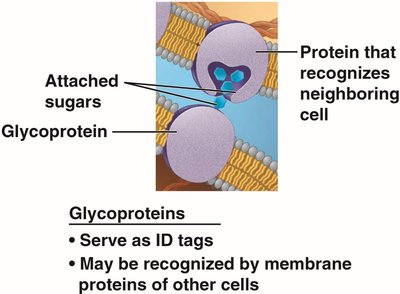
Membrane proteins: These perform various functions, including transport, enzymatic activity, signal transduction, cell-cell recognition, intercellular joining, and attachment to the cytoskeleton and extracellular matrix.
Major Functions of Membrane Proteins
Transport proteins: Allow specific ions or molecules to enter or exit the cell.
Enzymatic proteins: Catalyze chemical reactions at the membrane surface.
Attachment proteins: Anchor the membrane to the cytoskeleton and extracellular matrix, providing structural support.
Receptor proteins: Bind signaling molecules and relay messages into the cell.
Junction proteins: Form intercellular junctions that attach adjacent cells.
Glycoproteins: Serve as identification tags recognized by other cells.
Passive Transport Across Membranes
Diffusion
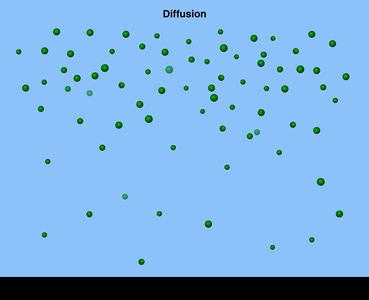
Diffusion is the tendency of particles to spread out evenly in an available space, moving from areas of higher concentration to areas of lower concentration. This process does not require energy and is termed passive transport.
Occurs due to the random movement of molecules.
Continues until equilibrium is reached.
Osmosis
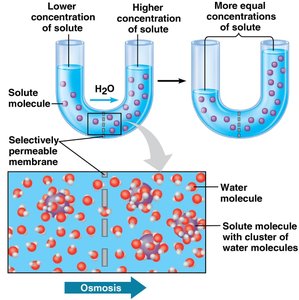
Osmosis is the diffusion of water across a selectively permeable membrane. Water moves from an area of lower solute concentration to an area of higher solute concentration until equilibrium is achieved.
Water moves down its own concentration gradient.
Solute cannot cross the membrane, but water can.
Tonicity and Water Balance
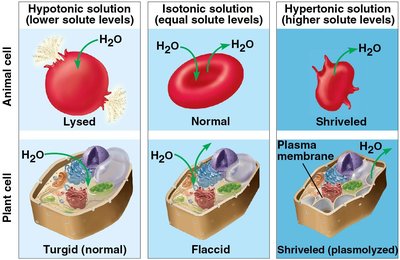
Tonicity describes the ability of a surrounding solution to cause a cell to gain or lose water. The effects of different solutions on animal and plant cells are as follows:
Solution Type | Animal Cell | Plant Cell |
|---|---|---|
Hypotonic (lower solute) | Lysed (bursts) | Turgid (normal) |
Isotonic (equal solute) | Normal | Flaccid |
Hypertonic (higher solute) | Shriveled | Shriveled (plasmolyzed) |
Facilitated Diffusion
Facilitated diffusion is the process by which polar or charged substances move across membranes with the help of specific transport proteins. This process does not require energy and relies on the concentration gradient.
Transport proteins are selective for the substances they move.
Aquaporins are channel proteins that facilitate rapid water movement.
Active Transport and Bulk Transport
Active Transport
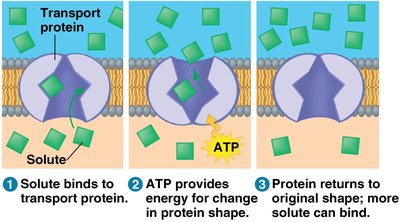
Active transport requires the cell to expend energy (usually from ATP) to move a solute against its concentration gradient. This process is essential for maintaining concentration differences across membranes.
Transport proteins change shape to move solutes across the membrane.
ATP provides the energy for this process.
Exocytosis and Endocytosis
Cells use exocytosis and endocytosis to transport large molecules across membranes.
Exocytosis: Exports bulky molecules (e.g., proteins, polysaccharides) by fusing vesicles with the plasma membrane.
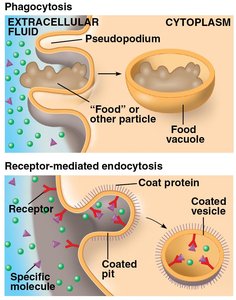
Endocytosis: Imports large molecules by forming vesicles from the plasma membrane.
Types of endocytosis:
Phagocytosis: Engulfment of particles by the cell.
Receptor-mediated endocytosis: Specific molecules are taken in after binding to receptors.
Energy and the Cell
Energy Concepts
Energy is the capacity to cause change. It exists as kinetic energy (energy of motion) and potential energy (stored energy, including chemical energy).
First law of thermodynamics: Energy can change form but cannot be created or destroyed.
Second law of thermodynamics: Energy transfers increase disorder (entropy), with some energy lost as heat.
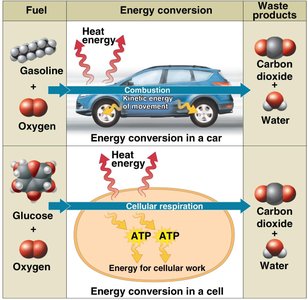
Chemical Reactions and Metabolism
Chemical reactions in cells either release or store energy.
Exergonic reactions: Release energy (e.g., cellular respiration).
Endergonic reactions: Require energy input and yield products rich in potential energy (e.g., photosynthesis).
Metabolism: The sum of all chemical reactions in a cell.
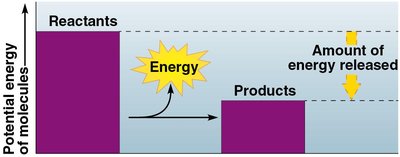
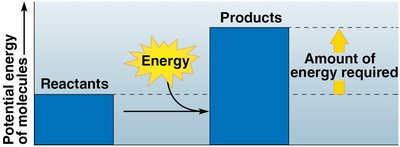
ATP and Cellular Work
ATP (adenosine triphosphate) powers nearly all forms of cellular work by coupling exergonic and endergonic reactions. The transfer of a phosphate group from ATP to another molecule (phosphorylation) is key to energy transfer.
ATP is regenerated from ADP and phosphate through cellular respiration.
*Additional info: The hydrolysis of ATP releases energy according to the equation:
How Enzymes Function
Enzyme Structure and Function
Enzymes are biological catalysts that speed up chemical reactions by lowering the activation energy required. They are not consumed in the reaction.
Each enzyme is specific to its substrate, which binds at the enzyme's active site.
The enzyme-substrate complex undergoes a catalytic cycle, resulting in product formation and enzyme release.
*Additional info: The activation energy barrier is lowered, but the overall energy change of the reaction remains the same.
Enzyme Inhibition and Regulation
Enzyme activity can be regulated by inhibitors:
Competitive inhibitors: Bind to the active site, blocking substrate access.
Noncompetitive inhibitors: Bind elsewhere on the enzyme, altering its shape and function.
Feedback inhibition: The end product of a metabolic pathway inhibits an upstream enzyme, regulating pathway activity.
*Additional info: Many drugs, pesticides, and poisons act as enzyme inhibitors, and their effects can be reversible or irreversible depending on the nature of the inhibitor's interaction with the enzyme.
