 Back
Chapter 6: A Tour of the Cell – General Biology Study Notes
Study Guide - Smart Notes
 Tailored notes based on your materials, expanded with key definitions, examples, and context.
CHAPTER 6: A TOUR OF THE CELL
Practice Questions
Practice questions help reinforce understanding of cell structure and function. Key concepts include the properties of biological macromolecules and water.
Starch and Cellulose: Both are polymers of glucose, but differ in structure and function. Starch is used for energy storage in plants, while cellulose is a structural component of the plant cell wall.
Water's Hydrogen Bonding: Water forms intermolecular hydrogen bonds with other water molecules and compounds with polar covalent bonds, but not intramolecular hydrogen bonds.
6.1: MICROSCOPY
Microscopy and the Study of Cells
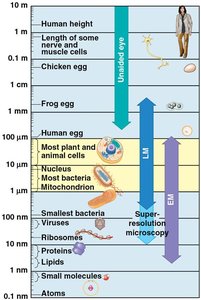
Microscopy is essential for visualizing cells and their components, which vary greatly in size. Different types of microscopes allow scientists to study cell structure at various levels of detail.
Types of Microscopy: Light microscopy (LM) is used for most plant and animal cells, while electron microscopy (EM) is required for smaller structures like ribosomes and viruses.
Resolution: The ability to distinguish two points as separate is called resolution. Electron microscopes provide higher resolution than light microscopes.
Cell Size Range: Cells and their components range from meters (human height) to nanometers (atoms).
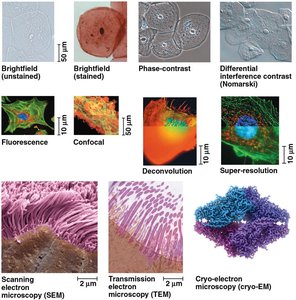
Microscopy Techniques: Brightfield, phase-contrast, fluorescence, confocal, and super-resolution microscopy are used to visualize cells. Electron microscopy includes scanning (SEM), transmission (TEM), and cryo-EM.
6.2: Comparing Prokaryotic and Eukaryotic Cells
Basic Features of All Cells
All cells share certain fundamental features, but prokaryotic and eukaryotic cells differ in complexity and organization.
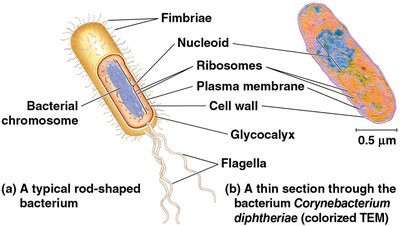
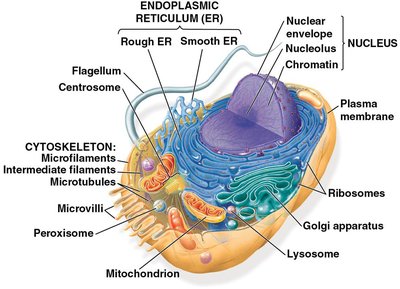
Common Features: Plasma membrane, cytosol, chromosomes, and ribosomes are present in all cells.
Prokaryotic Cells: Lack a nucleus and membrane-bound organelles. DNA is located in the nucleoid region. Cytoplasm is bound by the plasma membrane.
Eukaryotic Cells: Have a nucleus bounded by a double membrane, membrane-bound organelles, and cytoplasm between the plasma membrane and nucleus. Eukaryotic cells are generally larger.
The Plasma Membrane
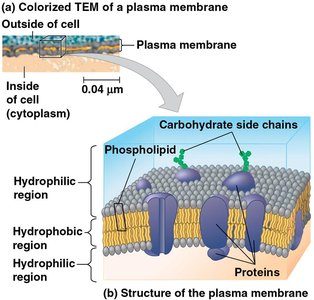
The plasma membrane is a selective barrier that regulates the passage of substances into and out of the cell.
Structure: Composed of a phospholipid bilayer with embedded proteins and carbohydrate side chains.
Function: Maintains homeostasis by controlling the movement of oxygen, nutrients, and waste.
6.3: The Eukaryotic Cell’s Genetic Instructions
The Nucleus: Information Central
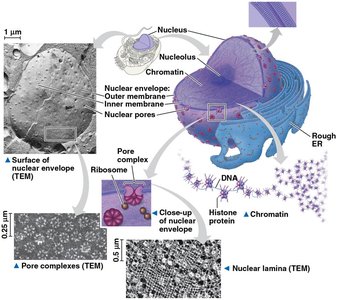
The nucleus houses most of the cell’s DNA and is surrounded by a double membrane called the nuclear envelope.
Nuclear Envelope: Double membrane with pores regulated by pore complexes.
Nuclear Lamina: Protein network that maintains nuclear shape.
Nuclear Matrix: Framework of protein fibers throughout the nucleus.
Chromosomes and Chromatin: DNA is organized into chromosomes, which are composed of chromatin (DNA and proteins).
Nucleolus: Site of ribosomal RNA (rRNA) synthesis.
Ribosomes: Protein Factories
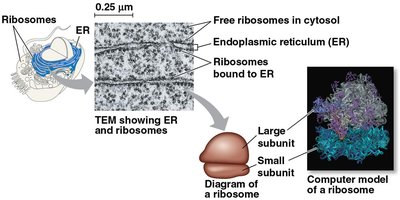
Ribosomes are complexes of rRNA and protein that synthesize proteins in the cell.
Free Ribosomes: Located in the cytosol; synthesize proteins for use within the cell.
Bound Ribosomes: Attached to the endoplasmic reticulum or nuclear envelope; synthesize proteins for secretion or membrane insertion.
6.4: The Endomembrane System
Components and Functions
The endomembrane system regulates protein traffic and performs metabolic functions within the cell.
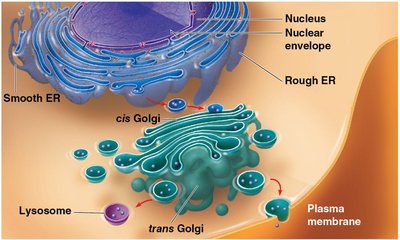
Components: Nuclear envelope, endoplasmic reticulum (ER), Golgi apparatus, lysosomes, vacuoles, and plasma membrane.
Connection: Components are either continuous or connected via vesicles.
The Endoplasmic Reticulum (ER)
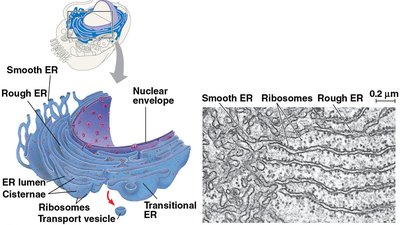
The ER is a biosynthetic factory, continuous with the nuclear envelope, and consists of two regions:
Smooth ER: Synthesizes lipids, detoxifies drugs and poisons, stores calcium ions.
Rough ER: Site of membrane-bound protein synthesis, including secretory proteins.
The Golgi Apparatus
The Golgi apparatus is the cell’s shipping and receiving center, consisting of flattened sacs called cisternae.
Functions: Modifies ER products, manufactures macromolecules, sorts and packages materials into transport vesicles.
Lysosomes: Digestive Compartments
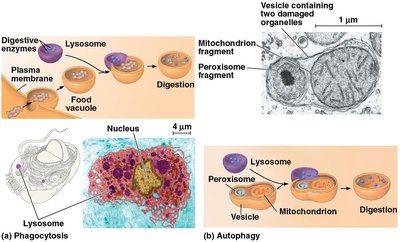
Lysosomes are membranous sacs of hydrolytic enzymes that digest macromolecules and recycle cellular components.
Phagocytosis: Cells engulf other cells, forming food vacuoles that fuse with lysosomes for digestion.
Autophagy: Lysosomes recycle the cell’s own organelles and macromolecules.
Vacuoles: Diverse Maintenance Compartments
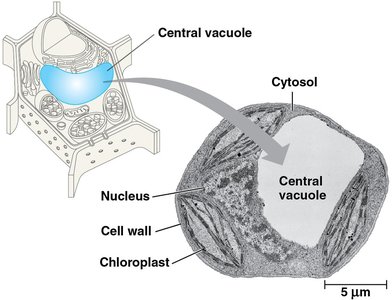
Vacuoles are large vesicles derived from the ER and Golgi apparatus, serving various functions in different cell types.
Food Vacuoles: Formed by phagocytosis.
Contractile Vacuoles: Pump excess water out of cells in freshwater protists.
Central Vacuole: Found in mature plant cells, stores inorganic ions and plays a major role in cell growth.
6.5: Mitochondria and Chloroplasts
Energy Conversion Organelles
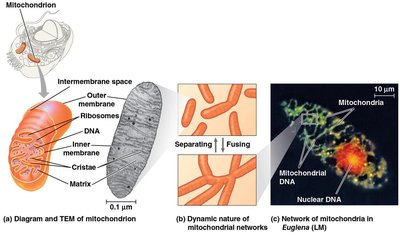
Mitochondria and chloroplasts are organelles that change energy from one form to another.
Mitochondria: Sites of cellular respiration, generating ATP using oxygen.
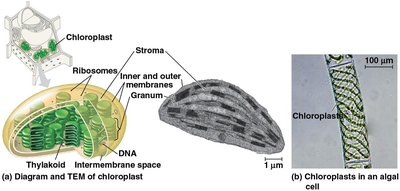
Chloroplasts: Sites of photosynthesis in plants and algae.
Peroxisomes: Oxidative organelles that detoxify harmful substances and break down fatty acids.
Peroxisomes: Oxidation
Peroxisomes are specialized metabolic compartments bounded by a single membrane. They contain enzymes that transfer hydrogen atoms to oxygen, forming hydrogen peroxide.
Functions: Breakdown of fatty acids, detoxification of alcohol and other harmful compounds.
