 Back
Chapter 8: An Introduction to Metabolism and Bioenergetics
Study Guide - Smart Notes
 Tailored notes based on your materials, expanded with key definitions, examples, and context.
Overview: The Energy of Life
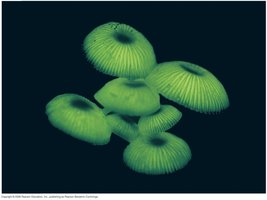
Cells function as biological factories, carrying out countless chemical reactions to sustain life. These reactions require energy, which cells extract from their environment and use to perform work, such as moving or rearranging matter. Some organisms can even convert chemical energy into light, as seen in bioluminescent species.
Metabolism: Transforming Matter and Energy
Definition and Scope
Metabolism is the sum of all chemical reactions in an organism. It includes both the synthesis and breakdown of molecules, such as the formation of polymers from monomers (dehydration reactions) and their breakdown (hydrolysis). Metabolism is an emergent property resulting from the interactions of molecules within cells.
Metabolic Pathways
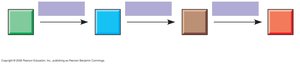
A metabolic pathway is a series of chemical reactions that begins with a specific molecule and ends with a product. Each step is catalyzed by a specific enzyme, ensuring efficiency and regulation.
Example: Tyrosine to Epinephrine Pathway
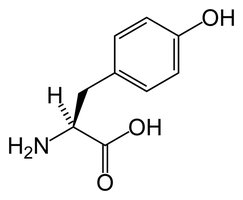
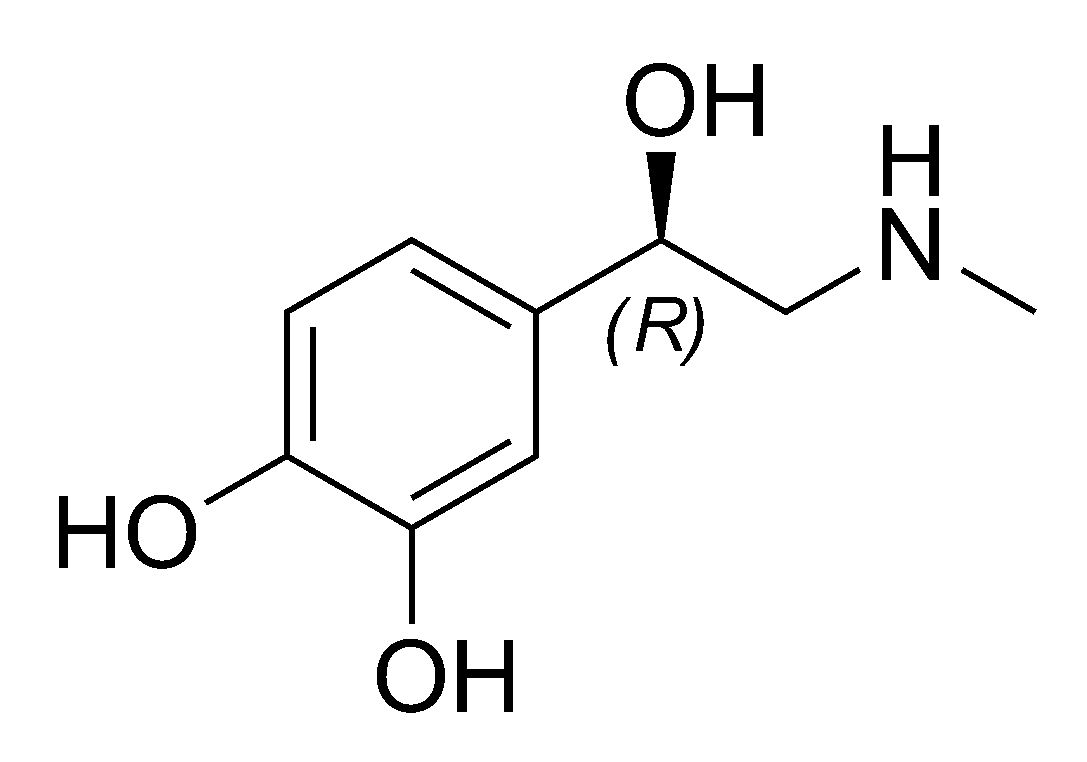
One example of a metabolic pathway is the conversion of the amino acid tyrosine into the hormone epinephrine (adrenaline). Each step modifies the molecule, with each intermediate serving as both a product and a substrate for the next reaction.

Catabolic and Anabolic Pathways
Catabolic Pathways
Catabolic pathways release energy by breaking down complex molecules into simpler compounds. This process is essential for extracting energy stored in chemical bonds.
Anabolic Pathways
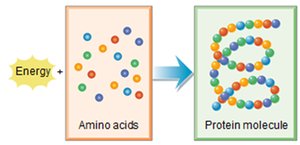
Anabolic pathways consume energy to build complex molecules from simpler ones. For example, linking amino acids to form a protein is an anabolic process.
Bioenergetics and Forms of Energy
Bioenergetics
Bioenergetics is the study of how organisms manage their energy resources. Energy is defined as the capacity to cause change, particularly by altering the position or structure of matter.
Forms of Energy
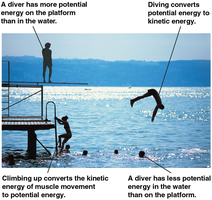
Kinetic energy: Energy of motion (e.g., heat/thermal energy is the kinetic energy of randomly moving atoms or molecules).
Potential energy: Energy stored due to an object's position or structure (e.g., chemical energy stored in bonds).
Thermodynamics in Biology
First Law of Thermodynamics
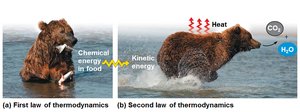
The First Law of Thermodynamics (Law of Conservation of Energy) states that energy can be transferred and transformed, but cannot be created or destroyed. When energy appears to be "used up," it has simply changed form or left the system.
Second Law of Thermodynamics
The Second Law of Thermodynamics states that every energy transfer or transformation increases the entropy (disorder) of the universe. Some energy becomes unusable, often lost as heat.
Spontaneous processes increase entropy and do not require net energy input.
Living organisms maintain order locally, but overall entropy increases in the universe.
Open vs. Closed Systems
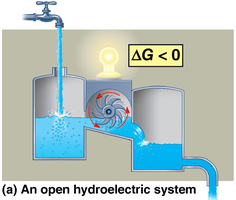
In a closed system, matter and energy are isolated from the surroundings (e.g., liquid in a thermos). In an open system, energy and matter can be exchanged with the environment. Organisms are open systems.

Free Energy and Spontaneity
Free Energy Change (ΔG)
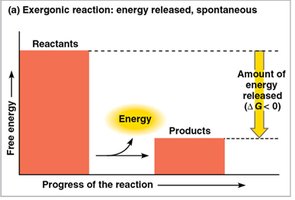
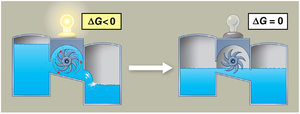
The free energy change () of a reaction determines whether it occurs spontaneously. Only processes with a negative $\Delta G$ are spontaneous and can perform work.
Exergonic reactions: Release free energy (), spontaneous.
Endergonic reactions: Absorb free energy (), nonspontaneous.
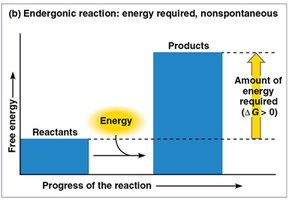
Equilibrium and Metabolism
Reactions in a closed system eventually reach equilibrium and stop doing work. Cells, as open systems, never reach equilibrium, allowing metabolism to continue.
ATP: The Energy Currency of the Cell
Structure and Function of ATP
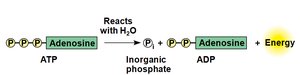
ATP (adenosine triphosphate) consists of ribose (a sugar), adenine (a nitrogenous base), and three phosphate groups. ATP stores and transfers energy within cells.
ATP Hydrolysis
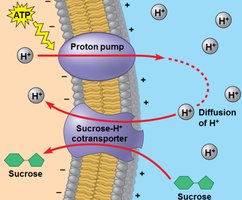
The bonds between ATP's phosphate groups can be broken by hydrolysis, releasing energy. This energy is used to power cellular work, such as chemical, transport, and mechanical processes.
Energy Coupling
Cells couple exergonic reactions (like ATP hydrolysis) to endergonic reactions, allowing the latter to proceed. ATP often transfers a phosphate group to another molecule (phosphorylation), increasing its energy.
Enzymes and Metabolic Regulation
Enzymes as Catalysts
Enzymes are catalytic proteins that speed up chemical reactions without being consumed. They lower the activation energy (EA) required for reactions to proceed.
Enzyme-Substrate Complex
The substrate is the reactant an enzyme acts on. The active site is the region where the substrate binds, and the enzyme changes shape (induced fit) to facilitate the reaction.
Enzyme Regulation
Competitive inhibitors: Bind to the active site, blocking the substrate.
Noncompetitive inhibitors: Bind elsewhere, altering enzyme shape and reducing activity.
Allosteric regulation: Regulatory molecules bind to sites other than the active site, stabilizing either the active or inactive form of the enzyme.
Feedback inhibition: The end product of a pathway inhibits an earlier step, preventing overproduction.
Summary Table: Catabolic vs. Anabolic Pathways
Catabolic Pathways | Anabolic Pathways |
|---|---|
Break down complex molecules | Build complex molecules |
Release energy (exergonic) | Consume energy (endergonic) |
Increase entropy | Decrease entropy (locally) |
e.g., Cellular respiration | e.g., Protein synthesis |
Key Equations
Cellular Respiration:
Free Energy Change: Where = change in enthalpy (total energy), = temperature (Kelvin), = change in entropy.
Study Questions for Review
Distinguish between catabolic and anabolic pathways; kinetic and potential energy; open and closed systems; exergonic and endergonic reactions.
Explain the second law of thermodynamics and why it is not violated by living organisms.
Describe how ATP performs cellular work and why activation energy is necessary for spontaneous reactions.
Describe mechanisms by which enzymes lower activation energy and how allosteric regulators affect enzyme activity.
Apply the principles of negative feedback to feedback inhibition in metabolic pathways.
