 Back
Chapter 8: An Introduction to Metabolism
Study Guide - Smart Notes
 Tailored notes based on your materials, expanded with key definitions, examples, and context.
Metabolism and Energy Transformations
Overview of Metabolism
Metabolism encompasses all biochemical reactions occurring within a cell, including both catabolic and anabolic pathways. These reactions are essential for maintaining life, enabling cells to extract, store, and utilize energy.
Catabolic reactions: Break down complex molecules into simpler ones, releasing energy. Example: aerobic cellular respiration ().
Anabolic reactions: Synthesize complex molecules from simpler ones, requiring energy input. Example: photosynthesis.
Energy: The capacity to do work, including mechanical, chemical, and transport work.
Kinetic energy: Energy of motion; Potential energy: Stored energy.
Thermodynamics in Biology
Thermodynamics governs energy transformations in biological systems.
First Law (Conservation of Energy): Energy cannot be created or destroyed, only transformed.
Second Law (Entropy): Every energy transfer increases the disorder (entropy) of the universe. Living organisms maintain low entropy locally by increasing entropy in their surroundings.
Free Energy and Reaction Types
Free energy (ΔG) determines whether a reaction can perform work in a cell.
Exergonic reactions: Release free energy (ΔG < 0); catabolic (e.g., respiration).
Endergonic reactions: Require energy input (ΔG > 0); anabolic (e.g., photosynthesis).
ATP: The Energy Currency of the Cell
Structure and Function of ATP
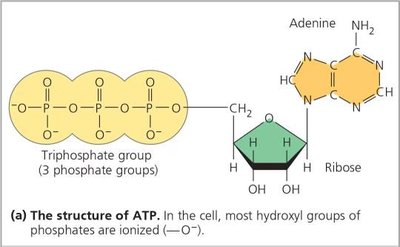
ATP (adenosine triphosphate) is the primary energy carrier in cells, composed of adenine, ribose, and three phosphate groups.
ATP Hydrolysis and Energy Release
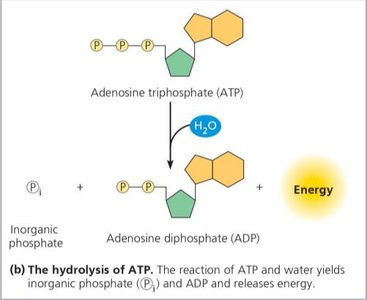
ATP hydrolysis releases energy by breaking the terminal phosphate bond, forming ADP and inorganic phosphate (Pi).
Reaction:
This energy is used for cellular work.
Types of Cellular Work Powered by ATP
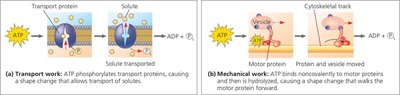
Transport work: ATP phosphorylates transport proteins, enabling solute movement across membranes.
Mechanical work: ATP binds to motor proteins, causing conformational changes for movement.
The ATP Cycle
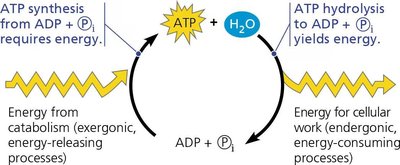
ATP is continuously regenerated from ADP and Pi using energy from catabolic reactions (e.g., cellular respiration).
ATP synthesis: Endergonic; requires energy.
ATP hydrolysis: Exergonic; releases energy for cellular work.
Enzymes: Biological Catalysts
Enzyme Structure and Function
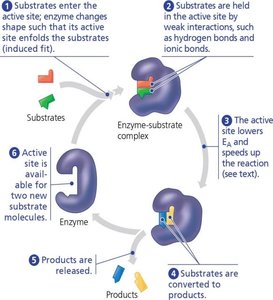
Enzymes are proteins that accelerate biochemical reactions by lowering activation energy. They are not consumed in the reaction and are highly specific for their substrates.
Active site: Region where substrate binds and reaction occurs.
Induced fit: Enzyme changes shape to better fit the substrate.
Enzyme-substrate complex: Temporary association during catalysis.
Factors Affecting Enzyme Activity
Temperature: High temperatures can denature enzymes; optimal temperature maximizes activity.
pH: Each enzyme has an optimal pH range.
Cofactors: Non-protein helpers (inorganic ions like Cu, Zn, Fe; organic coenzymes like vitamins).
Enzyme Inhibition
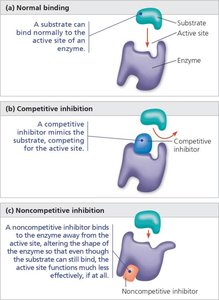
Competitive inhibitors: Bind to the active site, blocking substrate (e.g., DDT, penicillin).
Noncompetitive inhibitors: Bind elsewhere, altering enzyme shape and reducing activity.
Fermentation and Cellular Respiration
Fermentation
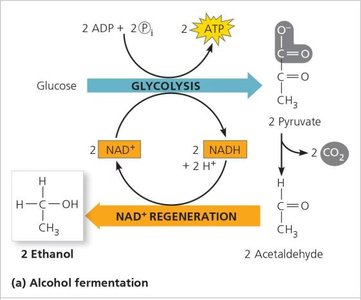
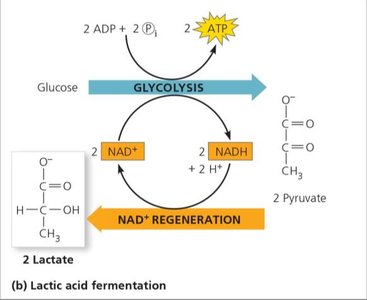
Fermentation is an anaerobic process for ATP production, occurring in the absence of oxygen. Two main types exist:
Alcohol fermentation: Occurs in yeasts and some bacteria. Glucose is converted to ethanol, CO2, and ATP.
Lactic acid fermentation: Occurs in fungi, bacteria, and animal muscles. Glucose is converted to lactate and ATP (no CO2 produced).
Aerobic Cellular Respiration
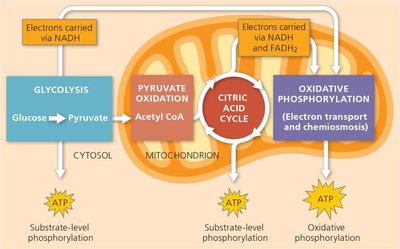
Aerobic respiration is a highly efficient ATP-generating process that requires oxygen. It consists of glycolysis, pyruvate oxidation, the citric acid cycle, and oxidative phosphorylation.
Overall equation:
Redox reactions: Glucose is oxidized; oxygen is reduced.
NAD+ and NADH: Electron Carriers
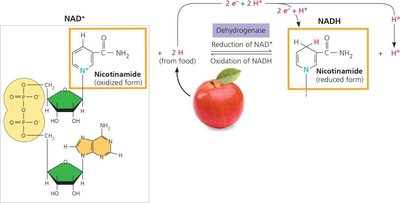
NAD+ (nicotinamide adenine dinucleotide) acts as an electron acceptor, becoming NADH when reduced. NADH carries electrons to the electron transport chain (ETC).
NAD+: Empty form; accepts electrons and H+.
NADH: Full form; donates electrons to the ETC.
Electron Transport Chain (ETC) and Oxidative Phosphorylation
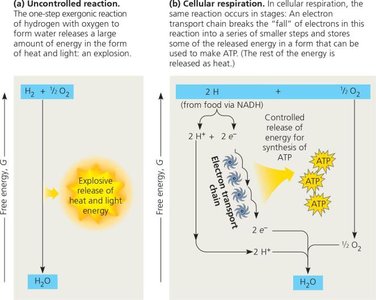
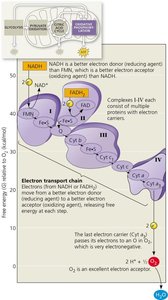
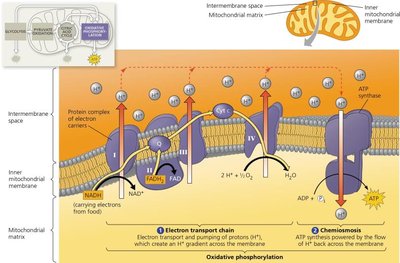
The ETC is a series of protein complexes in the inner mitochondrial membrane. Electrons from NADH and FADH2 are transferred through the chain, releasing energy to pump protons (H+) and create a gradient used for ATP synthesis.
Oxygen: Final electron acceptor; forms water.
Energy release: Gradual, controlled, and used to generate ATP.
ATP Synthase and Chemiosmosis
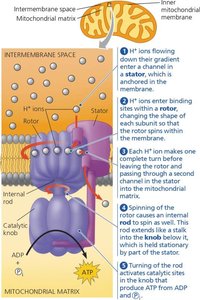
ATP synthase is a molecular machine that uses the proton gradient (proton-motive force) to synthesize ATP from ADP and Pi. This process is called chemiosmosis.
Oxidative phosphorylation: Combination of ETC and chemiosmosis; produces most cellular ATP.
Stages of Cellular Respiration
Glycolysis: Occurs in cytoplasm; glucose split into 2 pyruvate, 2 ATP, and 2 NADH.
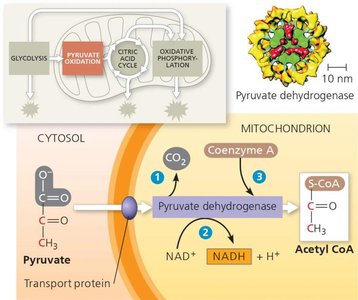
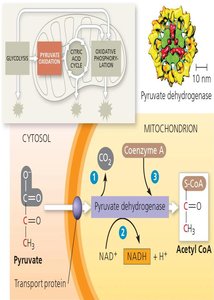
Pyruvate oxidation: Pyruvate transported into mitochondria, converted to acetyl CoA, producing NADH and CO2.
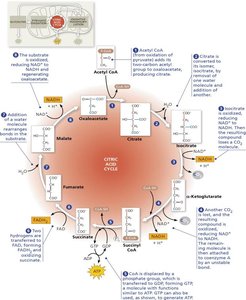
Citric Acid Cycle (Krebs Cycle): Acetyl CoA enters cycle, generating ATP, NADH, FADH2, and CO2.
Oxidative phosphorylation: ETC and chemiosmosis produce the majority of ATP.
ATP Yield from Cellular Respiration
Maximum ATP yield per glucose molecule is about 30-32 ATP, with most produced during oxidative phosphorylation.
