 Back
BackChapter 8: An Introduction to Metabolism – Study Notes
Study Guide - Smart Notes
 Tailored notes based on your materials, expanded with key definitions, examples, and context.
Metabolism and Thermodynamics in Biology
Overview of Metabolism
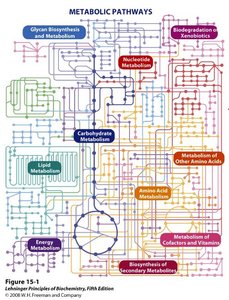
Metabolism refers to the totality of an organism’s chemical reactions, encompassing both the breakdown and synthesis of molecules. It is an emergent property of life, arising from the orderly interactions between molecules within cells.
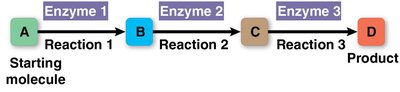
Metabolic Pathways: A series of chemical reactions where a specific molecule is altered stepwise to produce a product. Each step is catalyzed by a specific enzyme.
Catabolic Pathways: Release energy by breaking down complex molecules into simpler compounds (e.g., cellular respiration).
Anabolic Pathways: Consume energy to build complex molecules from simpler ones (e.g., protein synthesis, glycogen synthesis).
Enzymes: Macromolecules (usually proteins) that speed up specific reactions by lowering activation energy barriers.
The Laws of Thermodynamics in Biological Systems
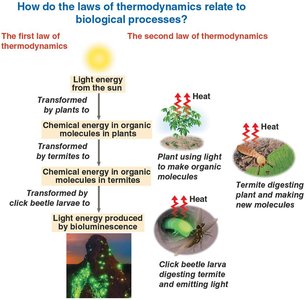
Biological processes are governed by the laws of thermodynamics, which describe how energy is transferred and transformed in living organisms.
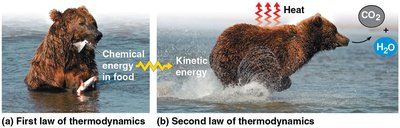
First Law (Conservation of Energy): Energy can be transferred and transformed, but not created or destroyed.
Second Law (Entropy): Every energy transfer increases the entropy (disorder) of the universe. Some energy is lost as heat and becomes unavailable to do work.
Forms of Energy in Biological Systems
Types of Energy
Energy is the capacity to cause change and exists in various forms relevant to biological systems.
Kinetic Energy: Energy associated with motion (e.g., moving water, muscle contraction).
Thermal Energy: Kinetic energy due to random movement of atoms or molecules; transfer is called heat.
Potential Energy: Energy due to location or structure (e.g., water behind a dam, arrangement of electrons in bonds).
Chemical Energy: Potential energy available for release in a chemical reaction (e.g., glucose breakdown).
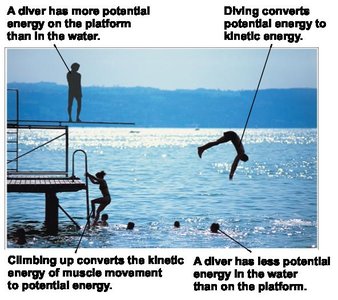
Free Energy and Spontaneity of Reactions
Free Energy Change (ΔG)
The change in free energy (ΔG) during a reaction determines whether the reaction occurs spontaneously.
Formula: Where: = change in free energy = change in enthalpy (total energy) = change in entropy = temperature in Kelvin
Spontaneous Processes: Occur when is negative; energetically favorable.
Nonspontaneous Processes: Occur when is zero or positive; require energy input.
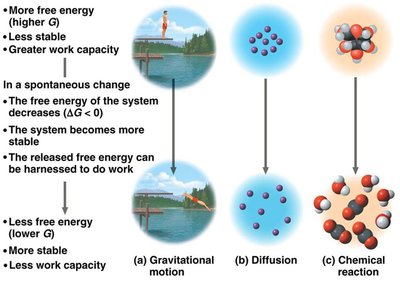
Exergonic vs. Endergonic Reactions
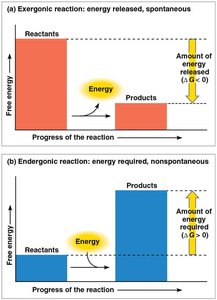
Chemical reactions are classified based on their free-energy changes:
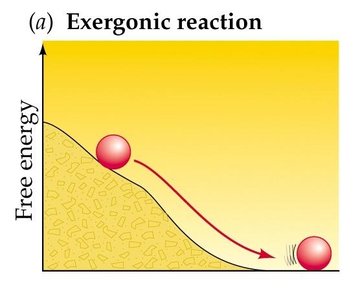
Exergonic Reaction: Proceeds with a net release of free energy (); spontaneous.
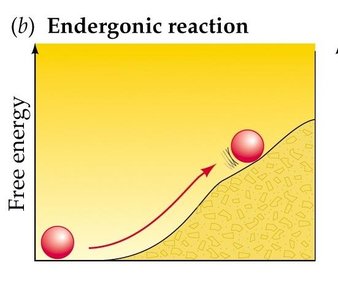
Endergonic Reaction: Absorbs free energy from surroundings (); nonspontaneous.
ATP and Energy Coupling
ATP Structure and Function
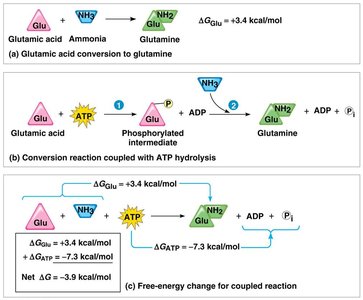
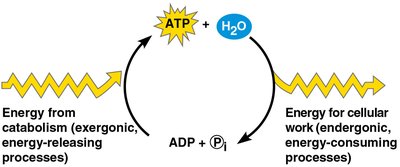
ATP (adenosine triphosphate) is the primary energy currency of the cell, mediating energy coupling between exergonic and endergonic reactions.
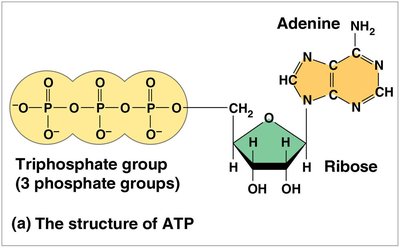
Structure: Composed of ribose (sugar), adenine (nitrogenous base), and three phosphate groups.
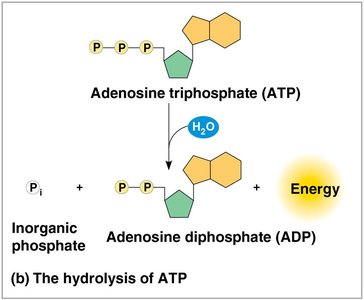
Hydrolysis: Energy is released when the terminal phosphate bond is broken by hydrolysis.
Phosphorylation: Transfer of a phosphate group from ATP to another molecule, making it more reactive.
ATP Cycle and Cellular Work
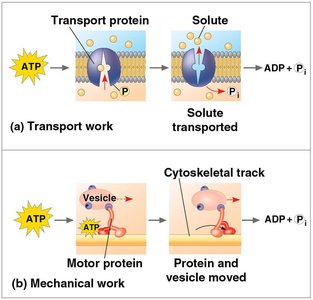
Cells use ATP to perform three main kinds of work: chemical, transport, and mechanical. ATP is regenerated from ADP and inorganic phosphate through catabolic reactions.
Chemical Work: Pushing endergonic reactions.
Transport Work: Pumping substances across membranes.
Mechanical Work: Moving structures within the cell (e.g., cilia, muscle contraction).
Enzymes and Activation Energy
Activation Energy and Catalysis
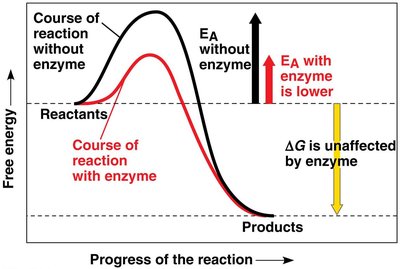
Every chemical reaction requires an initial input of energy to break bonds, known as activation energy (EA). Enzymes act as catalysts to lower this barrier, allowing reactions to proceed at moderate temperatures.
Catalyst: A chemical agent that speeds up a reaction without being consumed.
Enzyme: A protein catalyst that speeds up specific reactions by lowering activation energy.
Effect on ΔG: Enzymes do not change the free energy of a reaction; they only speed up the rate.
Enzyme Specificity and Mechanism
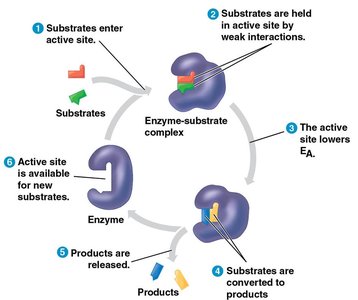
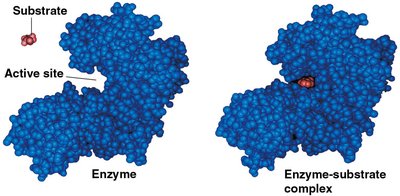
Enzymes are highly specific for their substrates, binding them at the active site to form an enzyme-substrate complex. The induced fit model describes how the enzyme changes shape to enhance catalysis.
Substrate: The reactant an enzyme acts on.
Active Site: The region on the enzyme where the substrate binds.
Induced Fit: The enzyme changes shape to fit the substrate, enhancing catalysis.
Factors Affecting Enzyme Activity
Environmental Effects
Enzyme activity is influenced by temperature, pH, and the presence of cofactors or inhibitors.
Optimal Temperature: Each enzyme has a temperature at which it works best; higher temperatures can cause denaturation.
Optimal pH: Enzymes have a pH range where they are most active (e.g., pepsin in stomach pH 2, trypsin in intestine pH 8).
Cofactors: Nonprotein helpers (inorganic or organic) required for enzyme activity; organic cofactors are called coenzymes.
Inhibitors: Chemicals that reduce enzyme activity; competitive inhibitors bind the active site, noncompetitive inhibitors bind elsewhere and change enzyme shape.
Factor | Effect on Enzyme Activity |
|---|---|
Temperature | Increases rate up to optimum, then causes denaturation |
pH | Each enzyme has an optimal pH; extremes cause denaturation |
Cofactors | Required for activity; can be inorganic (metal ions) or organic (coenzymes) |
Inhibitors | Competitive or noncompetitive; reduce enzyme activity |
*Additional info: The notes expand on the original slides by providing definitions, examples, and context for each concept, as well as relevant equations and a summary table for factors affecting enzyme activity.*
