 Back
Chapter 8: An Introduction to Metabolism – Study Notes
Study Guide - Smart Notes
 Tailored notes based on your materials, expanded with key definitions, examples, and context.
An Introduction to Metabolism
Overview of Metabolism
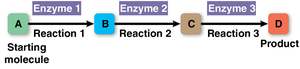
Metabolism encompasses all the chemical reactions occurring within a living organism. These reactions are organized into metabolic pathways, where a specific molecule is transformed through a series of steps, each catalyzed by a unique enzyme, to yield a final product.
Metabolic Pathway: A sequence of chemical reactions, each step facilitated by a specific enzyme.
Enzyme: A protein that accelerates a particular chemical reaction without being consumed.
Example: The breakdown of glucose in cellular respiration involves multiple steps, each catalyzed by different enzymes.
Types of Metabolic Pathways
Metabolic pathways are classified as catabolic or anabolic based on their function and energy requirements.
Catabolic Pathways: Break down complex molecules into simpler compounds, releasing energy. Example: Breakdown of glucose into carbon dioxide and water.
Anabolic Pathways: Build complex molecules from simpler ones, requiring energy input. Example: Synthesis of proteins from amino acids.
Energy Coupling: Catabolism provides energy for anabolism; cells use energy to perform work.
Thermodynamics in Biological Systems
Basic Principles of Thermodynamics
Thermodynamics is the study of energy transformations. It determines what processes are possible in biological systems.
First Law of Thermodynamics: Energy cannot be created or destroyed; it can only change form. The total energy of the universe remains constant.
Energy Transformation: Biological organisms convert light energy to chemical energy, and then to kinetic energy.
Open Systems: Living organisms exchange energy and matter with their surroundings.
Second Law of Thermodynamics
The second law states that the entropy (disorder) of the universe is always increasing. While organisms maintain order internally, they increase the entropy of their environment.
Entropy: A measure of disorder or randomness.
Biological Order: Organisms can be highly ordered by increasing the entropy of their surroundings.
Gibbs Free Energy and Spontaneity
Gibbs Free Energy (G)
Gibbs free energy (G) is the portion of a system’s energy available to do work. The change in free energy () indicates whether a process is thermodynamically possible.
Definition: is the difference in free energy between the final and initial states of a process.
Formula:
Spontaneous and Non-Spontaneous Processes
The sign of determines whether a process is spontaneous or not.
Spontaneous Process: is negative; the process releases free energy (exergonic).
Non-Spontaneous Process: is positive; the process absorbs free energy (endergonic).
Exergonic Reaction: Releases energy; final state has less free energy than starting state.
Endergonic Reaction: Requires energy input; final state has more free energy than starting state.
Equilibrium
At equilibrium, the free energy of the final and starting states is equal (), and no work can be done. Living organisms are not at equilibrium, allowing them to perform work.
Equilibrium: ; no net change, no capacity to do work.
Living Systems: Maintain non-equilibrium to sustain life processes.
Important Points about Free Energy
Significance of : Indicates spontaneity, not speed.
Pathway Independence: is unaffected by the pathway taken.
Energy Coupling: Endergonic processes can occur if coupled to exergonic processes with a larger negative .
Example: Combustion of glucose ( kcal/mol) releases the same energy whether in a single step or through multiple enzymatic steps.
Process Type | Energy Flow | Spontaneity | |
|---|---|---|---|
Exergonic | Negative | Releases energy | Spontaneous |
Endergonic | Positive | Absorbs energy | Non-spontaneous |
Equilibrium | Zero | No net energy change | Not spontaneous |
Additional info: The coupling of exergonic and endergonic reactions is fundamental to cellular metabolism, allowing cells to drive energetically unfavorable processes by linking them to favorable ones.
