Back
BackBio 100 LEC Chapter 8 Modules 1-3
Study Guide - Smart Notes
 Tailored notes based on your materials, expanded with key definitions, examples, and context.
Bio 100 LEC Chapter 8
Chapter 8: An Introduction to Metabolism
Overview of Metabolism
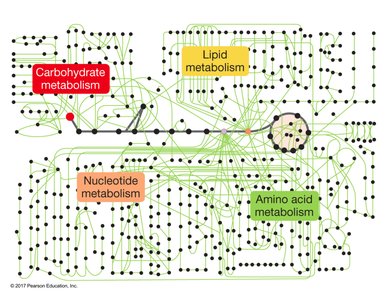
Metabolism encompasses all chemical reactions that occur within a cell, integrating the transformation of matter and energy. These reactions are organized into metabolic pathways, which are sequences of enzymatically catalyzed steps that convert specific molecules into final products. Understanding metabolism requires knowledge of large biological molecules, solute concentration, ion movement, and pH values, as these factors influence metabolic reactions.
Metabolic Pathways
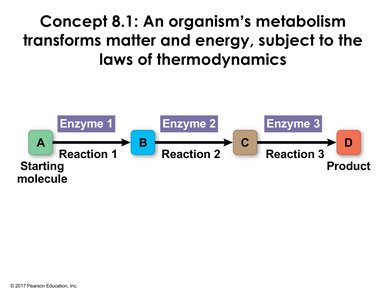
Metabolic pathways begin with a starting molecule and end with a product, with each step catalyzed by a specific enzyme. The product of one reaction often serves as the substrate for the next, allowing for precise regulation and integration of cellular activities.
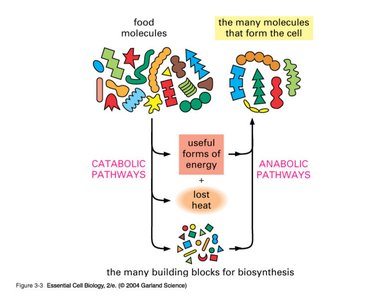
Catabolic pathways: Break down complex molecules into simpler ones, releasing energy.
Anabolic pathways: Build complex molecules from simpler ones, consuming energy.
Energy released from catabolic pathways can drive anabolic processes.
Energy and Life
Forms of Energy
Energy is the capacity to cause change. In biological systems, energy exists primarily as:
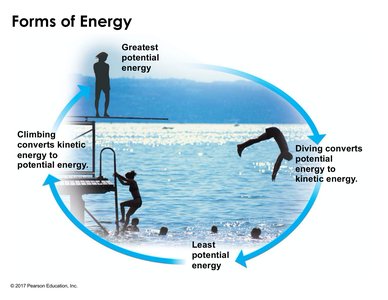
Kinetic energy: Energy of motion (e.g., muscle contraction, molecular movement).
Potential energy: Stored energy due to position or structure (e.g., chemical bonds, concentration gradients).
Energy can be transformed from one form to another, such as potential energy being converted to kinetic energy during movement.
The Laws of Thermodynamics
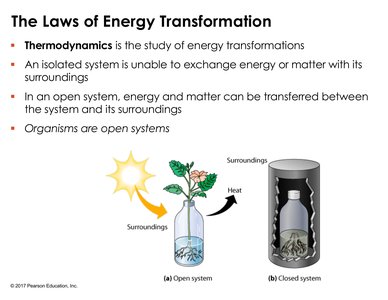
Thermodynamics is the study of energy transformations. Biological systems are considered open systems, exchanging energy and matter with their surroundings.
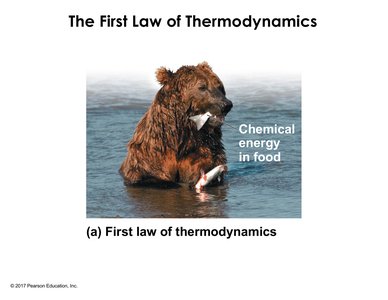
First Law of Thermodynamics: Energy cannot be created or destroyed, only transformed from one form to another.
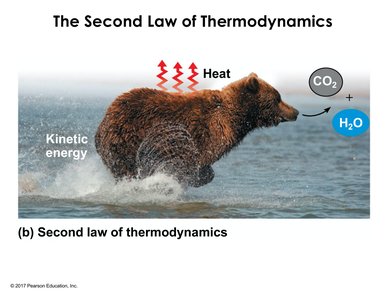
Second Law of Thermodynamics: Every energy transfer increases the entropy (disorder) of the universe; some energy is lost as heat.
Biological Order and Entropy
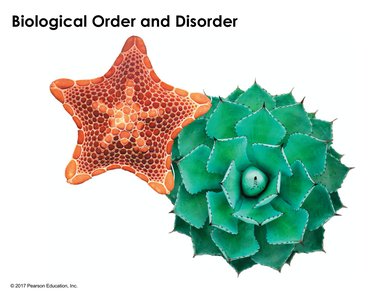
Living organisms maintain order and structure by increasing the entropy of their surroundings. While cells create ordered structures, the overall entropy of the universe increases due to the release of heat and other byproducts.
Free Energy and Spontaneity of Reactions
Free Energy (ΔG)
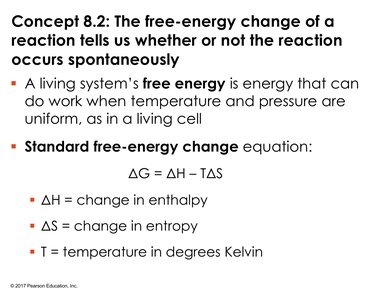
Free energy (G) is the portion of a system's energy that can perform work when temperature and pressure are uniform. The change in free energy (ΔG) determines whether a reaction is spontaneous.
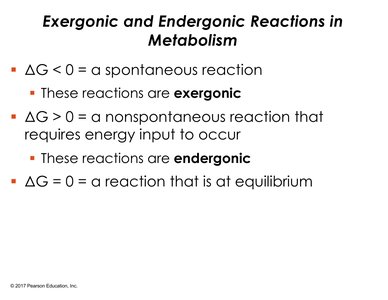
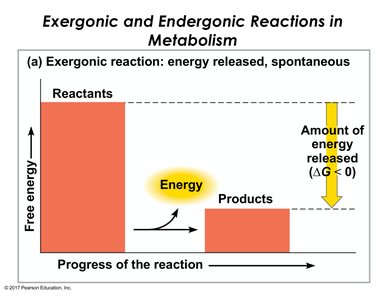
ΔG < 0: Spontaneous (exergonic) reaction; energy is released.
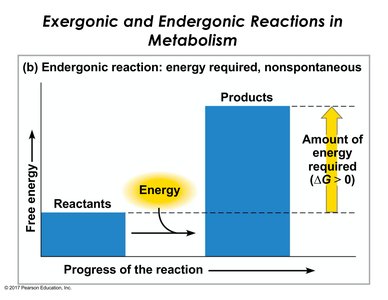
ΔG > 0: Non-spontaneous (endergonic) reaction; energy is required.
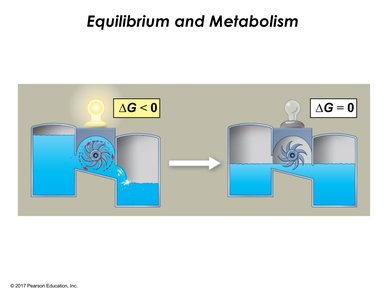
ΔG = 0: Reaction is at equilibrium; no net work can be done.
The standard equation for free energy change is:
= change in enthalpy (total energy)
= change in entropy (disorder)
= temperature in Kelvin
Free Energy, Stability, and Work Capacity
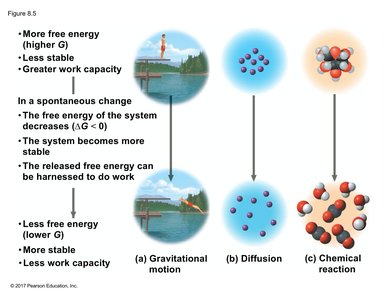
Systems tend to move from higher free energy (less stable) to lower free energy (more stable). The released free energy can be harnessed to do work, as seen in gravitational motion, diffusion, and chemical reactions.
Exergonic and Endergonic Reactions
Exergonic reactions release energy and are spontaneous, while endergonic reactions require energy input and are non-spontaneous. Graphical representations help visualize the energy changes during these reactions.
Equilibrium and Metabolism
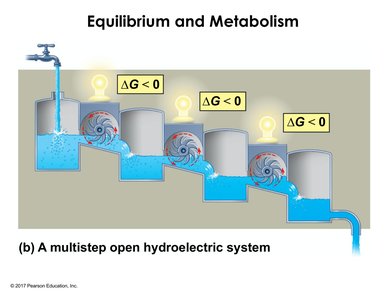
In a closed system, reactions eventually reach equilibrium (ΔG = 0), and no more work can be done. Living cells avoid equilibrium by remaining open systems, allowing continuous input and output of energy and materials, thus sustaining life and cellular processes.
ATP and Cellular Work
ATP: The Energy Currency of the Cell
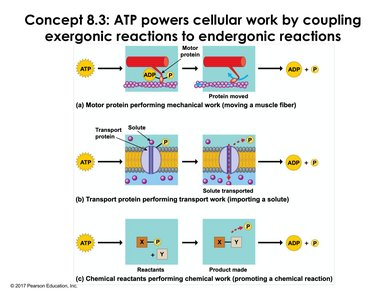
Adenosine triphosphate (ATP) powers cellular work by coupling exergonic reactions (energy-releasing) to endergonic reactions (energy-consuming). Cells perform three main types of work:
Mechanical work: Movement (e.g., muscle contraction)
Transport work: Pumping substances across membranes against gradients
Chemical work: Driving endergonic reactions (e.g., biosynthesis)
Structure and Hydrolysis of ATP
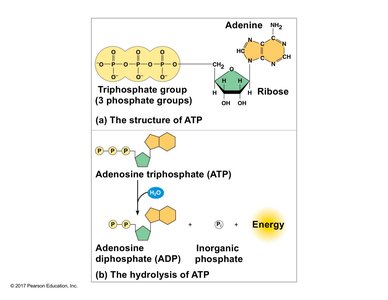
ATP consists of a ribose sugar, adenine base, and three phosphate groups. The bonds between phosphate groups are high-energy due to electrostatic repulsion. Hydrolysis of ATP (removal of a phosphate group) releases energy that can be used for cellular work:
Hydrolysis of the terminal phosphate releases the most energy.
ATP hydrolysis is an exergonic reaction.
Regeneration of ATP
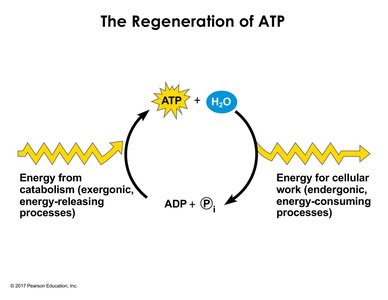
ATP is a renewable resource, continually regenerated from ADP and inorganic phosphate. The energy for ATP synthesis comes from exergonic (energy-releasing) processes, such as cellular respiration. Cells maintain small pools of ATP, constantly cycling between ATP and ADP to meet energy demands.