 Back
BackChapter 8: An Introduction to Metabolism – Study Notes
Study Guide - Smart Notes
 Tailored notes based on your materials, expanded with key definitions, examples, and context.
Metabolism and Energy Transformation
Overview of Metabolism
Metabolism encompasses all chemical reactions occurring within an organism, enabling the transformation of matter and energy. These reactions are organized into metabolic pathways, which are either catabolic (breaking down molecules to release energy) or anabolic (building molecules and consuming energy). Bioenergetics is the study of how energy flows through living systems.
Catabolic pathways: Decompose complex molecules, releasing energy (e.g., cellular respiration).
Anabolic pathways: Construct complex molecules, requiring energy input (e.g., protein synthesis).
Energy: The capacity to cause change; includes kinetic (motion), thermal (random movement of atoms/molecules), and potential (stored due to position or structure).
Heat: Transfer of thermal energy between objects.
Chemical energy: Potential energy stored in molecular bonds.
First Law of Thermodynamics: Energy cannot be created or destroyed, only transferred or transformed. Second Law of Thermodynamics: Spontaneous processes increase the entropy (disorder) of the universe.
Cellular Order and Entropy: Cells maintain order by using energy to decrease local entropy, but overall entropy of the universe increases.
Free Energy and Spontaneity
Free Energy Change (ΔG) in Biological Reactions
The free energy of a system is the energy available to do work under cellular conditions. The change in free energy (ΔG) determines whether a reaction is spontaneous:
ΔG = ΔH − TΔS Where ΔH is the change in enthalpy (total energy), T is temperature in Kelvin, and ΔS is the change in entropy.
Spontaneous reactions: Occur without energy input; ΔG is negative (exergonic).
Nonspontaneous reactions: Require energy input; ΔG is positive (endergonic).
Equilibrium: Maximum stability; no work can be done.
Importance: Spontaneous reactions drive cellular processes, maintaining life and order.
ATP and Energy Coupling
ATP: The Cellular Energy Shuttle
ATP (Adenosine Triphosphate) is the primary energy carrier in cells. Hydrolysis of ATP releases energy by breaking its terminal phosphate bond, forming ADP and inorganic phosphate (Pi).
Energy coupling: Exergonic ATP hydrolysis drives endergonic reactions via phosphorylation, creating a more reactive intermediate.
Protein phosphorylation: Alters shape and function of transport and motor proteins.
ATP regeneration: Catabolic pathways (e.g., cellular respiration) regenerate ATP from ADP and Pi.
ATP Cycle: ATP is used for cellular work and continuously regenerated.
Enzymes and Activation Energy
Enzyme Function and Mechanism
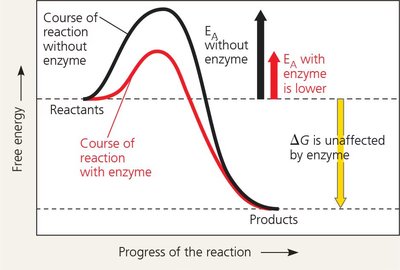
Enzymes are biological catalysts that speed up metabolic reactions by lowering the activation energy (EA) barrier. They do not affect the overall free energy change (ΔG) of the reaction.
Activation energy (EA): Energy required to break reactant bonds.
Active site: Unique region on the enzyme where substrate(s) bind.
Induced fit: Enzyme changes shape to bind substrate(s) more tightly.
Mechanisms: Enzymes orient substrates, strain bonds, provide favorable environments, or form temporary covalent bonds.
Optimal conditions: Each enzyme has an optimal temperature and pH.
Inhibitors: Competitive inhibitors bind the active site; noncompetitive inhibitors bind elsewhere, altering enzyme function.
Enzyme diversity: Natural selection leads to a variety of enzymes in organisms.
Regulation of Enzyme Activity
Enzyme Regulation and Metabolic Control
Enzyme activity is tightly regulated to control metabolism. Allosteric regulation involves regulatory molecules binding to specific sites, affecting enzyme shape and function.
Allosteric regulation: Activators or inhibitors bind to regulatory sites, modulating activity.
Cooperativity: Binding of one substrate enhances activity at other active sites.
Feedback inhibition: End product of a pathway inhibits an earlier enzyme, preventing overproduction.
Enzyme organization: Enzymes may form complexes, be embedded in membranes, or reside in organelles for efficiency.
Role: These mechanisms maintain metabolic balance and efficiency in cells.
