 Back
Chapter 8: An Introduction to Metabolism – Study Notes
Study Guide - Smart Notes
 Tailored notes based on your materials, expanded with key definitions, examples, and context.
Metabolism and Metabolic Pathways
Overview of Metabolism
Metabolism encompasses all chemical reactions that occur within a cell or organism, enabling the transformation of matter and energy. These reactions are essential for maintaining life, allowing cells to build and break down molecules as needed.
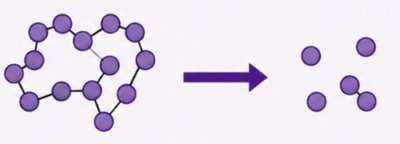
Catabolic pathways break down complex molecules into simpler ones, releasing energy.
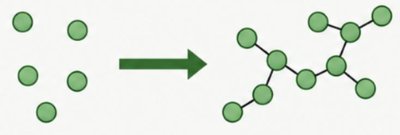
Anabolic pathways build complex molecules from simpler ones, requiring energy input.
Each step in a metabolic pathway is catalyzed by a specific enzyme, ensuring efficiency and regulation.
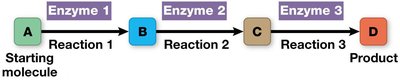
Example: Cellular respiration is a catabolic pathway, while protein synthesis is anabolic.
Catabolic vs. Anabolic Pathways
Catabolic reactions: Release energy by breaking down molecules (e.g., glucose breakdown in respiration).
Anabolic reactions: Consume energy to build complex molecules (e.g., synthesis of proteins from amino acids).
Forms and Transformations of Energy
Types of Energy
Energy is the capacity to cause change. In biological systems, energy exists in various forms:
Kinetic energy: Energy of motion (e.g., movement of molecules).
Thermal energy: Random movement of atoms and molecules; heat is thermal energy transferred between objects.
Potential energy: Stored energy due to position or structure (e.g., chemical bonds).
Chemical energy: Potential energy available for release in chemical reactions.
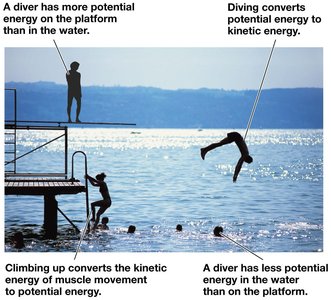
Example: A diver on a platform has potential energy, which is converted to kinetic energy during a dive.
Laws of Thermodynamics
Thermodynamics is the study of energy transformations. Biological systems obey two fundamental laws:
First Law (Conservation of Energy): Energy cannot be created or destroyed, only transferred or transformed.
Second Law (Entropy Increases): Every energy transfer increases the entropy (disorder) of the universe; some energy is lost as heat.
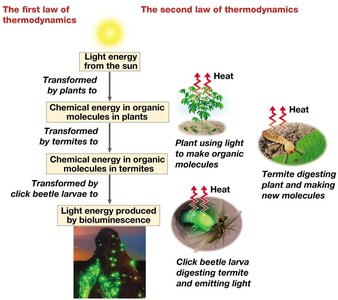
Example: Light energy from the sun is transformed by plants into chemical energy, which is then transferred through food chains, with heat lost at each step.
Free Energy and Spontaneity of Reactions
Free Energy (G) and Spontaneous Reactions
Free energy (G) is the portion of a system's energy available to do work. The change in free energy (ΔG) during a reaction determines whether the process is spontaneous.
ΔG < 0: Spontaneous reaction (releases free energy; energetically favorable).
ΔG = 0: System is at equilibrium (no net change).
ΔG > 0: Nonspontaneous reaction (requires energy input; energetically unfavorable).
The equation for free-energy change is:
Where:
ΔH: Change in enthalpy (total energy)
ΔS: Change in entropy (disorder)
T: Temperature in Kelvin
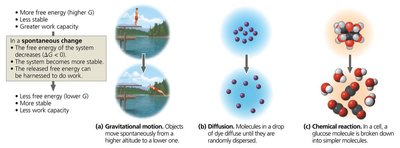
Example: Diffusion of molecules and breakdown of glucose are spontaneous processes.
Exergonic vs. Endergonic Reactions
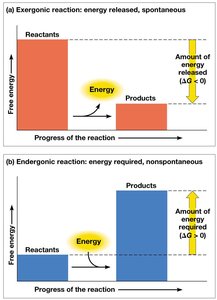
Exergonic reactions: ΔG < 0, release free energy, spontaneous (e.g., cellular respiration).
Endergonic reactions: ΔG > 0, require energy input, nonspontaneous (e.g., synthesis of macromolecules).
ATP and Energy Coupling
ATP Structure and Function
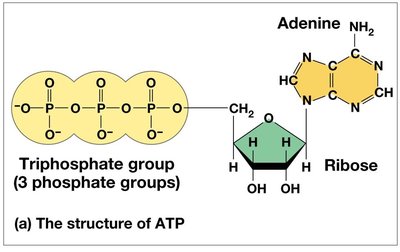
Adenosine triphosphate (ATP) is the main energy currency of the cell. It consists of ribose (a sugar), adenine (a nitrogenous base), and three phosphate groups.
ATP Hydrolysis and Energy Coupling
ATP hydrolysis is an exergonic reaction that releases free energy:
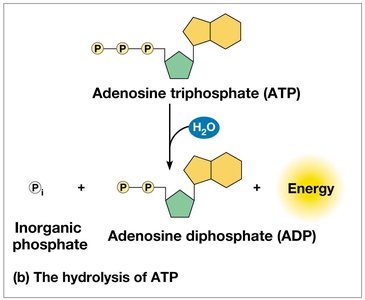
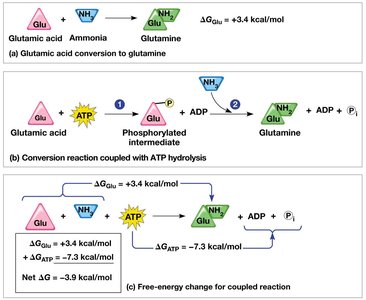
This released energy is used to drive endergonic cellular processes, a phenomenon known as energy coupling.
ATP Cycle
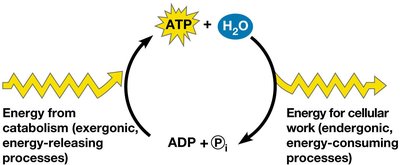
ATP is regenerated by the addition of a phosphate group to ADP, using energy from catabolic reactions. This cycle ensures a continuous supply of ATP for cellular work.
Enzymes and Metabolic Regulation
Enzymes as Catalysts
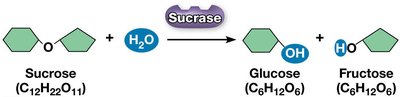
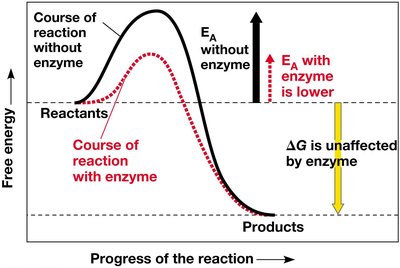
Enzymes are catalytic proteins that speed up metabolic reactions by lowering the activation energy (EA) required to initiate a reaction. They do not change the ΔG of the reaction.
Substrate Specificity and the Active Site
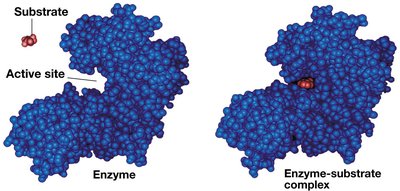
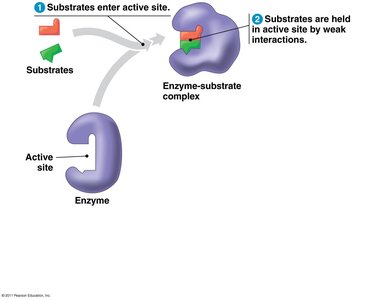
Each enzyme acts on a specific substrate, binding at the enzyme's active site to form an enzyme-substrate complex. The active site brings substrates together, strains bonds, provides a favorable environment, and may form temporary covalent bonds.
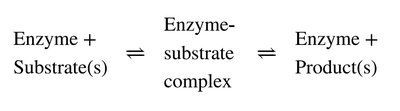
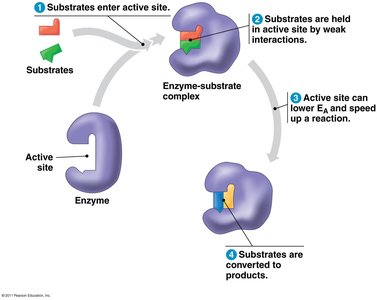
The general reaction is:
Regulation of Enzyme Activity
Allosteric Regulation
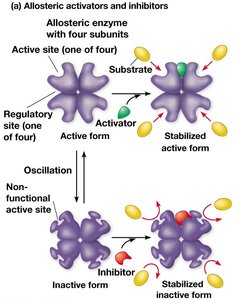
Cells regulate metabolism by controlling enzyme activity. Allosteric regulation involves a regulatory molecule binding to a site other than the active site, causing a change in enzyme activity. This can either activate or inhibit the enzyme.
Feedback Inhibition
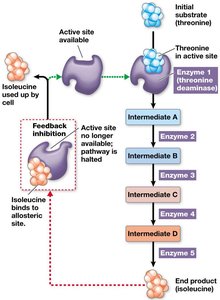
Feedback inhibition is a common regulatory mechanism where the end product of a metabolic pathway inhibits an enzyme involved earlier in the pathway. This prevents the cell from wasting resources and energy.
Summary Table: Key Concepts in Metabolism
Concept | Description | Example |
|---|---|---|
Catabolic Pathway | Breaks down molecules, releases energy | Cellular respiration |
Anabolic Pathway | Builds molecules, requires energy | Protein synthesis |
Exergonic Reaction | ΔG < 0, spontaneous, releases energy | Hydrolysis of ATP |
Endergonic Reaction | ΔG > 0, nonspontaneous, requires energy | Synthesis of macromolecules |
Enzyme | Lowers activation energy, speeds up reaction | Sucrase catalyzing sucrose breakdown |
Allosteric Regulation | Regulatory molecule binds away from active site | Feedback inhibition |
BIG PICTURE: Cells capture energy, transfer it through ATP, and use enzymes to control when and how reactions occur, ensuring efficient and regulated metabolism.
