 Back
Chapter 8: An Introduction to Metabolism – Study Notes part 1
Study Guide - Smart Notes
 Tailored notes based on your materials, expanded with key definitions, examples, and context.
Chapter 8: An Introduction to Metabolism
Overview of Metabolism
Metabolism encompasses all chemical reactions occurring within a living organism. These reactions are organized into metabolic pathways, where each step is catalyzed by a specific enzyme. Metabolism is essential for transforming matter and energy, supporting life’s processes.
Catabolic pathways: Break down complex molecules into simpler ones, releasing energy (e.g., cellular respiration).
Anabolic pathways: Build complex molecules from simpler ones, consuming energy (e.g., protein synthesis).
Energy is the capacity to cause change and is required for all cellular work. It exists in various forms, including kinetic, potential, thermal, and chemical energy.
Thermodynamics and Biological Systems
Thermodynamics is the study of energy transformations. Biological systems obey the laws of thermodynamics, which govern how energy is transferred and transformed in living organisms.
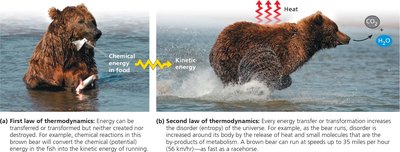
First Law of Thermodynamics: Energy can be transferred or transformed, but cannot be created or destroyed (principle of conservation of energy).
Second Law of Thermodynamics: Every energy transfer or transformation increases the entropy (disorder) of the universe. Some energy is always lost as heat, making it less available for work.
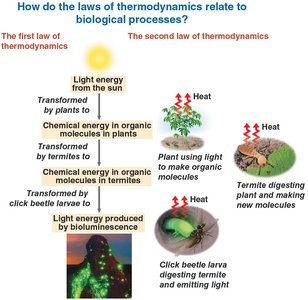
Living organisms are open systems, exchanging energy and matter with their surroundings. They maintain order locally by increasing entropy in the environment.
Metabolic Pathways and Enzymes
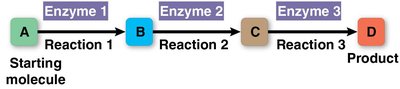
Metabolic pathways consist of a series of chemical reactions, each catalyzed by a specific enzyme. Enzymes lower the activation energy required for reactions, increasing the rate at which they occur.
Each step in a pathway is controlled by a different enzyme.
Regulation of enzyme activity allows cells to control metabolism efficiently.
Energy in Biological Systems
Kinetic energy: Energy of motion (e.g., movement of molecules, heat).
Potential energy: Stored energy due to position or structure (e.g., chemical energy in bonds).
Chemical energy: A form of potential energy stored in molecules, released during chemical reactions.
Free Energy and Spontaneity of Reactions
Gibbs free energy (G) is the portion of a system’s energy that can perform work at constant temperature and pressure. The change in free energy (ΔG) determines whether a reaction is spontaneous.
Formula: Where: = change in free energy = change in enthalpy (total energy) = temperature in Kelvin = change in entropy
Spontaneous reactions: (negative), occur without energy input, increase stability.
Nonspontaneous reactions: (positive), require energy input.
Exergonic and Endergonic Reactions
Chemical reactions are classified by their free energy changes:
Exergonic reactions: Release free energy (), spontaneous (e.g., cellular respiration).
Endergonic reactions: Absorb free energy (), nonspontaneous (e.g., photosynthesis).
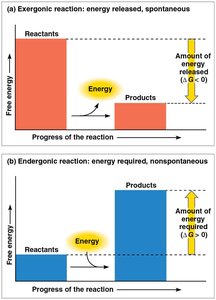
Example: Cellular respiration is exergonic ( kcal/mol), while photosynthesis is endergonic ( kcal/mol).
ATP: The Energy Currency of the Cell
Adenosine triphosphate (ATP) is the primary energy carrier in cells. It powers cellular work by coupling exergonic and endergonic reactions.
Structure: ATP consists of ribose (a sugar), adenine (a nitrogenous base), and three phosphate groups.
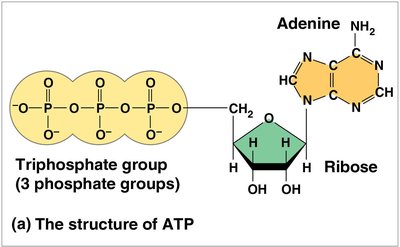
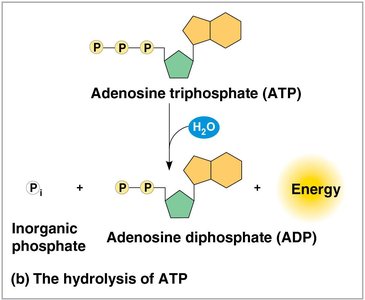
ATP hydrolysis: ATP + H2O → ADP + Pi + energy
Hydrolysis of ATP releases energy (ΔG ≈ –7.3 kcal/mol under standard conditions; about –13 kcal/mol in cells).
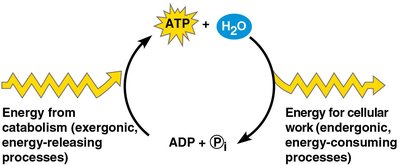
ATP Cycle and Energy Coupling
ATP is continuously regenerated from ADP and inorganic phosphate (Pi) using energy from catabolic (exergonic) reactions. This cycle couples energy-releasing and energy-consuming processes in the cell.
ATP cycle: ADP + Pi → ATP (energy input from catabolism); ATP → ADP + Pi (energy released for cellular work).
Summary Table: Catabolic vs. Anabolic Pathways
d cns. |
|---|
Entropy (S): Measure of disorder or randomness.
Free energy (G): Energy available to do work.
ATP: Main energy currency of the cell.
Practice Questions
What types of reactions are cellular respiration and protein synthesis? Answer: Catabolism and anabolism, respectively.
What is the study of energy transformations called? Answer: Thermodynamics.
How do living organisms create order? Answer: By creating local order while increasing the entropy of the universe through energy transformations.
What form of energy is least useful to life? Answer: Heat.
What can cause a reaction to occur spontaneously? Answer: Negative ΔG.
How does ATP power cellular reactions? Answer: By coupling the hydrolysis of ATP (an exergonic process) to endergonic cellular processes.
