 Back
Chapter 8: Introduction to Metabolism and Thermodynamics in Biology
Study Guide - Smart Notes
 Tailored notes based on your materials, expanded with key definitions, examples, and context.
Metabolism: The Chemical Basis of Life
Definition and Overview
Metabolism refers to the sum of all chemical reactions that occur within a living organism to sustain life. These reactions are responsible for the transformation of molecules and the flow of energy necessary for growth, maintenance, and reproduction.
Small molecules: CO2, water, amino acids, monosaccharides, nucleotides
Large molecules: Macromolecules such as proteins, lipids, nucleic acids, carbohydrates
Metabolic pathways: Series of enzyme-catalyzed reactions converting a starting molecule to a product

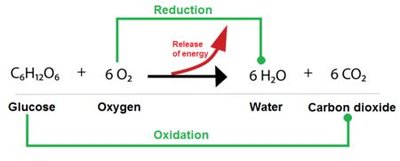
Catabolism breaks down molecules to release energy (e.g., respiration), while anabolism builds up molecules, requiring energy input (e.g., photosynthesis).
Key Point: Metabolic Reactions as Redox Reactions
Metabolic reactions often involve the transfer of electrons, making them redox (reduction-oxidation) reactions. Catabolic and anabolic processes depend on these electron transfers.
Oxidation: Loss of electrons
Reduction: Gain of electrons
Electron acceptors: Often oxygen, due to its high electronegativity
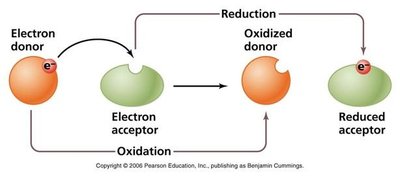
Example: Formation of NaCl from Na and Cl involves a redox reaction.
Thermodynamics in Biological Systems
First Law of Thermodynamics
The first law states that energy cannot be created or destroyed, only converted from one form to another. The total energy of the universe remains constant.
Kinetic energy: Energy of motion (e.g., thermal energy)
Potential energy: Stored energy (e.g., chemical energy in bonds)
Example: Chemical energy in food is converted to kinetic energy and heat in animals.

Second Law of Thermodynamics
The second law states that systems tend toward increased disorder (entropy), and some energy is lost as heat during energy transfers.
Entropy: Measure of disorder in a system
With every energy transfer, usable energy decreases and entropy increases
Free Energy and Spontaneity of Reactions
Gibbs Free Energy
Gibbs free energy (G) is the energy available to do work in a system. It helps predict whether a reaction will occur spontaneously.
H: Total energy (enthalpy)
T: Temperature in Kelvin
S: Entropy (disorder)
Equation:
The change in free energy () determines spontaneity:
Spontaneous vs. Non-Spontaneous Reactions
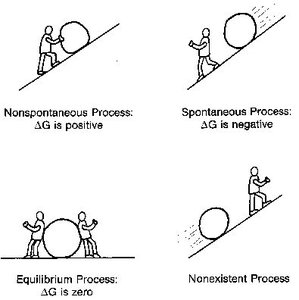
Spontaneous reactions: ; release energy; increase entropy; do not require energy input
Non-spontaneous reactions: ; require energy input; decrease entropy
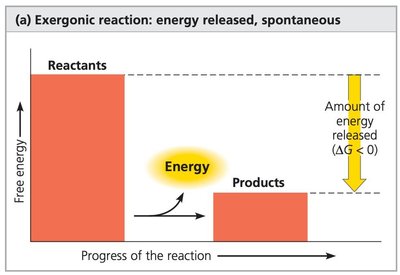
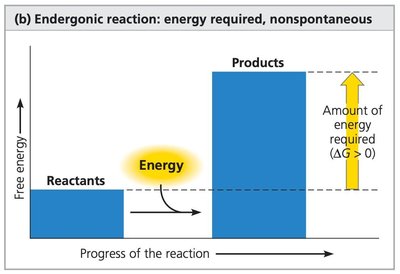
Example: Cell respiration is exergonic and spontaneous ( kcal/mol), while photosynthesis is endergonic and non-spontaneous ( kcal/mol).
Visualizing Spontaneity
Spontaneous processes move toward stability and lower free energy, while non-spontaneous processes require energy input.
Summary Table: Exergonic vs. Endergonic Reactions
Type of Reaction | ΔG | Energy Flow | Spontaneity | Example |
|---|---|---|---|---|
Exergonic | Negative | Energy released | Spontaneous | Cell respiration |
Endergonic | Positive | Energy absorbed | Non-spontaneous | Photosynthesis |
Source of Energy for Endergonic Reactions
ATP and Coupling of Reactions
Endergonic reactions often obtain energy from exergonic reactions, such as the hydrolysis of ATP. This coupling allows cells to drive non-spontaneous processes using the energy released from spontaneous ones.
Example: The energy released from cell respiration is used to synthesize ATP, which then powers anabolic reactions like photosynthesis.
Additional info: ATP (adenosine triphosphate) is the primary energy carrier in cells, linking catabolic and anabolic pathways.
