 Back
Chapter 8: Photosynthesis – Structure, Function, and Mechanisms
Study Guide - Smart Notes
 Tailored notes based on your materials, expanded with key definitions, examples, and context.
Photosynthesis: The Process That Feeds the Biosphere
Autotrophs and Heterotrophs
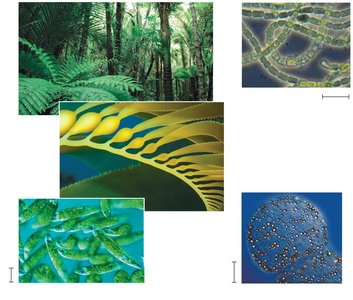
Photosynthesis is the fundamental process by which plants, algae, and certain prokaryotes convert solar energy into chemical energy, sustaining nearly all life on Earth. Organisms are classified based on how they obtain energy and carbon:
Autotrophs: "Self-feeders" that produce organic molecules from CO2 and other inorganic substances. Most plants are photoautotrophs, using sunlight as their energy source.
Heterotrophs: Obtain energy and carbon from organic compounds produced by other organisms. Includes consumers and decomposers.
Example: Cyanobacteria, algae, and plants are photoautotrophs, while animals and fungi are heterotrophs.
Chloroplasts: The Sites of Photosynthesis
Leaf Structure and Chloroplast Anatomy
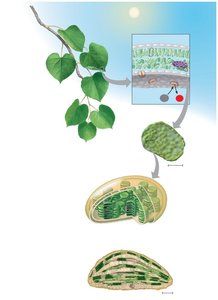
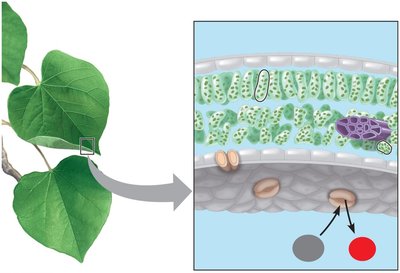
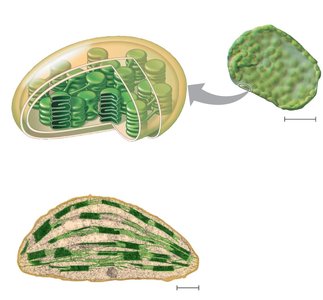
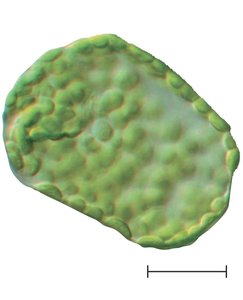
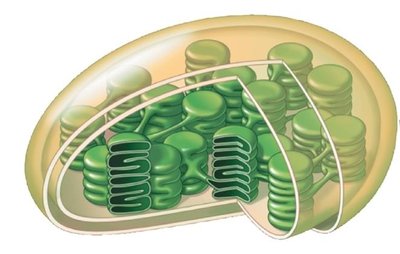
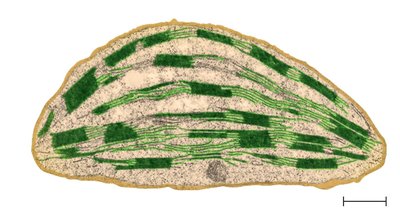
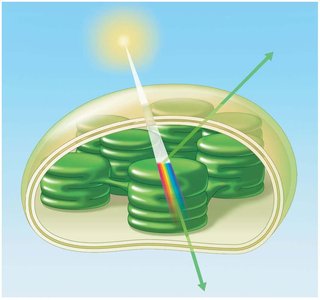
Photosynthesis occurs primarily in leaves, where CO2 enters and O2 exits through stomata. Chloroplasts are concentrated in the mesophyll cells. Each chloroplast is surrounded by a double membrane and contains a dense fluid called the stroma. Suspended within the stroma are thylakoids, which may be stacked into grana. The green pigment chlorophyll resides in the thylakoid membranes.
Stomata: Microscopic pores for gas exchange.
Mesophyll: Leaf tissue rich in chloroplasts.
Thylakoids: Membranous sacs where light reactions occur.
Grana: Stacks of thylakoids.
Stroma: Fluid surrounding thylakoids, site of the Calvin cycle.
Photosynthesis: Overview and Equation
Tracking Atoms and Redox Reactions
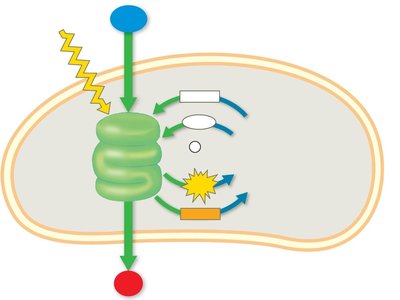
Photosynthesis is a series of redox reactions, reversing the electron flow of cellular respiration. Water is oxidized, and carbon dioxide is reduced, powered by light energy. The overall equation is:
Photosynthesis Equation:

The Two Stages of Photosynthesis
Light Reactions and the Calvin Cycle
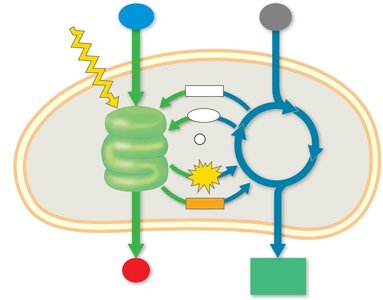
Photosynthesis consists of two main stages:
Light Reactions: Occur in thylakoid membranes. Convert solar energy to chemical energy (ATP and NADPH), split water, release O2, and reduce NADP+ to NADPH.
Calvin Cycle: Occurs in the stroma. Uses ATP and NADPH to fix CO2 and produce sugars (G3P).
Example: The Calvin cycle incorporates CO2 into organic molecules via carbon fixation.
The Light Reactions: Conversion of Solar Energy
The Nature of Sunlight and Pigments
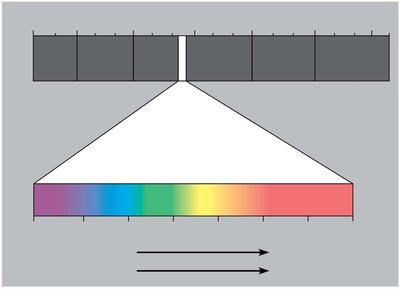
Light is electromagnetic energy, traveling in waves. The electromagnetic spectrum includes all wavelengths; visible light (380–750 nm) powers photosynthesis. Light also behaves as photons, with energy inversely proportional to wavelength.
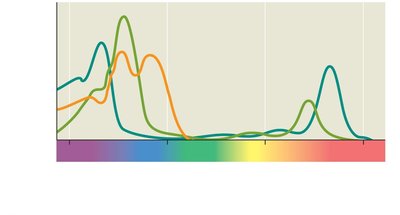
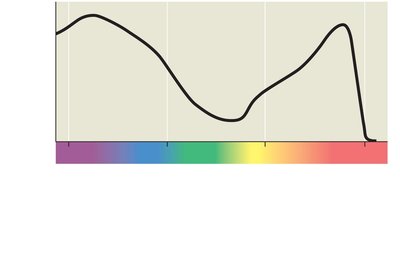
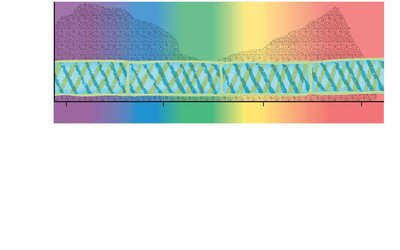
Pigments: Substances that absorb visible light. Chlorophyll absorbs violet-blue and red light, reflecting green.
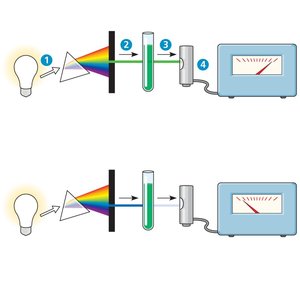
Spectrophotometer: Measures pigment absorption at different wavelengths.
Absorption Spectrum: Graph of pigment absorption vs. wavelength.
Action Spectrum: Graph of photosynthesis rate vs. wavelength.
Photosystems: Structure and Function
Light-Harvesting Complexes and Reaction Centers
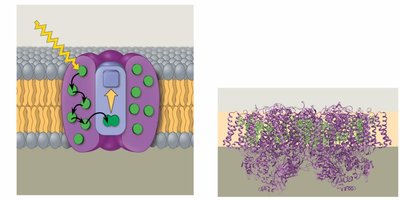
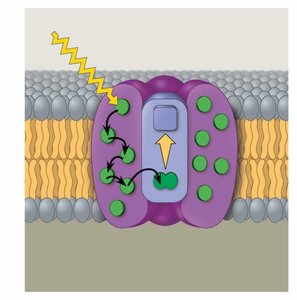
A photosystem consists of a reaction-center complex surrounded by light-harvesting complexes. Pigment molecules transfer energy to the reaction center, where chlorophyll a passes excited electrons to a primary electron acceptor. There are two types:
Photosystem II (PS II): Best at absorbing 680 nm (P680).
Photosystem I (PS I): Best at absorbing 700 nm (P700).
Linear Electron Flow in Light Reactions
Steps and Products
Linear electron flow produces ATP and NADPH:
Photon excites pigment in PS II; energy reaches P680.
P680 transfers excited electron to primary acceptor.
Water is split; electrons reduce P680, O2 released.
Electrons move through electron transport chain, creating proton gradient.
Proton gradient powers ATP synthesis via chemiosmosis.
Photon excites PS I; P700 transfers electron to acceptor.
Electrons passed to ferredoxin (Fd), then NADP+ reductase forms NADPH.
Chemiosmosis: ATP Generation in Chloroplasts and Mitochondria
Comparison and Mechanism
Both organelles use chemiosmosis to generate ATP, but differ in energy sources and proton gradients:
Mitochondria: Transfer energy from food; protons pumped to intermembrane space, diffuse back to matrix.
Chloroplasts: Transform light energy; protons pumped into thylakoid space, diffuse back to stroma.
The Calvin Cycle: Synthesis of Sugar
Phases and Key Steps
The Calvin cycle is an anabolic pathway that uses ATP and NADPH to reduce CO2 to sugar (G3P). It consists of three phases:
Phase 1: Carbon Fixation – CO2 combines with RuBP (ribulose bisphosphate) via rubisco, forming 3-phosphoglycerate.
Phase 2: Reduction – 3-phosphoglycerate is phosphorylated and reduced to G3P. Six ATP and six NADPH are used for six G3P, but only one exits the cycle.
Phase 3: Regeneration – Five G3P molecules are rearranged to regenerate RuBP, requiring three ATP.
Alternative Mechanisms of Carbon Fixation
C3, C4, and CAM Pathways
Plants have evolved mechanisms to minimize photorespiration in hot, arid climates:
C3 Plants: Use rubisco for CO2 fixation, forming 3-phosphoglycerate. Prone to photorespiration.
C4 Plants: Fix CO2 in mesophyll cells, then transfer to bundle-sheath cells for Calvin cycle. Reduces photorespiration.
CAM Plants: Open stomata at night, fix CO2 into organic acids; release CO2 during the day for Calvin cycle. Adapted to arid environments.
Example: Sugarcane (C4), pineapple (CAM).
Life Depends on Photosynthesis
Importance and Applications
Photosynthesis stores solar energy as chemical energy in organic compounds, providing food and oxygen for nearly all life. Sugars are transported as sucrose and stored as starch. About half of the sugar produced is used for cellular respiration in plants.
Summary Tables
Photosystem II & Photosystem I
Component | Function |
|---|---|
Photosystem II (PS II) | Absorbs 680 nm, splits water, initiates electron flow |
Photosystem I (PS I) | Absorbs 700 nm, produces NADPH |
Electron Transport Chain | Creates proton gradient for ATP synthesis |
Calvin Cycle
Phase | Key Steps |
|---|---|
Carbon Fixation | CO2 + RuBP → 3-phosphoglycerate |
Reduction | 3-phosphoglycerate → G3P (using ATP & NADPH) |
Regeneration | G3P → RuBP (using ATP) |
Additional info: The notes above expand on brief points with academic context, definitions, and examples, and include only images that directly reinforce the explanation of each paragraph.
