 Back
BackChemical Bonding and Molecular Structure: Study Notes
Study Guide - Smart Notes
 Tailored notes based on your materials, expanded with key definitions, examples, and context.
Chemical Bonding and Molecular Structure
Introduction to Chemical Bonding
Chemical bonding explains how atoms combine to form molecules and compounds. The stability of chemical compounds is largely due to the tendency of atoms to achieve a noble gas electron configuration, often referred to as the octet rule.
Octet Rule: Atoms tend to gain, lose, or share electrons to achieve eight electrons in their valence shell, similar to noble gases.
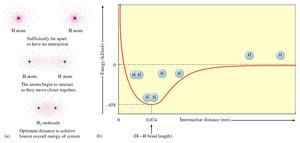
Bond Formation: Atoms bond to lower their potential energy and achieve greater stability.
Types of Chemical Bonds
There are three primary types of chemical bonds: ionic, covalent, and metallic.
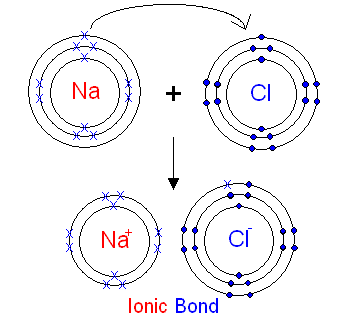
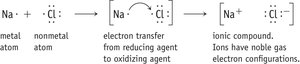
Ionic Bonds: Complete transfer of electrons from a metal (low ionization energy) to a nonmetal (high electron affinity), resulting in oppositely charged ions that attract each other.
Covalent Bonds: Sharing of electrons between two nonmetals. Electrons are shared to achieve an octet in both atoms.
Metallic Bonds: Involves a 'sea' of mobile valence electrons shared among metal atoms.
Valence Electrons and Lewis Dot Structures
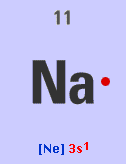
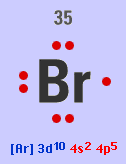
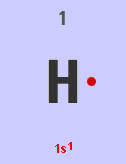
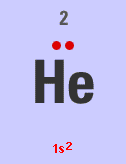
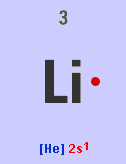
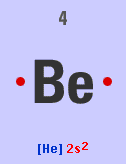
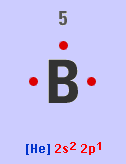
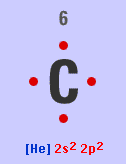
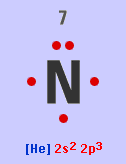
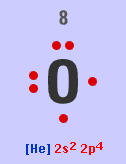
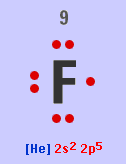
Valence electrons are the outermost electrons involved in bonding. Lewis dot structures are used to represent valence electrons and visualize bonding in molecules.
Lewis Dot Symbols: Dots around an element symbol represent valence electrons.
Lewis Structures: Show how atoms share or transfer electrons to achieve octets.
Ionic Bonding
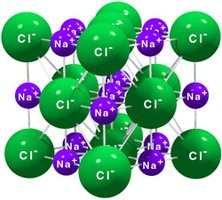
Ionic bonding involves the transfer of electrons from a metal to a nonmetal, forming cations and anions that are held together by electrostatic forces.
Example: Sodium (Na) transfers one electron to chlorine (Cl), forming Na⁺ and Cl⁻ ions.
Properties: Ionic compounds have high melting points due to strong electrostatic attractions.
Covalent Bonding
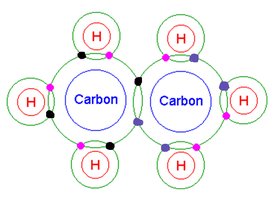
Covalent bonds form when two atoms share one or more pairs of electrons. The shared electrons allow each atom to achieve a stable electron configuration.
Single Bond: One pair of shared electrons (e.g., H₂).
Double Bond: Two pairs of shared electrons (e.g., O₂).
Triple Bond: Three pairs of shared electrons (e.g., N₂).
Electronegativity and Bond Polarity
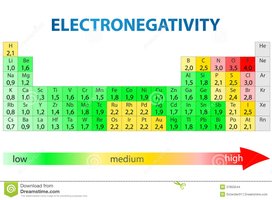
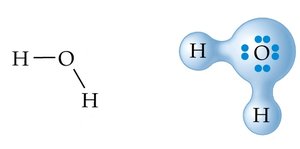
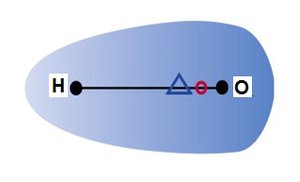
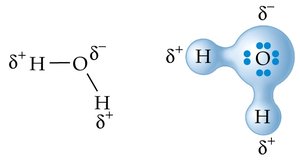
Electronegativity (EN) is the ability of an atom to attract shared electrons in a bond. The difference in EN between two atoms determines bond polarity.
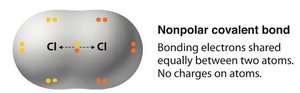
Nonpolar Covalent Bond: Electrons are shared equally (ΔEN = 0–0.4).
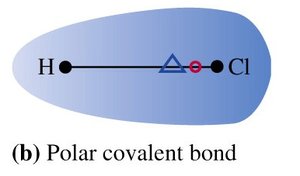
Polar Covalent Bond: Electrons are shared unequally (ΔEN = 0.4–2.0).
Ionic Bond: Electrons are transferred (ΔEN ≥ 2.0).
Coordinate (Dative) Covalent Bonds
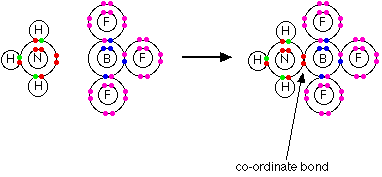
A coordinate covalent bond forms when both electrons in a shared pair come from the same atom. This often occurs when one atom has a lone pair and another atom is electron-deficient.
Example: Ammonia (NH3) donates a lone pair to boron trifluoride (BF3).
Bond Properties
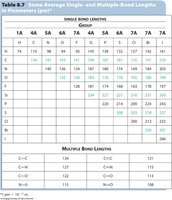
Bond properties include bond length, bond order, and bond strength.
Bond Length: The distance between the nuclei of two bonded atoms. Shorter bonds are generally stronger.
Bond Order: The number of shared electron pairs between two atoms. Higher bond order means stronger, shorter bonds.

Lewis Structures and Resonance
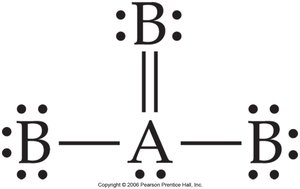
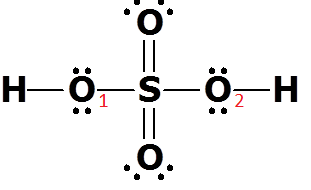
Lewis structures represent the arrangement of electrons in a molecule. Some molecules cannot be represented by a single Lewis structure; instead, resonance structures are used to show delocalized electrons.
Resonance: Occurs when more than one valid Lewis structure can be drawn for a molecule.
Example: Ozone (O₃) and carbonate ion (CO₃²⁻).
Formal Charge
Formal charge helps determine the most stable Lewis structure. It is calculated as:
Formula:
The most stable structure has the smallest formal charges, with negative charges on the most electronegative atoms.
VSEPR Theory and Molecular Geometry
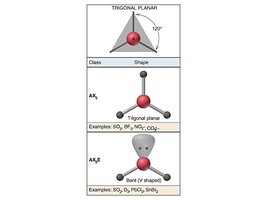
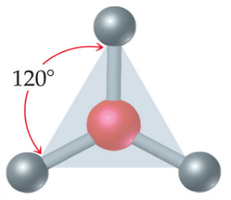
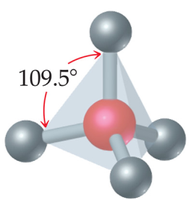
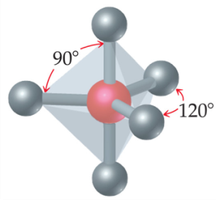
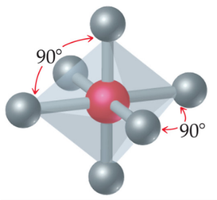
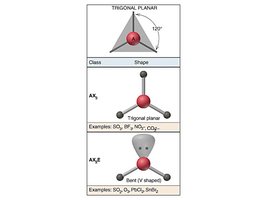
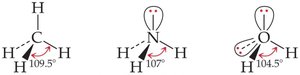
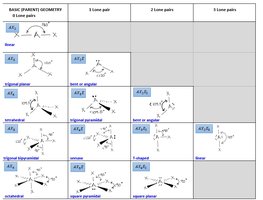
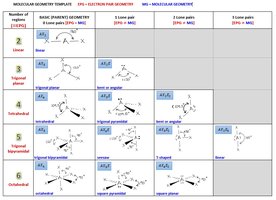
Valence Shell Electron Pair Repulsion (VSEPR) theory predicts the 3D shape of molecules based on the repulsion between electron pairs around a central atom.
Electron Pair Geometry (EPG): Considers all electron pairs (bonding and lone pairs).
Molecular Geometry (MG): Considers only the arrangement of atoms (bonding pairs).
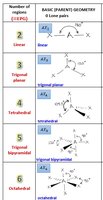
Common Geometries:
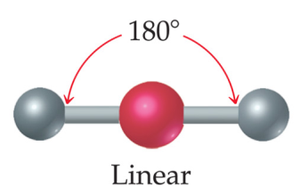
Linear (AX2): 180°
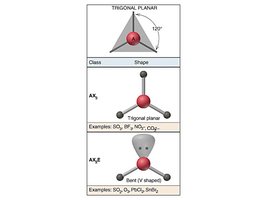
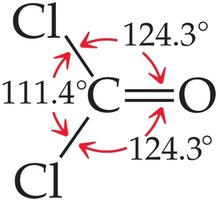
Trigonal Planar (AX3): 120°
Tetrahedral (AX4): 109.5°
Trigonal Bipyramidal (AX5): 90°, 120°
Octahedral (AX6): 90°
Molecular Polarity
Molecular polarity depends on both bond polarity and molecular geometry. A molecule is polar if it has a net dipole moment due to an asymmetrical arrangement of polar bonds.
Nonpolar Molecules: Symmetrical geometry allows bond dipoles to cancel.
Polar Molecules: Asymmetrical geometry results in a net dipole moment.
Practice and Application
Practice drawing Lewis structures, assigning formal charges, predicting molecular geometry, and determining molecular polarity for a variety of molecules and ions. Use VSEPR theory and electronegativity differences to guide your predictions.
Additional info: These notes cover the core concepts of chemical bonding, molecular structure, and related properties, which are foundational for understanding molecular biology, biochemistry, and general chemistry as applied in biological systems.
