 Back
Lecture 4 (Ch.4)
Study Guide - Smart Notes
 Tailored notes based on your materials, expanded with key definitions, examples, and context.
Chemical Context of Life
Atomic Structure and Electron Shells
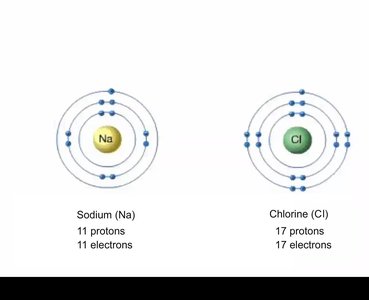
Atoms are the fundamental units of matter, and their properties are determined by the arrangement of electrons in specific electron shells. Atoms with incomplete outer shells, known as valence shells, are chemically reactive and tend to form bonds to achieve stability.
Valence electrons: Electrons in the outermost shell, responsible for chemical bonding.
Reactivity: Atoms with incomplete valence shells seek to fill or empty their outer shell through bonding.
Chemical Bonds
Covalent Bonds
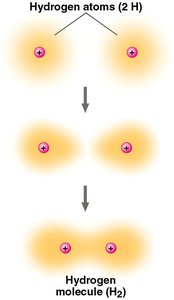
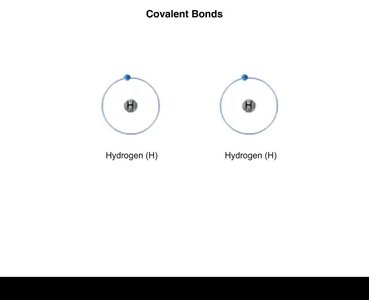
Covalent bonds are formed when two atoms share pairs of valence electrons. This type of bond is fundamental to the structure of biological molecules.
Covalent bond: The sharing of a pair of valence electrons by two atoms.
Molecule: A group of two or more atoms held together by covalent bonds.
Single bond: Sharing of one pair of electrons.
Double bond: Sharing of two pairs of electrons.
Valence: The bonding capacity of an atom (e.g., H = 1, O = 2, N = 3, C = 4).
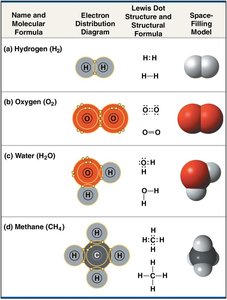
Methods to represent molecules:
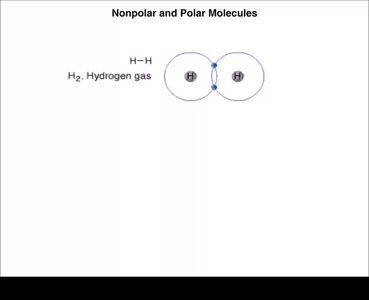
Structural formula: Shows the arrangement of atoms and bonds (e.g., H—H).
Molecular formula: Indicates the number and type of atoms (e.g., H2).
Lewis dot structure: Uses dots to represent valence electrons around element symbols.
Electronegativity and Bond Polarity
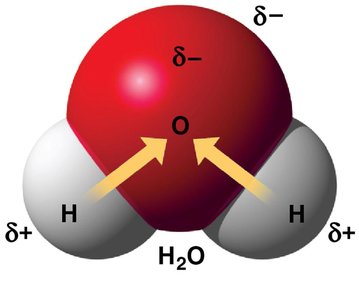
Electronegativity is an atom's ability to attract electrons in a covalent bond. Differences in electronegativity lead to polar and nonpolar covalent bonds.
Nonpolar covalent bond: Electrons are shared equally between atoms (e.g., H2).
Polar covalent bond: Electrons are shared unequally, resulting in partial charges (e.g., H2O).
Ionic Bonds
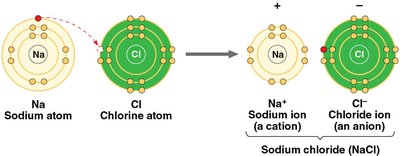
Ionic bonds are formed when one atom transfers electrons to another, resulting in oppositely charged ions that attract each other.
Cation: Positively charged ion (e.g., Na+).
Anion: Negatively charged ion (e.g., Cl-).
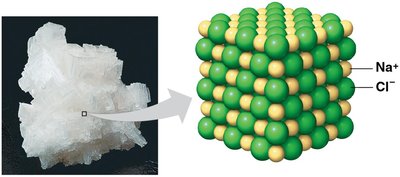
Ionic compound: Compound formed by ionic bonds, such as sodium chloride (NaCl).
Weak Chemical Interactions
In addition to strong covalent and ionic bonds, weak interactions play crucial roles in biological systems. These include hydrogen bonds and van der Waals interactions.
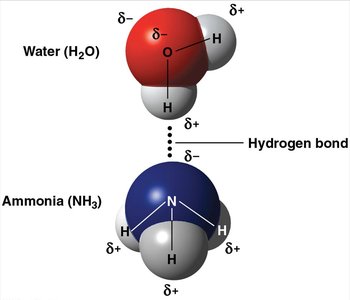
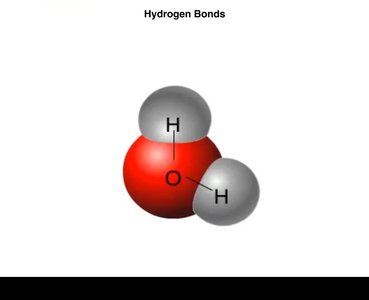
Hydrogen bond: Attraction between a hydrogen atom covalently bonded to an electronegative atom (usually O or N) and another electronegative atom.
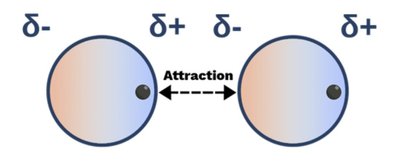
Van der Waals interactions: Weak attractions due to transient local partial charges, including London dispersion forces, dipole-dipole, and dipole-induced dipole interactions.
Molecular Shape and Function
Hybridization of Orbitals and Molecular Geometry
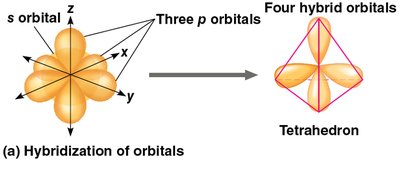
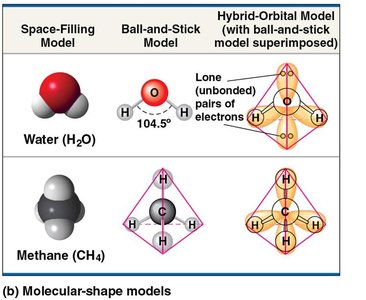
The shape of a molecule is determined by the arrangement of its atoms' orbitals. Covalent bonding often leads to hybridization of atomic orbitals, resulting in specific molecular geometries that are critical for biological function.
Hybrid orbitals: Combination of s and p orbitals to form tetrahedral shapes (e.g., in methane and water).
Molecular shape: Determines how molecules interact and recognize each other (e.g., enzyme-substrate binding).
Chemical Reactions
Making and Breaking Bonds
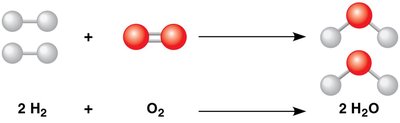
Chemical reactions involve the making and breaking of chemical bonds, transforming reactants into products. All chemical reactions are theoretically reversible, and equilibrium is reached when the forward and reverse reactions occur at the same rate.
Reactants: Starting substances in a chemical reaction.
Products: Substances formed as a result of a chemical reaction.
Chemical equilibrium: State where the concentrations of reactants and products remain constant over time.

Example: Ammonia Formation and Breakdown
The reaction for ammonia synthesis and decomposition is reversible and can be represented as:
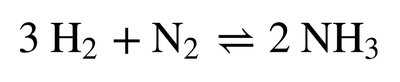
At equilibrium, the rate of ammonia formation equals the rate of its decomposition.
Equilibrium does not mean equal concentrations, but stable ratios of reactants and products.
Summary Table: Types of Chemical Bonds and Interactions
Bond/Interaction | Mechanism | Relative Strength | Biological Importance |
|---|---|---|---|
Covalent Bond | Sharing of electron pairs | Strong | Stabilizes molecules (e.g., DNA, proteins) |
Ionic Bond | Transfer of electrons; attraction between ions | Strong (weaker in water) | Formation of salts, nerve signaling |
Hydrogen Bond | Attraction between H and electronegative atom | Weak (individually) | Stabilizes DNA, protein structure, water properties |
Van der Waals | Transient local charges | Very weak | Stabilizes large molecules, gecko adhesion |
Additional info: This guide expands on the lecture outline by providing definitions, examples, and context for each type of chemical bond and interaction, as well as the importance of molecular shape and chemical equilibrium in biological systems.
