 Back
BackChemical Bonds and Polarity in Biological Molecules
Study Guide - Smart Notes
 Tailored notes based on your materials, expanded with key definitions, examples, and context.
Chemical Bonds and Polarity
Polarity and Dipole Moments
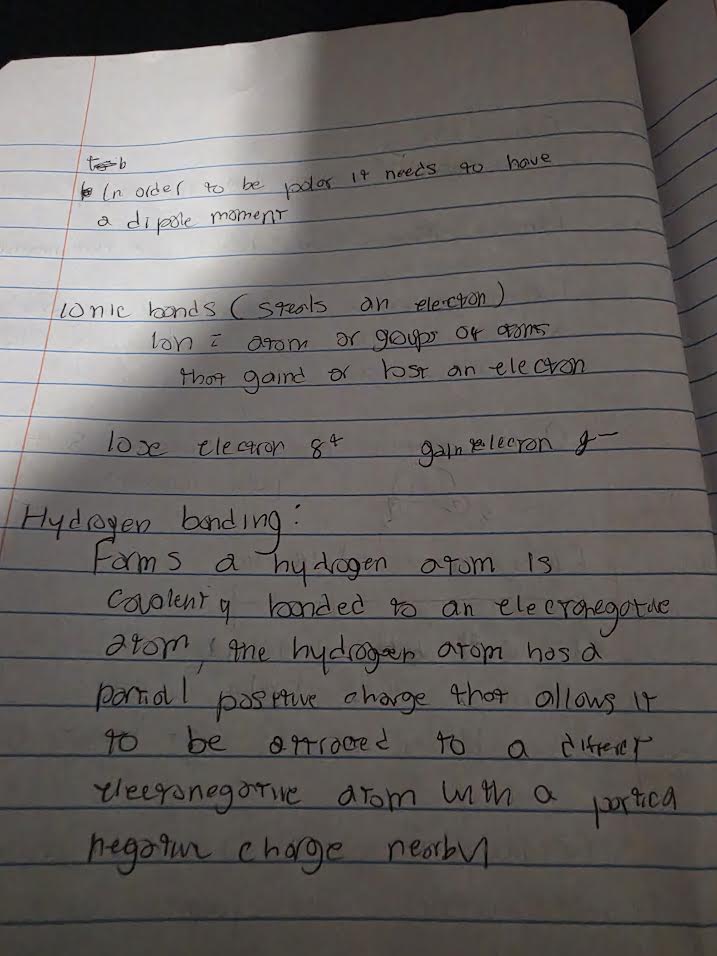
Polarity in molecules is a key concept in understanding how biological molecules interact. For a molecule to be polar, it must have a dipole moment, which is a separation of electrical charge leading to a molecule having a positive end and a negative end.
Dipole Moment: A measure of the separation of positive and negative charges in a molecule.
Polarity: Occurs when there is an uneven distribution of electrons between atoms in a molecule, resulting in partial charges.
Example: Water (H2O) is a polar molecule because oxygen is more electronegative than hydrogen, creating a dipole moment.
Ionic Bonds
Ionic bonds are a type of chemical bond that forms when one atom or group of atoms steals an electron from another, resulting in the formation of ions. These ions are held together by electrostatic attraction.
Ions: Atoms or groups of atoms that have gained or lost one or more electrons, acquiring a net charge.
Cation: An ion that has lost an electron and thus has a positive charge (e.g., Na+).
Anion: An ion that has gained an electron and thus has a negative charge (e.g., Cl-).
Example: Sodium chloride (NaCl) forms when sodium donates an electron to chlorine, resulting in Na+ and Cl- ions.
Hydrogen Bonding
Hydrogen bonds are a special type of weak chemical bond that is crucial in biology, especially in the structure of water, proteins, and nucleic acids. A hydrogen bond forms when a hydrogen atom covalently bonded to an electronegative atom (such as oxygen or nitrogen) has a partial positive charge, allowing it to be attracted to another electronegative atom with a partial negative charge nearby.
Hydrogen Bond: An attraction between a hydrogen atom with a partial positive charge and an electronegative atom with a partial negative charge.
Electronegative Atom: Typically oxygen, nitrogen, or fluorine in biological molecules.
Example: The hydrogen bonds between water molecules give water its unique properties, such as high surface tension and boiling point.
Additional info: Hydrogen bonding is essential for the secondary and tertiary structures of proteins and the double helix structure of DNA.
