 Back
Chemical Context of Life: Foundations for General Biology
Study Guide - Smart Notes
 Tailored notes based on your materials, expanded with key definitions, examples, and context.
Chemical Connection to Biology
Multidisciplinary Nature of Biology
Biology is fundamentally connected to chemistry and physics, as living organisms obey the same physical and chemical laws as non-living matter. Understanding biological processes requires knowledge of chemical principles, such as the behavior of atoms and molecules.
Example: Ants use formic acid to influence plant communities, demonstrating the chemical basis of ecological interactions.
Matter: Anything that occupies space and has mass; organisms are composed of matter.
Elements and Compounds
Definitions and Properties
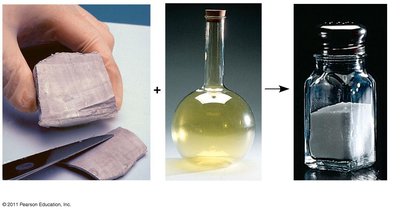
Matter is made up of elements and compounds. Elements are pure substances that cannot be broken down by chemical reactions, while compounds are combinations of two or more elements in fixed ratios.
Element: A substance that cannot be broken down into other substances by chemical reactions.
Compound: A substance consisting of two or more elements in a fixed ratio, with properties different from its constituent elements.
Example: Sodium (Na) and chlorine (Cl) combine to form sodium chloride (NaCl), a compound with properties distinct from either element.
The Elements of Life
Essential Elements and Trace Elements
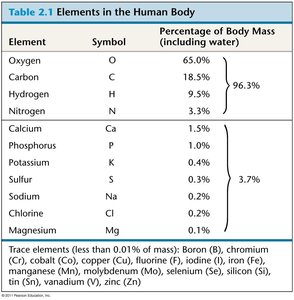
Of the 92 naturally occurring elements, only a subset is essential for life. Four elements—carbon, hydrogen, oxygen, and nitrogen (CHON)—make up the majority of living matter. Other elements are required in smaller amounts, and trace elements are needed in minute quantities.
Essential elements: Carbon, hydrogen, oxygen, and nitrogen constitute about 96% of living matter.
Other important elements: Calcium, phosphorus, potassium, and sulfur make up most of the remaining 4%.
Trace elements: Required in very small amounts (e.g., iron, zinc).
Element | Symbol | Percentage of Body Mass (including water) |
|---|---|---|
Oxygen | O | 65.0% |
Carbon | C | 18.5% |
Hydrogen | H | 9.5% |
Nitrogen | N | 3.3% |
Calcium | Ca | 1.5% |
Phosphorus | P | 1.0% |
Potassium | K | 0.4% |
Sulfur | S | 0.3% |
Sodium | Na | 0.2% |
Chlorine | Cl | 0.2% |
Magnesium | Mg | 0.1% |
Evolution of Tolerance to Toxic Elements
Adaptation to Toxic Environments
Some elements, such as mercury, are toxic to most organisms. However, certain species can adapt to environments containing toxic elements, such as plant communities thriving on serpentine soils rich in chromium, nickel, and cobalt.
Toxic elements: Mercury, chromium, nickel, cobalt.
Adaptation: Some plants and animals evolve mechanisms to tolerate or detoxify these elements.

Atoms and Atomic Structure
Subatomic Particles and Atomic Properties
Each element consists of unique atoms, which are the smallest units retaining the properties of the element. Atoms are composed of subatomic particles: protons, neutrons, and electrons.
Protons: Positively charged; determine the element's identity (atomic number).
Neutrons: No charge; determine isotope.
Electrons: Negatively charged; determine chemical behavior.
Atomic nucleus: Contains protons and neutrons; electrons form a cloud around the nucleus.
Mass number: Total number of protons and neutrons.
Isotopes and Radioactivity
Isotopes and Their Applications
Isotopes are variations of an element with different numbers of neutrons. Radioactive isotopes decay spontaneously, emitting particles and energy. All isotopes of an element behave similarly in chemical reactions.
Isotope: Atoms of the same element with different numbers of neutrons.
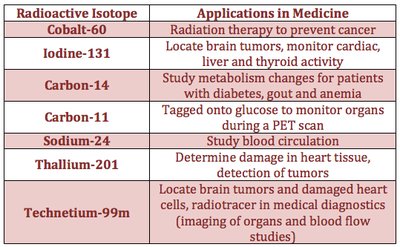
Radioactive isotope: Unstable isotope that decays, used in dating fossils, tracing metabolic processes, and medical diagnostics.
Example: Radioactive glucose is used in PET scans to trace metabolic activity.
Radioactive Isotope | Applications in Medicine |
|---|---|
Cobalt-60 | Radiation therapy to prevent cancer |
Iodine-131 | Locate brain tumors, monitor cardiac, liver, and thyroid activity |
Carbon-14 | Study metabolism changes for patients with diabetes, gout, and anemia |
Carbon-11 | Tagged onto glucose to monitor organs during a PET scan |
Sodium-24 | Study blood circulation |
Thallium-201 | Determine damage in heart tissue, detection of tumors |
Technetium-99m | Locate brain tumors and damaged heart cells, radiotracer in medical diagnostics |
Energy Levels of Electrons
Potential Energy and Electron Shells
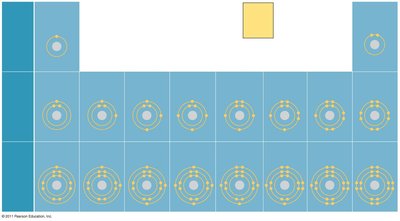
Energy is the capacity to cause change. Electrons possess potential energy based on their location relative to the nucleus. The arrangement of electrons in shells determines their energy levels.
Potential energy: Energy due to position or structure.
Electron shell: Energy level where electrons reside; electrons in higher shells have more energy.
Valence electrons: Electrons in the outermost shell; determine chemical reactivity.
Chemical Bonding
Covalent Bonds
Atoms with incomplete valence shells can share or transfer electrons, forming chemical bonds. Covalent bonds involve the sharing of electron pairs between atoms and are the strongest type of chemical bond.
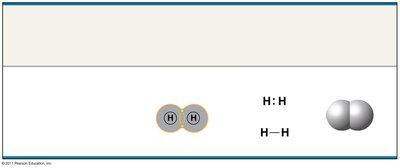
Single covalent bond: Sharing one pair of electrons.
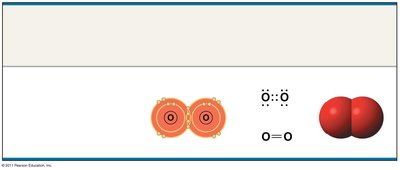
Double covalent bond: Sharing two pairs of electrons.
Molecule: Two or more atoms held together by covalent bonds.
Bond Representation
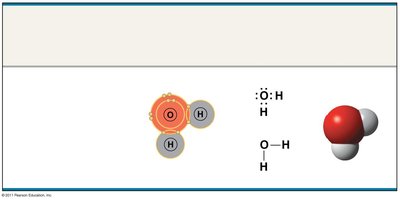
Chemical bonds can be represented using structural formulas, molecular formulas, and space-filling models.
Structural formula: Shows arrangement of atoms and bonds.
Molecular formula: Indicates the types and numbers of atoms.
Electronegativity and Bond Polarity
Electronegativity
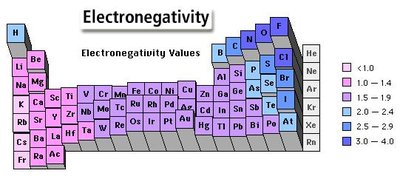
Electronegativity is the ability of an atom to attract electrons in a covalent bond. Differences in electronegativity lead to polar and nonpolar covalent bonds.
Nonpolar covalent bond: Electrons are shared equally.
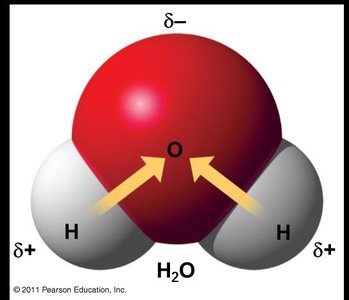
Polar covalent bond: Electrons are shared unequally, resulting in partial charges.
Example: Water (H2O) is a polar molecule due to the higher electronegativity of oxygen.
Ionic Bonds
Formation and Properties
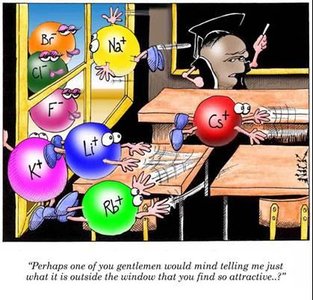
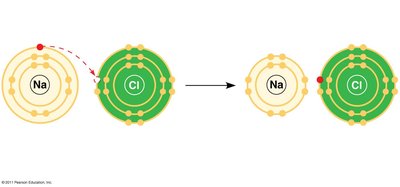
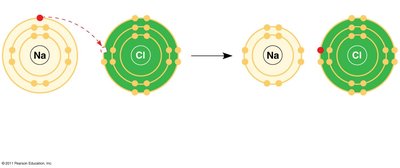
Ionic bonds result from the transfer of electrons between atoms, creating charged ions. These bonds are weaker than covalent bonds and are easily broken in water.
Cation: Positively charged ion.
Anion: Negatively charged ion.
Ionic compound: Formed by ionic bonds, often found as crystals (e.g., NaCl).
Hydrogen Bonds and Van der Waals Interactions
Hydrogen Bonds
Hydrogen bonds form when a hydrogen atom covalently bonded to one electronegative atom is attracted to another electronegative atom. These bonds are important in biological molecules, especially involving oxygen and nitrogen.
Hydrogen bond: Weak attraction between hydrogen and electronegative atoms.
Example: Hydrogen bonding in water and ammonia.
Van der Waals Interactions
Van der Waals interactions are weak attractions between molecules or atoms due to temporary "hot spots" of charge. These interactions help stabilize molecular shapes and are important in large biological molecules.
Van der Waals interaction: Weak, transient attraction between molecules.
Molecular Shape and Function
Shape Determines Function
The shape of a molecule is determined by the positions of its atoms' valence orbitals. Molecular shape is crucial for biological recognition and function, as molecules with similar shapes can have similar effects.
Example: Morphine and endorphins have similar shapes and can bind to the same receptors in the brain.
Chemical Reactions
Reactants, Products, and Equilibrium
Chemical reactions involve the making and breaking of chemical bonds. The starting substances are reactants, and the resulting substances are products. All chemical reactions are reversible, and equilibrium is reached when the rates of forward and reverse reactions are equal.
Reactant: Starting molecule in a chemical reaction.
Product: Final molecule in a chemical reaction.
Chemical equilibrium: State where forward and reverse reaction rates are stable.
Example: Photosynthesis:
