 Back
Chemical Energy and Cellular Respiration: ATP and Food Energy
Study Guide - Smart Notes
 Tailored notes based on your materials, expanded with key definitions, examples, and context.
Chemical Energy
Introduction to Chemical Energy
Chemical energy is a form of potential energy stored in the bonds of molecules. In biological systems, this energy is essential for powering cellular processes and maintaining life.
Chemical energy is released during the breakdown of organic molecules.
Cells convert chemical energy into usable forms, primarily ATP.
Chemical Energy and ATP
ATP: The Cellular Energy Currency
ATP (adenosine triphosphate) is the primary molecule used by cells to store and transfer energy. It is produced during cellular respiration, which transfers energy from organic molecules such as glucose to ATP.
ATP is used for cellular work, including muscle contraction, active transport, and biosynthesis.
Cellular respiration is complementary to photosynthesis; photosynthesis stores energy in glucose, while respiration releases it for cellular use.
ATP-ADP Cycle
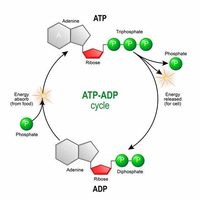
The ATP-ADP cycle describes how ATP is continuously regenerated and used in cells.
ATP is hydrolyzed to ADP (adenosine diphosphate) and inorganic phosphate, releasing energy for cellular activities.
ADP can be recharged to ATP by adding a phosphate group, using energy from food.
Energy Transfer in Biological Systems
Flow of Energy from Sun to Cells
Energy flows from the sun to living organisms through a series of processes.
Sunlight is captured by plants during photosynthesis to produce glucose.
Animals, such as cows, consume plants and use glucose in cellular respiration to produce ATP.

Analyzing Energy Content in Food
Calories and Macronutrients
The energy content of food is measured in calories. Different macronutrients provide varying amounts of energy per gram.
Proteins and carbohydrates: 4 calories per gram
Fats: 9 calories per gram
Carbohydrates are most commonly broken down to make ATP.
Fat is used for energy storage due to its high calorie density and ability to yield more ATP per unit mass.
Proteins are primarily used for building new proteins rather than energy.
Summary Table: Energy Content of Macronutrients
Macronutrient | Calories per Gram | Main Function |
|---|---|---|
Carbohydrates | 4 | Quick energy, ATP production |
Fats | 9 | Energy storage, high ATP yield |
Proteins | 4 | Building new proteins, less for energy |
Cellular Respiration
Definition and Importance
Cellular respiration is the process by which cells extract energy from organic molecules, primarily glucose, to produce ATP.
Occurs in all living cells.
Provides energy for essential cellular functions.
Key Equation for Cellular Respiration
The overall equation for cellular respiration is: Glucose and oxygen are converted to carbon dioxide, water, and ATP.
Complementarity of Photosynthesis and Cellular Respiration
Relationship Between Processes
Photosynthesis stores energy from sunlight in glucose.
Cellular respiration releases energy from glucose for cellular use.
These processes form a cycle that sustains life on Earth.
Summary
Chemical energy is essential for life, stored in molecules and released as ATP.
ATP is the energy currency of the cell, produced by cellular respiration.
Food provides energy in the form of calories, with fats being the most energy-dense.
Cellular respiration and photosynthesis are complementary processes in the energy cycle of living organisms.
