 Back
Chemical Tools and Atomic Structure: Foundations for General Biology
Study Guide - Smart Notes
 Tailored notes based on your materials, expanded with key definitions, examples, and context.
Chemical Tools: Experimentation and Measurement
SI Units and Measurement
The International System of Units (SI) is the standard for scientific measurement, providing consistency across disciplines. Understanding SI units is essential for accurate experimentation and data analysis in biology and chemistry.
Mass: measured in kilograms (kg), grams (g), milligrams (mg)
Length: measured in meters (m), centimeters (cm), millimeters (mm)
Temperature: measured in Kelvin (K), Celsius (°C), Fahrenheit (°F)
Volume: measured in liters (L), milliliters (mL)
Density: measured in grams per cubic centimeter (g/cm3)
SI Prefixes
SI prefixes denote multiples or fractions of units, facilitating measurement across scales.
Giga (G):
Mega (M):
Kilo (k):
Deci (d):
Centi (c):
Milli (m):
Micro (\mu):
Nano (n):
Temperature Conversion
Temperature can be converted between Fahrenheit, Celsius, and Kelvin using the following equations:
Celsius to Kelvin:
Celsius to Fahrenheit:
Fahrenheit to Celsius:
Accuracy vs. Precision
Accuracy refers to how close a measurement is to the true value, while precision describes the reproducibility of measurements.
Accurate measurements are close to the accepted value.
Precise measurements are consistent with each other.
Significant Figures
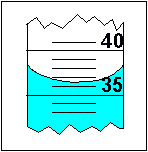
Significant figures indicate the certainty of a measurement. Proper use of significant figures is crucial for reporting scientific data.
All nonzero digits are significant.
Zeroes between numbers are significant.
Leading zeroes are not significant.
Trailing zeroes after a decimal are significant.
Trailing zeroes before a decimal are ambiguous; use scientific notation to clarify.
Example: 41.2 mg (3 sig figs), 4.803 cm (4 sig figs), 0.00661 mL (3 sig figs), 55.220 K (5 sig figs), 3.42 × 10⁴ m (3 sig figs)
Significant Figures in Calculations
Multiplication/Division: Result has the same number of sig figs as the factor with the fewest.
Addition/Subtraction: Result has the same number of decimal places as the quantity with the fewest.
Rounding: Round down if the dropped digit is 4 or less; round up if 5 or more.
In multistep calculations, round only after the final step.
Dimensional Analysis
Dimensional analysis uses conversion factors to convert between units. It is a systematic approach to solving measurement problems.
Conversion factor: Relationship between two units (e.g., 1 m = 39.37 in)
General approach: Read the problem, identify what is asked and provided, layout steps, solve, check answer, and ensure it makes sense.
Example: To convert 2.5 meters to inches:
The Structure and Stability of Atoms
Physical vs. Chemical Properties
Properties of matter are classified as physical or chemical:
Physical properties: Characteristics of state or appearance (e.g., mass, volume, density).
Chemical properties: Describe how a substance reacts to form other substances.
Physical changes: Alter state or appearance without changing composition.
Chemical changes: Result in a change in chemical composition.
Extensive vs. Intensive Properties
Extensive properties: Depend on the amount of substance (e.g., mass, volume).
Intensive properties: Independent of the amount of substance (e.g., density).
Classification of Matter
Matter is anything that has mass and takes up space. It can be classified as pure substances or mixtures:
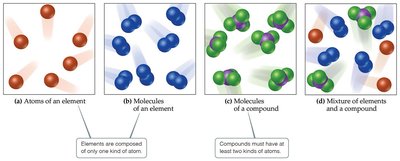
Pure substance: Made up of only one type of atom or molecule.
Element: A single type of atom.
Compound: More than one atom chemically bonded together.
Mixture: Made up of more than one type of atom or molecule.
Heterogeneous mixture: Composition varies by region.
Homogeneous mixture: Composition is uniform.
States of Matter
Solid: Fixed volume and shape; particles are ordered.
Liquid: Fixed volume, not shape; particles move freely.
Gas: Neither volume nor shape fixed; mostly empty space; particles move freely.
Atoms, Elements, and Compounds
Atoms are the basic units of matter. Elements are composed of only one kind of atom, while compounds consist of at least two kinds of atoms chemically bonded.
Common Elements and Their Symbols
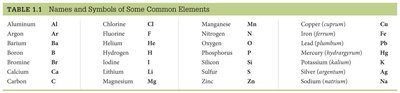
Table 1.1 lists the names and symbols of some common elements:
Element | Symbol |
|---|---|
Aluminum | Al |
Argon | Ar |
Barium | Ba |
Boron | B |
Bromine | Br |
Calcium | Ca |
Carbon | C |
Chlorine | Cl |
Fluorine | F |
Helium | He |
Hydrogen | H |
Iodine | I |
Lithium | Li |
Magnesium | Mg |
Manganese | Mn |
Nitrogen | N |
Oxygen | O |
Phosphorus | P |
Silicon | Si |
Sulfur | S |
Zinc | Zn |
Copper | Cu |
Iron | Fe |
Lead | Pb |
Mercury | Hg |
Potassium | K |
Silver | Ag |
Sodium | Na |
The Periodic Table and Periodic Law
The periodic table organizes elements by increasing atomic number, revealing recurring properties. The periodic law states that properties of elements recur periodically when arranged by increasing mass.
Groups (families): Vertical columns; elements in a group have similar chemical properties.
Periods: Horizontal rows; properties vary widely across a period.
Classification of Elements
Metals: Metallic luster, conduct heat and electricity, malleable.
Nonmetals: Dull luster, nonconductors, brittle.
Semimetals (Metalloids): Properties of both metals and nonmetals; some are semiconductors.
Major Groups in the Periodic Table
Alkali Metals: Very reactive metals in Group 1.
Alkaline Earth Metals: Reactive metals in Group 2.
Transition Metals: Groups 3-12; variable properties.
Halogens: Very reactive nonmetals in Group 17.
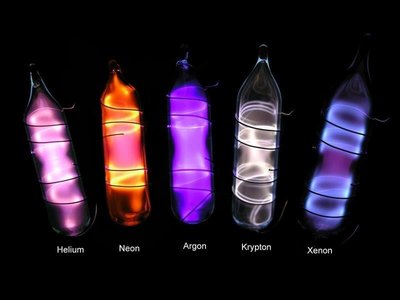
Noble Gases: Nonreactive nonmetals in Group 18.
Example: Sodium (Na) reacts vigorously with water to form sodium hydroxide and hydrogen gas:
Periodic Table Classifications
The periodic table visually distinguishes metals, nonmetals, and semimetals. Elements are classified based on their physical and chemical properties.
Relative Abundance of Elements
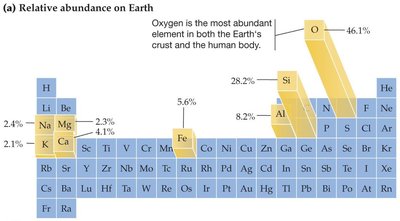
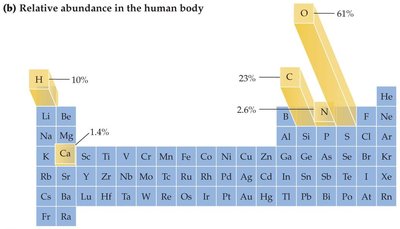
Some elements are more abundant in the Earth's crust and human body than others. Oxygen is the most abundant element in both.
Earth's crust: Oxygen (46.1%), Silicon (28.2%), Aluminum (8.2%), Iron (5.6%)
Human body: Oxygen (61%), Carbon (23%), Hydrogen (10%), Nitrogen (2.6%), Calcium (1.4%)
Atomic Structure in the Periodic Table
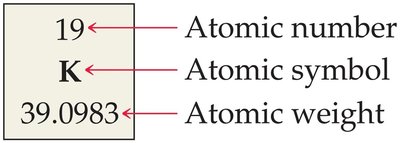
Each element is represented by its atomic number, symbol, and atomic weight.
Atomic number: Number of protons in the nucleus.
Atomic symbol: One or two-letter abbreviation.
Atomic weight: Average mass of atoms of an element.
Summary Table: Properties of Metals, Nonmetals, and Semimetals
Type | Properties |
|---|---|
Metals | Metallic luster, conduct heat/electricity, malleable |
Nonmetals | Dull luster, nonconductors, brittle |
Semimetals | Intermediate properties, some are semiconductors |
Example: Silicon (Si) is a semimetal used in electronics due to its semiconductor properties.
*Additional info: The notes expand on the original content by providing definitions, examples, and context for each topic, ensuring completeness and academic quality.*
