 Back
Chemical Tools: Experimentation and Measurement – Foundations for Biology
Study Guide - Smart Notes
 Tailored notes based on your materials, expanded with key definitions, examples, and context.
Introduction to Measurement in Science
Accurate measurement is fundamental to all scientific disciplines, including biology. Understanding units, measurement tools, and the principles of accuracy and precision ensures reliable data collection and interpretation in experiments.
SI Units and Measurement Systems
Fundamental SI Units
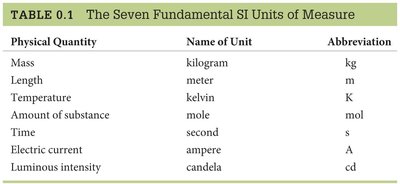
The International System of Units (SI) is the standard system used in science for consistency and clarity. There are seven base SI units, each corresponding to a fundamental physical quantity.
Physical Quantity | Name of Unit | Abbreviation |
|---|---|---|
Mass | kilogram | kg |
Length | meter | m |
Temperature | kelvin | K |
Amount of substance | mole | mol |
Time | second | s |
Electric current | ampere | A |
Luminous intensity | candela | cd |
Metric Prefixes
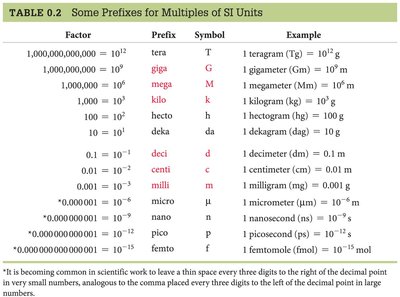
Metric prefixes are used to express multiples or fractions of SI units, making it easier to handle very large or small quantities.
Factor | Prefix | Symbol | Example |
|---|---|---|---|
109 | giga | G | 1 gigameter (Gm) = 109 m |
106 | mega | M | 1 megameter (Mm) = 106 m |
103 | kilo | k | 1 kilogram (kg) = 103 g |
10-1 | deci | d | 1 decimeter (dm) = 0.1 m |
10-2 | centi | c | 1 centimeter (cm) = 0.01 m |
10-3 | milli | m | 1 milligram (mg) = 0.001 g |
10-6 | micro | μ | 1 micrometer (μm) = 10-6 m |
10-9 | nano | n | 1 nanometer (nm) = 10-9 m |
Global Use of Measurement Systems
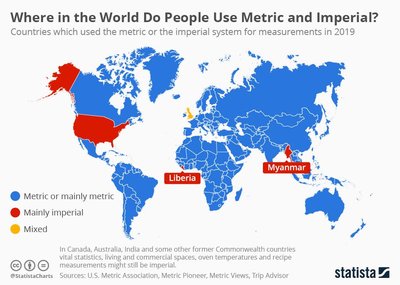
Most countries use the metric system, but a few, such as the United States, Liberia, and Myanmar, primarily use the imperial system. This can lead to confusion and errors in international scientific and engineering projects.
Importance of Units
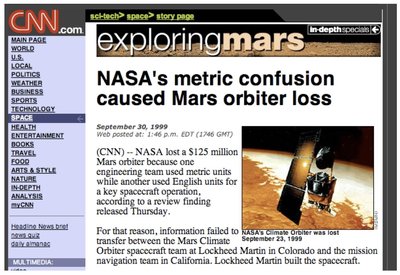
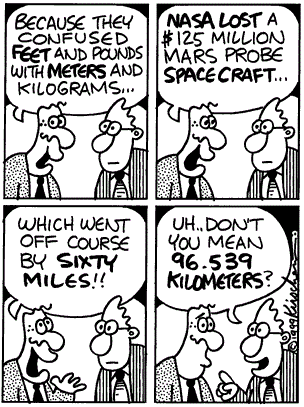
Using correct units is essential for clear communication and avoiding costly mistakes. For example, NASA lost a Mars orbiter due to a mix-up between metric and imperial units.
Measurement of Physical Quantities
Measuring Mass
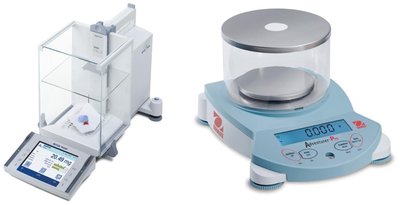
Mass is the amount of matter in an object, measured in kilograms (kg) or grams (g). Weight is the force of gravity on an object and depends on location. Balances and scales are used to measure mass in the laboratory.
Measuring Length
The definition of the meter has evolved over time, from a fraction of the Earth's meridian to the distance light travels in a vacuum in a specific fraction of a second. Standard meter bars were once used as physical references.

Measuring Temperature
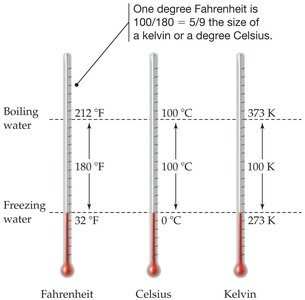
Temperature can be measured in Celsius (°C), Fahrenheit (°F), or Kelvin (K). The Kelvin scale is the SI unit for temperature and is used in scientific contexts. Conversion formulas are as follows:
Derived Units
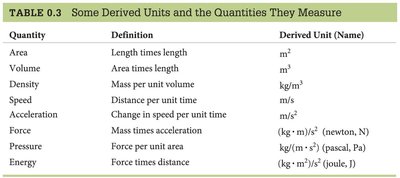
Many scientific quantities are measured using derived units, which are combinations of the seven base SI units. Common derived units include:
Quantity | Definition | Derived Unit (Name) |
|---|---|---|
Area | Length × Length | m2 |
Volume | Area × Length | m3 |
Density | Mass per unit volume | kg/m3 |
Speed | Distance per unit time | m/s |
Force | Mass × Acceleration | (kg·m)/s2 (newton, N) |
Pressure | Force per unit area | kg/(m·s2) (pascal, Pa) |
Energy | Force × Distance | (kg·m2)/s2 (joule, J) |
Measuring Volume
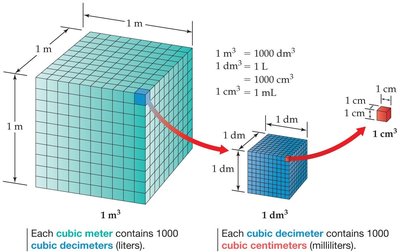
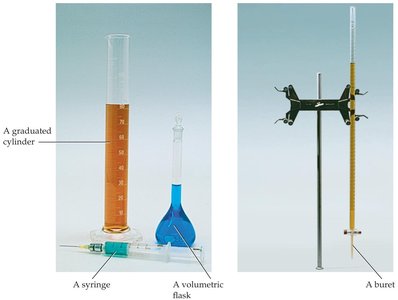
Volume is the amount of space an object occupies. The SI unit is the cubic meter (m3), but liters (L) and milliliters (mL) are commonly used in biology and chemistry. Laboratory glassware such as graduated cylinders, volumetric flasks, and burets are used for precise volume measurements.
Measuring Density
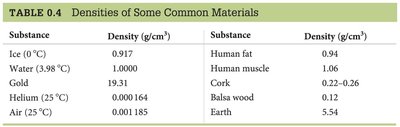
Density is defined as mass per unit volume. It is calculated using the formula:
Density is a useful property for identifying substances and is commonly measured in g/cm3 or g/mL.
Accuracy, Precision, and Significant Figures
Accuracy vs. Precision
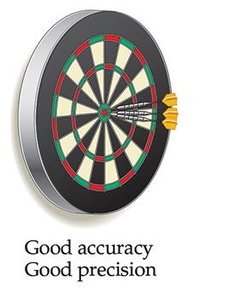
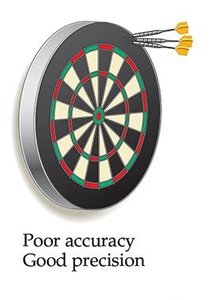
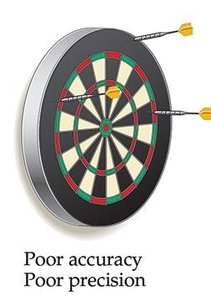
Accuracy refers to how close a measurement is to the true value. Precision refers to how reproducible measurements are, regardless of their closeness to the true value. Errors can be random (varying in both directions) or systematic (consistently high or low).
Good accuracy and good precision: Measurements are both close to the true value and to each other.
Poor accuracy, good precision: Measurements are close to each other but not to the true value.
Poor accuracy, poor precision: Measurements are neither close to each other nor to the true value.
Significant Figures
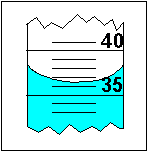
Significant figures (sig figs) reflect the certainty of a measurement. The rules for counting significant figures are:
All nonzero digits are significant.
Zeroes between nonzero digits are significant.
Leading zeroes are not significant.
Trailing zeroes after a decimal point are significant.
Trailing zeroes before a decimal point are ambiguous; use scientific notation to clarify.
When performing calculations:
For multiplication/division: The result has the same number of sig figs as the factor with the fewest.
For addition/subtraction: The result has the same number of decimal places as the quantity with the fewest decimal places.
Round only at the end of multistep calculations.
Dimensional Analysis and Problem Solving
Dimensional Analysis
Dimensional analysis is a systematic method for converting between units using conversion factors. It ensures that calculations are consistent and units are properly handled. The general approach is:
Read the problem carefully.
Identify what is being asked and what is provided.
Lay out the steps and conversion factors needed.
Solve, keeping track of units and significant figures.
Check that the answer makes sense.
Example: To convert 2.5 meters to inches, use the conversion factor 1 m = 39.37 in:
Dimensional analysis is essential for solving real-world problems in biology, chemistry, and physics, such as calculating dosages, concentrations, and rates.
Practice Problems and Applications
Convert 335 g to kg.
Convert 63.0 μL to mL.
Convert 2.41 cm to nm.
Calculate the density of a metal sample given its mass and volume displacement.
Apply significant figure rules in calculations and report answers with correct units.
Mastery of these measurement concepts is foundational for success in all laboratory sciences, including biology.
