 Back
Chemistry and Water: Foundations for Biological Systems
Study Guide - Smart Notes
 Tailored notes based on your materials, expanded with key definitions, examples, and context.
Ch. 2 – Chemistry and Water (From a Biologist’s Perspective)
Introduction
This chapter explores the chemical principles essential for understanding biological systems, focusing on atomic structure, chemical bonding, water’s properties, acids and bases, and the energetic basis of biochemical reactions. Mastery of these concepts is foundational for all subsequent topics in biology.
Atomic Structure
Subatomic Particles
Protons: Positively charged particles found in the nucleus; define the atomic number and identity of an element. Mass = 1 Da (Dalton) or amu (atomic mass unit).
Neutrons: Neutral particles in the nucleus; add mass and stabilize the nucleus by reducing repulsion between protons. Mass = 1 Da/amu. Varying neutron number creates isotopes.
Electrons: Negatively charged particles orbiting the nucleus in shells; determine chemical behavior and bonding. Mass is negligible compared to protons and neutrons.
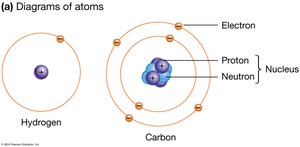
Atomic Abbreviations and Isotopes
Isotopes: Atoms of the same element with different numbers of neutrons (e.g., 12C, 13C, 14C).
Some isotopes are radioactive or magnetically active, making them useful in biological research (e.g., radiolabeling).
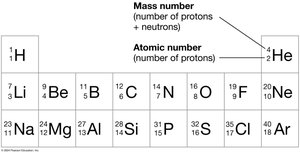
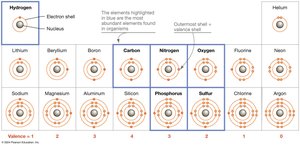
The Periodic Table and Valence Electrons
Elemental Abundance and Valence
Four elements—hydrogen (H), carbon (C), nitrogen (N), and oxygen (O)—make up 96% of living matter.
Valence electrons are the outermost electrons and determine an atom’s bonding behavior.
Groups (columns) in the periodic table indicate the number of valence electrons.
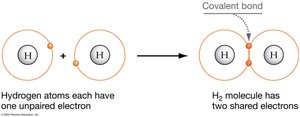
Chemical Bonding
Types of Bonds
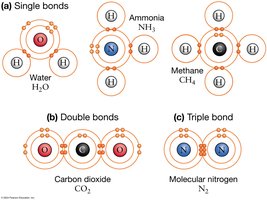
Covalent bonds: Atoms share electrons to fill their valence shells. Can be single, double, or triple bonds.
Ionic bonds: Electrons are transferred from one atom to another, creating oppositely charged ions that attract each other.
Hydrogen bonds: Weak attractions between a hydrogen atom with a partial positive charge and an electronegative atom (usually O or N) with a partial negative charge.
Hydrophobic interactions: Nonpolar molecules cluster together in water, not due to a true bond but because water excludes them.
Electronegativity and Bond Polarity
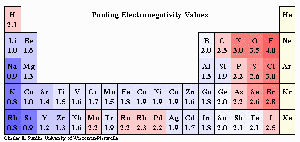
Electronegativity: The tendency of an atom to attract shared electrons. Increases with more protons and smaller atomic radius.
Oxygen is the most electronegative common biological element, followed by nitrogen, then carbon, hydrogen, sulfur, and phosphorus.
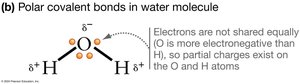
Polar covalent bonds: Electrons are shared unequally, creating partial charges (dipoles).
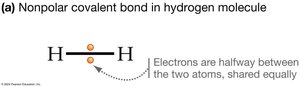
Nonpolar covalent bonds: Electrons are shared equally; no partial charges.
Hydrophobic Interactions
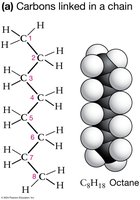
Nonpolar molecules (e.g., hydrocarbons like octane) do not dissolve in water and cluster together due to water’s polarity.
These interactions are critical for the formation of biological membranes.
Ionic Bonds
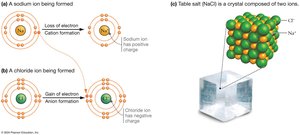
Formed by the transfer of electrons, resulting in cations (positive) and anions (negative) that attract each other.
Example: Sodium chloride (NaCl) forms from Na+ and Cl-.
The Importance of Water in Biology
Properties of Water
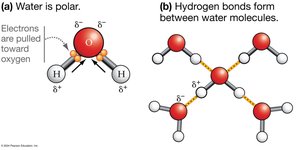
Water is a polar molecule, allowing it to form hydrogen bonds with itself and other polar molecules.
Hydrogen bonding gives water unique properties essential for life.
Biological Roles of Hydrogen Bonds
Stabilize the DNA double helix by holding complementary base pairs together.
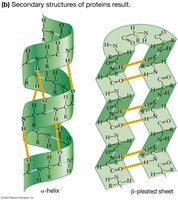
Maintain protein secondary structures (α-helix and β-pleated sheet).
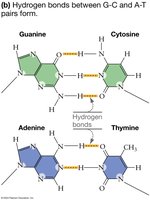
Solubility: Hydrophilic vs. Hydrophobic
Hydrophilic: Polar molecules and ions dissolve in water due to favorable interactions with water’s partial charges.
Hydrophobic: Nonpolar molecules do not dissolve in water and are excluded by it.
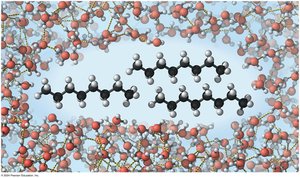
Dissolving Ionic Compounds
Ionic compounds dissolve in water via ion-dipole interactions, where water molecules surround and stabilize individual ions (hydration shell).
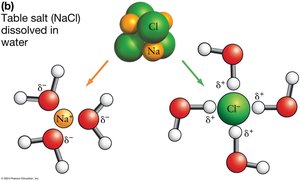
Emergent Properties of Water
Solvent ability: Water dissolves many substances, facilitating biochemical reactions.
Cohesion and adhesion: Water molecules stick to each other (cohesion) and to other surfaces (adhesion), enabling processes like water transport in plants.
Surface tension: Allows small organisms to move on water’s surface.
Density anomaly: Ice is less dense than liquid water, so it floats and insulates aquatic life.
High specific heat and heat of vaporization: Water absorbs and releases heat slowly, stabilizing temperatures in organisms and environments.
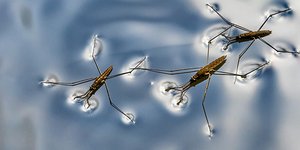

Acids, Bases, and pH
Definitions and Properties
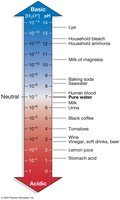
Acid: A molecule that donates a proton (H+).
Base: A molecule that accepts a proton (H+).
Water can act as both an acid and a base, leading to the concept of pH.
pH: A measure of hydrogen ion concentration;
Buffers and Homeostasis
Buffers: Substances that minimize changes in pH by absorbing or releasing H+ ions.
Example: The carbonic acid/bicarbonate buffer system in blood helps maintain physiological pH.
Energy and Entropy in Biological Systems
Types of Energy
Potential energy: Stored energy, often in chemical bonds.
Kinetic energy: Energy of motion.
Chemical energy: A form of potential energy stored in bonds.
Thermal energy: Kinetic energy of molecular motion.
Bond Polarity, Length, and Stability
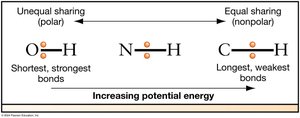
Polar bonds (e.g., O–H) are shorter and stronger, with lower potential energy.
Nonpolar bonds (e.g., C–H) are longer and weaker, with higher potential energy.
Breaking bonds requires energy; energy is released when new, more stable bonds form.
Spontaneity of Chemical Reactions
Spontaneous reactions: Occur without external input if products have lower potential energy and/or higher entropy (disorder).
Gibbs free energy () determines spontaneity:
Negative indicates a spontaneous reaction.
Key Terms: Enthalpy (), Entropy (), Temperature ( in Kelvin)
Functional Groups in Biological Molecules
Common Functional Groups
Hydroxyl (–OH): Found in alcohols; polar and hydrophilic.
Carbonyl (C=O): Found in aldehydes and ketones; polar.
Carboxyl (–COOH): Acidic; found in amino acids and fatty acids.
Amino (–NH2): Basic; found in amino acids.
Sulfhydryl (–SH): Found in some amino acids; forms disulfide bonds.
Phosphate (–PO4): Found in nucleic acids and ATP; acidic and hydrophilic.
Condensation and Hydrolysis Reactions
Condensation (dehydration) reactions: Join monomers by removing water.
Hydrolysis reactions: Break polymers into monomers by adding water.
Additional info: Understanding these chemical principles is essential for grasping the structure and function of biological macromolecules, cellular processes, and metabolic pathways.
