 Back
Chemistry Comes to Life: Foundations for General Biology
Study Guide - Smart Notes
 Tailored notes based on your materials, expanded with key definitions, examples, and context.
Chemistry Comes to Life
Nature of Atoms and Matter
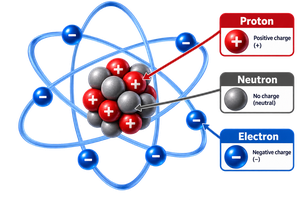
All living and nonliving things are composed of matter, which is anything that takes up space and has mass. Matter exists in three primary states: solids, liquids, and gases. The fundamental unit of matter is the atom, which is composed of three subatomic particles: protons, neutrons, and electrons.
Protons: Positively charged particles located in the nucleus.
Neutrons: Neutral particles also found in the nucleus.
Electrons: Negatively charged particles that move in a 'cloud' around the nucleus.
Elements and the Periodic Table
An element is a pure substance consisting of only one type of atom. Each element is defined by its atomic number (the number of protons in its nucleus). The periodic table organizes elements by their properties and atomic numbers. The atomic mass is the sum of protons and neutrons in an atom.
Group Number: Columns of elements with similar chemical properties.
Atomic Number: Number of protons in the atom.
Atomic Mass: Number of protons plus neutrons.
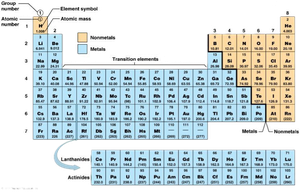
The four most common elements in the human body are carbon (C), hydrogen (H), oxygen (O), and nitrogen (N).
Compounds and Chemical Bonds
Molecules and Compounds
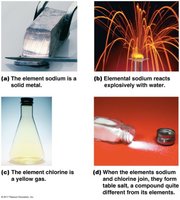
A molecule is formed when two or more atoms bond together. If the atoms are of different elements, the molecule is also a compound. For example, O2 is a molecule but not a compound, while H2O is both a molecule and a compound.
Molecule: Two or more atoms bonded together (can be the same or different elements).
Compound: Two or more different elements chemically combined.
Chemical Bonds
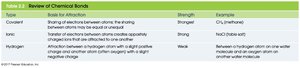
Chemical bonds hold atoms together in molecules and compounds. The three main types of chemical bonds are covalent, ionic, and hydrogen bonds.
Type | Basis for Attraction | Strength | Examples |
|---|---|---|---|
Covalent | Sharing of electrons between atoms | Strongest | O2, methane |
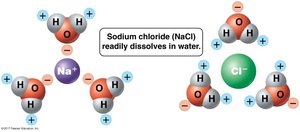
Ionic | Attraction between oppositely charged ions | Strong | NaCl (table salt) |
Hydrogen | Attraction between hydrogen atom with slight positive charge and another atom with slight negative charge | Weak | Between water molecules |
Covalent Bonds
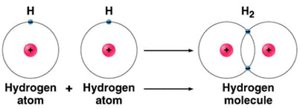
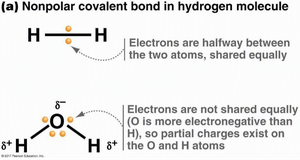
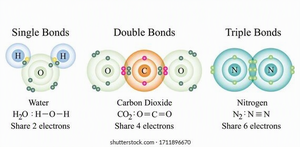
Covalent bonds involve the sharing of electrons between atoms. The number of shared electron pairs determines whether the bond is single, double, or triple. Differences in electronegativity (an atom's ability to attract electrons) determine if the bond is nonpolar (equal sharing) or polar (unequal sharing).
Nonpolar Covalent Bond: Electrons are shared equally (e.g., H2).
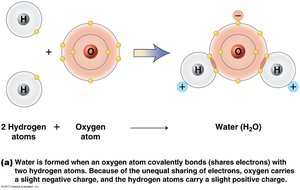
Polar Covalent Bond: Electrons are shared unequally, creating partial charges (e.g., H2O).
Ionic Bonds
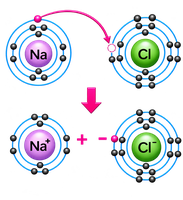
Ionic bonds form when electrons are transferred from one atom to another, resulting in the formation of ions. Cations are positively charged ions, and anions are negatively charged ions. The mutual attraction between oppositely charged ions forms an ionic bond.
Cation: Positively charged ion (e.g., Na+).
Anion: Negatively charged ion (e.g., Cl-).
Hydrogen Bonds
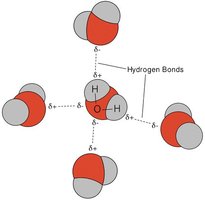
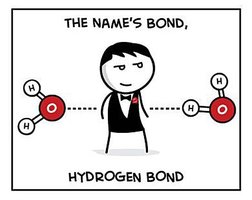
Hydrogen bonds are weak attractions between the slightly positive hydrogen atom of one molecule and the slightly negative atom (often oxygen or nitrogen) of another molecule. These bonds are crucial for the properties of water and the structure of biological molecules like DNA and proteins.
Water and Its Importance in Life
Properties of Water
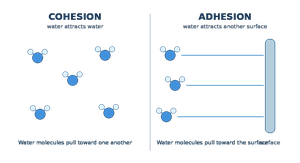
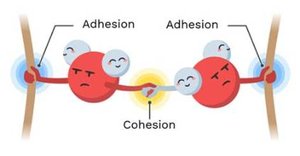
Water's unique properties arise from its polarity and ability to form hydrogen bonds. Oxygen is slightly negative, while hydrogen is slightly positive, allowing water molecules to attract each other and other substances.
Cohesion: Water molecules stick to each other.
Adhesion: Water molecules stick to other substances.
High Heat Capacity: Water can absorb a lot of heat before changing temperature.
High Heat of Vaporization: Water requires a lot of energy to evaporate.
Solvent Properties: Water dissolves many substances, making it essential for biological reactions.
Acids, Bases, and pH
pH Scale
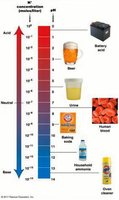
The pH scale measures the concentration of hydrogen ions (H+) in a solution. Acids increase H+ concentration (lower pH), while bases decrease H+ concentration (higher pH). The scale ranges from 0 (most acidic) to 14 (most basic), with 7 being neutral.
Acid: Releases H+ ions in water.
Base: Reduces H+ ions, often by releasing OH- ions.
Buffers
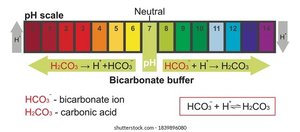
Buffers are substances that minimize changes in pH by absorbing or releasing H+ ions. The carbonic acid-bicarbonate system is a key buffer in human blood, maintaining pH within a narrow range.
Carbonic Acid (H2CO3): Can release H+ to lower pH.
Bicarbonate Ion (HCO3-): Can absorb H+ to raise pH.
Key equation:
Major Molecules of Life
Organic Molecules and Macromolecules
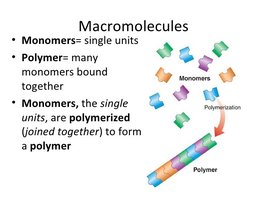
Organic molecules are carbon-based and form the basis of life. Macromolecules are large molecules made by joining smaller units called monomers. The process of joining monomers is called polymerization, and the resulting large molecule is a polymer.
Monomer: Single molecular unit.
Polymer: Large molecule made of many monomers.
Polymerization: Process of joining monomers to form a polymer.
Building and Breaking Polymers
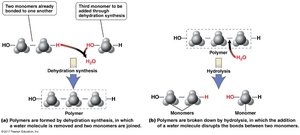
Polymers are built by dehydration synthesis (removal of water to form a bond) and broken down by hydrolysis (addition of water to break a bond).
Dehydration Synthesis: Joins monomers by removing water.
Hydrolysis: Breaks polymers into monomers by adding water.
Carbohydrates
Structure and Classification
Carbohydrates are biological molecules with the general formula (CH2O)n. They are classified by the number of sugar units:
Monosaccharide: One sugar unit (e.g., glucose).
Disaccharide: Two sugar units linked together (e.g., sucrose).
Polysaccharide: Many sugar units linked together (e.g., starch, glycogen, cellulose).
Polysaccharides
Polysaccharides are large carbohydrates that store energy or provide structure.
Starch: Storage form of glucose in plants.
Glycogen: Storage form of glucose in animals.
Cellulose: Structural component of plant cell walls.
Lipids
Structure and Types
Lipids are mostly made of hydrogen and carbon, are nonpolar, and hydrophobic (do not mix well with water). Major types include fats and oils, waxes, phospholipids, and steroids.
Triglycerides: Polymers of fatty acids and glycerol; can be saturated (single bonds) or unsaturated (one or more double bonds).
Phospholipids: Polymers of fatty acids, glycerol, and phosphate; have hydrophilic heads and hydrophobic tails; major component of cell membranes.
Steroids and Waxes: Made up of four fused carbon rings (steroids) or long-chain fatty acids (waxes).
Saturated fats have only single bonds between carbons, while unsaturated fats have one or more double bonds.
Proteins
Amino Acids and Protein Structure
Proteins are polymers of amino acids. Each amino acid has a central carbon, an amino group (NH2), a carboxyl group (COOH), a hydrogen atom, and a variable R group. The sequence and properties of amino acids determine protein structure and function.
Primary Structure: Sequence of amino acids in a polypeptide chain.
Secondary Structure: Local folding patterns (alpha helices, beta sheets) formed by hydrogen bonding.
Tertiary Structure: Overall 3D shape of a single polypeptide, determined by interactions among R groups.
Quaternary Structure: Interaction of two or more polypeptide chains (not all proteins have this).
Proteins are formed by dehydration synthesis reactions that join amino acids via peptide bonds, forming polypeptides.
Enzymes
Enzymes are proteins that catalyze (speed up) chemical reactions. They bind specific molecules called substrates at an active site, convert them to products, and are not used up in the reaction.
Substrate: Molecule an enzyme acts on.
Active Site: Region where the substrate binds.
Products: Molecules released after the reaction.
Nucleic Acids
Nucleotides and Nucleic Acids
Nucleic acids are polymers made of nucleotides. Each nucleotide consists of a 5-carbon sugar (ribose in RNA, deoxyribose in DNA), a phosphate group, and a nitrogenous base. The two major nucleic acids are DNA (deoxyribonucleic acid) and RNA (ribonucleic acid).
DNA: Stores genetic information.
RNA: Involved in protein synthesis and gene regulation.
Adenosine Triphosphate (ATP)
ATP is a nucleotide that serves as the primary energy carrier in cells. It contains adenine, ribose, and three phosphate groups. Energy is released when ATP is broken down to ADP (adenosine diphosphate) and a phosphate group.
Key equation:
