 Back
Lecture 3 (Ch.3)
Study Guide - Smart Notes
 Tailored notes based on your materials, expanded with key definitions, examples, and context.
Chemistry Foundations: Elements & Atoms
Introduction to Matter, Elements, and Compounds
Understanding the chemical foundations of biology begins with the study of matter, elements, and compounds. The properties of biological molecules and living organisms are determined by the elements they contain and the ways these elements interact.
Matter is anything that takes up space and has mass.
Elements are pure substances that cannot be broken down into other substances by chemical reactions.
Compounds are substances consisting of two or more elements in a fixed ratio, exhibiting emergent properties distinct from their constituent elements.
Examples of elements: Hydrogen (H), Oxygen (O), Carbon (C).
Examples of compounds: Water (H2O), Carbon dioxide (CO2), Sodium chloride (NaCl).
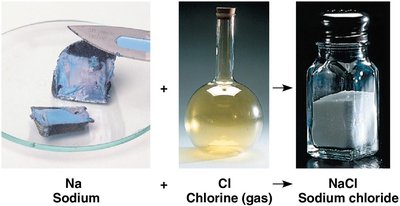
Example: Sodium (a reactive metal) and chlorine (a poisonous gas) combine to form sodium chloride (table salt), which is safe to eat. This demonstrates how compounds have properties different from their constituent elements.
The Elements of Life
Life depends on a relatively small subset of the elements found on Earth. These elements are essential for the structure and function of biological molecules.
About 20–25% of the 92 natural elements are essential for life.
Four elements—carbon (C), hydrogen (H), oxygen (O), and nitrogen (N)—make up approximately 96% of living matter.
The remaining 4% is primarily composed of calcium (Ca), phosphorus (P), potassium (K), and sulfur (S).
Trace elements are required in minute quantities but are vital for proper physiological function.
Element | Symbol | Percentage of Body Mass (including water) |
|---|---|---|
Oxygen | O | 65.0% |
Carbon | C | 18.5% |
Hydrogen | H | 9.5% |
Nitrogen | N | 3.3% |
Calcium | Ca | 1.5% |
Phosphorus | P | 1.0% |
Potassium | K | 0.4% |
Sulfur | S | 0.3% |
Sodium | Na | 0.2% |
Chlorine | Cl | 0.2% |
Magnesium | Mg | 0.1% |
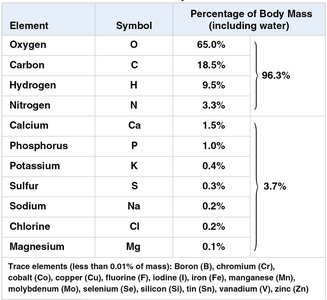
Example: Iron (Fe) is a trace element essential for oxygen transport in blood.
Case Study: Evolution of Tolerance to Toxic Elements
Some environments contain toxic elements, and certain species have evolved adaptations to survive in these conditions. For example, some plants can tolerate serpentine soils, which are rich in heavy metals like nickel, cobalt, and chromium.

Biological Theme: Evolution—adaptation to environmental challenges.
Atomic Structure and Properties
Atoms and Subatomic Particles
Atoms are the smallest units of matter that retain the properties of an element. Each atom is composed of subatomic particles:
Protons: Positively charged particles found in the nucleus.
Neutrons: Electrically neutral particles found in the nucleus.
Electrons: Negatively charged particles that orbit the nucleus in electron shells.
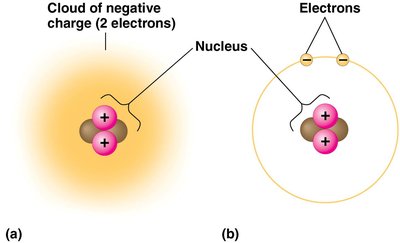
Key Point: The number of protons defines the element (atomic number), while the number of neutrons can vary, resulting in isotopes.
Atomic Number, Mass Number, and Atomic Mass
The identity and properties of an atom are determined by its atomic number and mass number:
Atomic number = number of protons in the nucleus.
Mass number = number of protons + number of neutrons.
Atomic mass is approximately equal to the mass number (measured in daltons).
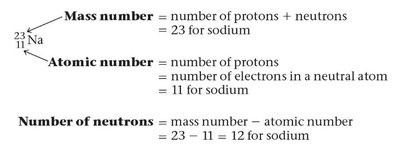
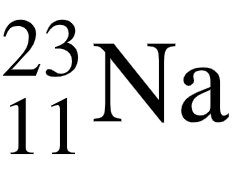
Example: For sodium (23Na), atomic number = 11, mass number = 23, so number of neutrons = 23 - 11 = 12.
Isotopes and Radioactivity
Isotopes are atoms of the same element with different numbers of neutrons. Some isotopes are unstable (radioactive) and decay, emitting particles and energy.
Stable isotopes do not change spontaneously.
Radioactive isotopes decay at a predictable rate (half-life) and are used in radiometric dating and as tracers in medicine.
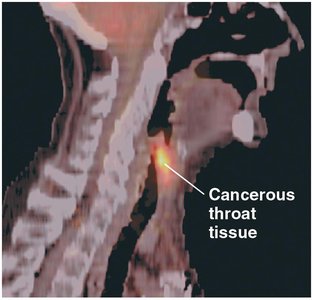
Example: PET scans use radioactive tracers to monitor cancer growth and metabolism in the body.
Energy Levels of Electrons
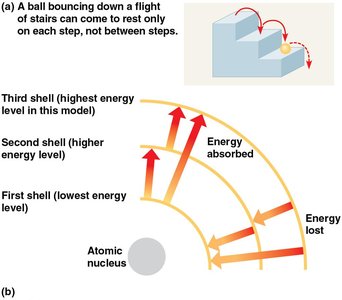
Electrons occupy specific energy levels or shells around the nucleus. The energy of an electron increases with its distance from the nucleus. Electrons can move between shells by absorbing or releasing energy in fixed amounts.
Potential energy is the energy due to position or structure.
Electrons in higher shells have more potential energy.
Energy is absorbed when electrons move to higher shells and released when they fall to lower shells.
Electron Distribution and Chemical Properties
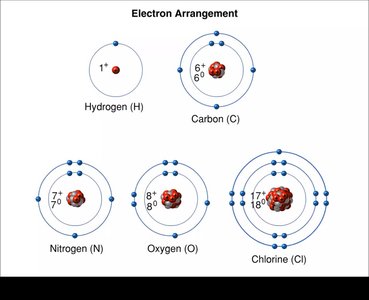
The arrangement of electrons in shells determines an atom's chemical behavior. The periodic table reflects the electron configurations of elements.
Valence electrons are those in the outermost shell and are most important for chemical reactivity.
Atoms with full valence shells are chemically inert (noble gases).
Atoms with incomplete valence shells are reactive and tend to form bonds to achieve stability.
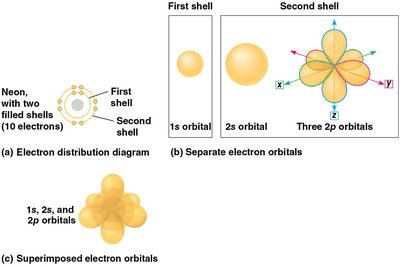
Electron Orbitals
Electrons occupy orbitals, which are three-dimensional regions around the nucleus where electrons are likely to be found. Each orbital can hold up to two electrons, and orbitals have specific shapes (spherical for s orbitals, dumbbell-shaped for p orbitals).
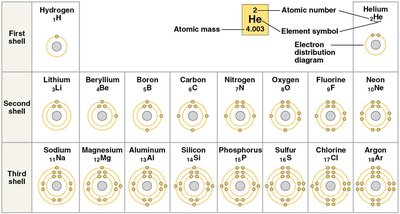
Key Point: The arrangement of electrons in orbitals and shells underlies the chemical properties and bonding behavior of elements.
Summary Table: Key Concepts
Concept | Summary |
|---|---|
Matter | Composed of elements and compounds; has mass and occupies space. |
Elements | Pure substances; cannot be broken down by chemical means. |
Compounds | Combinations of two or more elements in fixed ratios; have emergent properties. |
Atoms | Smallest unit of an element; composed of protons, neutrons, and electrons. |
Atomic Number | Number of protons; defines the element. |
Mass Number | Sum of protons and neutrons. |
Isotopes | Atoms of the same element with different numbers of neutrons. |
Electron Shells | Energy levels where electrons are found; chemical behavior depends on valence electrons. |
Orbitals | Three-dimensional spaces where electrons are likely to be found. |
