 Back
Chemistry Foundations for Biology: Elements, Bonds, and Chemical Reactions
Study Guide - Smart Notes
 Tailored notes based on your materials, expanded with key definitions, examples, and context.
Chemistry and Biology
The Importance of Chemistry in Biology
Chemistry forms the basis for understanding biological processes. All living organisms depend on chemical principles for structure, function, and survival. For example, wood ants (Formica rufa) use formic acid, a chemical compound, as a defense mechanism.
The Elements of Life
Essential and Trace Elements
Life depends on a limited subset of the 92 naturally occurring elements. These elements are classified based on their abundance and necessity in living organisms.
Essential elements: About 20–25% of elements are required for life. The four most abundant are carbon (C), hydrogen (H), oxygen (O), and nitrogen (N), making up approximately 96% of living matter.
Other important elements: Calcium (Ca), phosphorus (P), potassium (K), and sulfur (S) account for most of the remaining 4%.
Trace elements: Required in minute quantities but essential for proper physiological function (e.g., iron, iodine).
Atoms and Electron Structure
Atomic Number and Electron Shells
The atomic number of an element equals the number of protons and, in a neutral atom, the number of electrons. Electrons are arranged in shells around the nucleus, each with a characteristic energy level.
The first shell holds up to 2 electrons.
The second shell holds up to 8 electrons.
The third shell also holds up to 8 electrons (for main group elements).
The distribution of electrons among these shells determines the chemical properties of the element.
Valence Electrons and Chemical Behavior
Valence electrons are those in the outermost shell. The number of valence electrons largely determines how an atom interacts with others. Atoms with a full valence shell are chemically inert (e.g., noble gases), while those with incomplete shells tend to form bonds to achieve stability.
Chemical Bonds
Covalent Bonds
A covalent bond involves the sharing of one or more pairs of valence electrons between two atoms. This type of bond is fundamental in forming the molecules of life.
Single bond: Sharing one pair of electrons.
Double bond: Sharing two pairs of electrons.
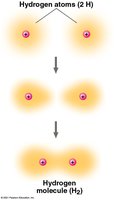
Electronegativity is an atom’s ability to attract shared electrons. If two atoms have similar electronegativity, they form a nonpolar covalent bond (equal sharing). If one atom is more electronegative, a polar covalent bond forms (unequal sharing), resulting in partial charges.
Ionic Bonds
An ionic bond forms when one atom strips electrons from another, creating oppositely charged ions (cations and anions) that attract each other. Ionic bonds are strong in air but weaker in aqueous solutions due to competition with water molecules.
Weak Chemical Interactions
Many biological molecules are stabilized by weak interactions, which are reversible and allow dynamic biological processes.
Hydrogen bonds: Form when a hydrogen atom covalently bonded to one electronegative atom is attracted to another electronegative atom (commonly oxygen or nitrogen).
Van der Waals interactions: Weak attractions due to transient local partial charges. Collectively, these can be significant, as seen in the ability of geckos to climb walls.

Chemical Reactions
Making and Breaking Bonds
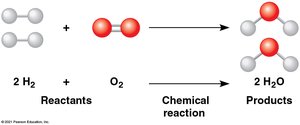
Chemical reactions involve the making and breaking of chemical bonds. The substances present at the start are called reactants, and those formed are products.
Example: The reaction of hydrogen and oxygen to form water:
Chemical Equilibrium
A chemical reaction reaches equilibrium when the rate of the forward reaction equals the rate of the reverse reaction, resulting in no net change in the concentrations of reactants and products.
Review Questions and Applications
Electron Shells: An oxygen atom (atomic number 8) has 2 electrons in the first shell and 6 in the second shell.
Bond Analogy: A person carefully walking on a slippery sidewalk is most like a hydrogen bond (weak and easily broken).
Chemical Equilibrium Analogy: A room is at equilibrium when equal numbers of squirrels are entering and leaving the room.
Trace Elements: Elements like iron or iodine are trace elements in the human body, required in minute amounts.
Additional info: The examples and analogies provided help reinforce the concepts of electron configuration, bond types, and chemical equilibrium, which are foundational for understanding biological molecules and processes.
