 Back
Chemistry Foundations for General Biology: Matter, Elements, Bonds, Water, and Functional Groups
Study Guide - Smart Notes
 Tailored notes based on your materials, expanded with key definitions, examples, and context.
Basic Terminology of Matter
Definition and Classification
Matter is anything that occupies space and has mass. It is composed of elements, which are pure substances that cannot be broken down by chemical means.
Element: A pure substance consisting of only one type of atom.
Compound: A substance formed from two or more elements in a fixed ratio, with properties distinct from its component elements.
Example: Table salt (NaCl) is a compound formed from sodium (Na) and chlorine (Cl), both of which have very different properties from the salt itself. 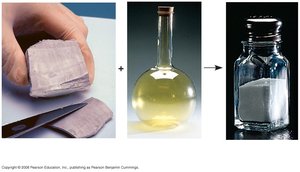
Elements Essential to Life
Major and Trace Elements
About 25 elements are essential for life, with approximately 95% of living matter composed of carbon (C), hydrogen (H), oxygen (O), and nitrogen (N). The remaining elements include calcium (Ca), phosphorus (P), potassium (K), sulfur (S), sodium (Na), chlorine (Cl), and magnesium (Mg).
Trace elements: Required in minute quantities for proper physiological functioning.
Atomic Structure and Electron Distribution
Potential Energy and Valence Electrons
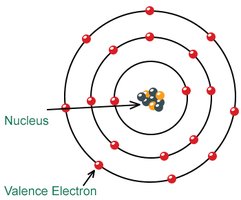
The periodic table displays the electron distribution for each element. Electrons occupy orbitals, which are three-dimensional spaces where electrons are found 90% of the time. The energy of an electron depends on its location relative to the nucleus.
Valence electrons: Electrons in the outermost shell, crucial for chemical bonding.
Orbital: The region around the nucleus where an electron is likely to be found.
Covalent Bonds and Electronegativity
Bond Types and Molecular Polarity
Covalent bonds involve the sharing of valence electrons between atoms.
Single bond: Sharing one pair of electrons.
Double bond: Sharing two pairs of electrons.
Electronegativity: The ability of an atom to attract electrons in a covalent bond.
Polar covalent bond: Unequal sharing of electrons, resulting in partial charges across the molecule.
Example: Water (H2O) is a polar molecule due to the higher electronegativity of oxygen compared to hydrogen. 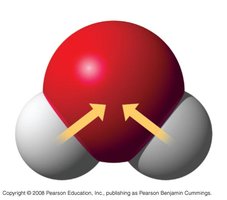
Ionic Bonds
Electron Transfer and Ion Formation
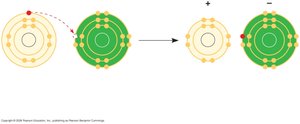
Ionic bonds form when atoms transfer electrons, resulting in charged ions.
Cation: Positively charged ion (loss of electron).
Anion: Negatively charged ion (gain of electron).
Ionic compound: Formed from the electrostatic attraction between cations and anions.
Hydrogen Bonds
Intermolecular Attraction
Hydrogen bonds occur when a hydrogen atom covalently bonded to an electronegative atom is attracted to another electronegative atom. These bonds are crucial for the structure and properties of water and biological molecules. 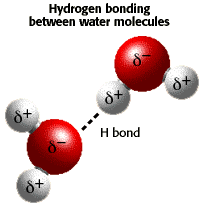
Properties of Water
Biological Importance
Water is the biological medium for life, essential for all living organisms. Its abundance is a key factor in Earth's habitability. 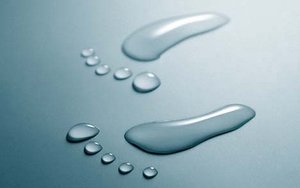
Water as a Universal Solvent
Polarity and Solubility
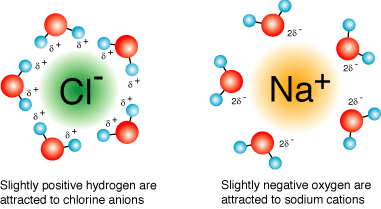
Water's polarity allows it to dissolve ionic and polar substances.
Hydrophilic: Substances with an affinity for water.
Hydrophobic: Substances that repel water.
Acidic and Basic Conditions in Water
Dissociation and pH
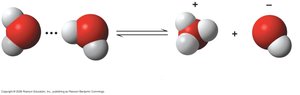
Water molecules can dissociate into hydronium (H3O+) and hydroxide (OH–) ions.
Dynamic equilibrium: Dissociation and reformation occur at equal rates.
Acid: Substance that increases H+ concentration.
Base: Substance that increases OH– concentration.
pH Scale and Buffer Systems
Measurement and Regulation
The pH scale measures the concentration of H+ ions in a solution, ranging from 0 (acidic) to 14 (basic).
pH: Defined as the negative logarithm of H+ concentration:
Buffer: Substance that minimizes changes in pH by reversible binding of H+.
Example: Most biological fluids have pH values between 6 and 8. 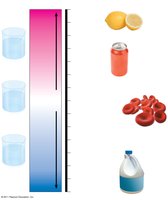
Carbon: The Backbone of Life
Bonding Versatility
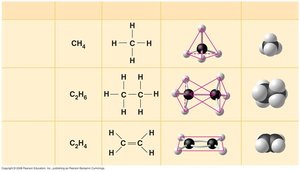
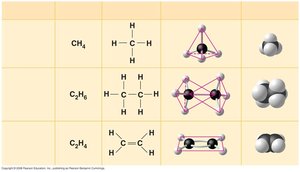
Carbon's tetravalence allows it to form covalent bonds with many elements, making it the foundation of organic molecules.
Frequent bonding partners: Hydrogen, oxygen, nitrogen, and other carbons.
Hydrocarbons
Structure and Energy
Hydrocarbons are organic molecules composed only of carbon and hydrogen. They can undergo reactions that release significant energy, making them important in biological processes. 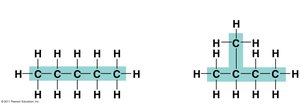
Isomers
Structural Diversity
Isomers are compounds with the same molecular formula but different structures and properties.
Structural isomers: Different covalent arrangements of atoms.
Cis-trans isomers: Same covalent arrangement, different spatial arrangement.
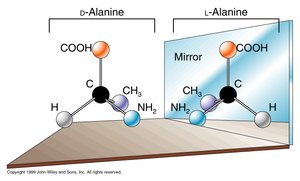
Enantiomers: Mirror images of each other.
Functional Groups in Biological Molecules
Importance and Examples
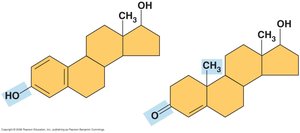
The function of organic molecules depends on their carbon skeleton and attached functional groups.
Estradiol and Testosterone: Example of how functional groups affect biological activity.
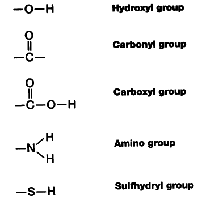
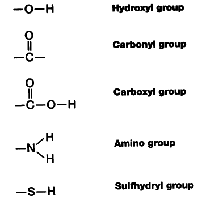
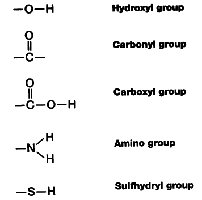
The Seven Most Important Functional Groups
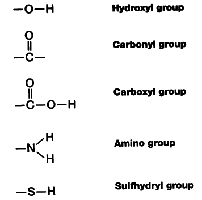
Functional groups are specific groups of atoms within molecules that are responsible for the characteristic chemical reactions of those molecules.
Hydroxyl group (–OH)
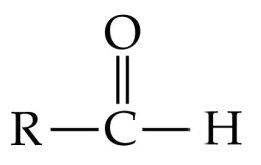
Carbonyl group (C=O)
Carboxyl group (–COOH)
Amino group (–NH2)
Sulfhydryl group (–SH)
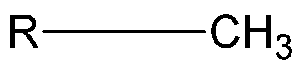
Methyl group (–CH3)
Phosphate group (–OPO32–)
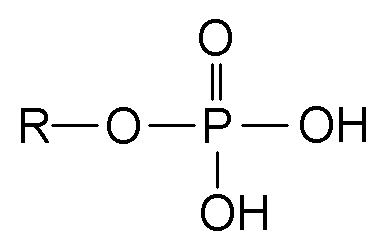
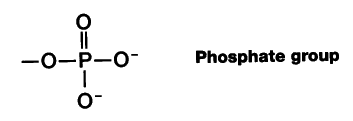 Example: The presence of a phosphate group in ATP is essential for energy transfer in cells.
