 Back
Chemistry of Life: Atoms, Bonds, Water, and Biological Macromolecules
Study Guide - Smart Notes
 Tailored notes based on your materials, expanded with key definitions, examples, and context.
Chemistry of Life
Major Concepts
All molecules are composed of atoms joined by covalent bonds.
The type of bond formed depends on the electronegativity of the atoms involved.
Water has unique properties due to hydrogen bonds between water molecules.
The presence of water is essential for life and influences biological processes.
Four types of organic molecules are essential for life: carbohydrates, proteins, nucleic acids, and lipids.
Student Learning Objectives
Identify the most common elements in cells and describe atomic structure.
Define electronegativity and use it to determine bond types (polar covalent, nonpolar covalent, ionic).
Draw a water molecule, identify bond types, and explain hydrogen bonding.
Contrast covalent, ionic, and hydrogen bonds.
Predict the behavior of polar and nonpolar molecules in water (hydrophilic vs. hydrophobic).
Identify the four classes of biological macromolecules and their monomers.
Atoms and Elements of Life
Most Common Elements in Cells
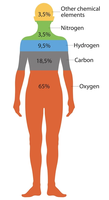
Cells are primarily composed of a few key elements, despite the abundance of elements on Earth. The most abundant elements in living organisms are oxygen (O), hydrogen (H), carbon (C), and nitrogen (N). Less abundant but important elements include sulfur (S) and phosphorus (P).
Atomic Structure
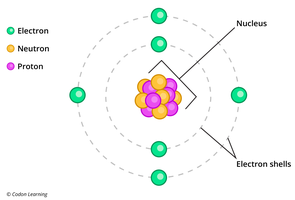
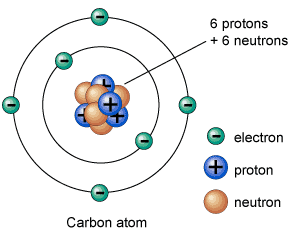
An atom consists of a central nucleus containing protons (positively charged) and neutrons (neutral), surrounded by electrons (negatively charged) in orbitals. Electrons occupy energy levels called shells:
First shell: up to 2 electrons
Second shell: up to 8 electrons
Third shell: up to 8 electrons
The number of electrons in the outermost shell (valence shell) determines how atoms interact and form bonds.
Electron Shells of Life's Elements
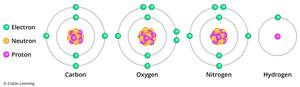
Atoms are most stable when their outermost shell is filled. For hydrogen, this means 2 electrons; for carbon, nitrogen, and oxygen, 8 electrons. Atoms achieve stability by forming bonds with other atoms.
Bond Formation and Electronegativity
Types of Bonds
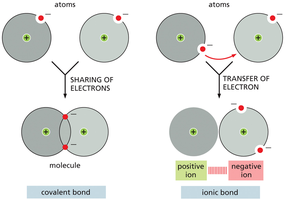
Atoms form bonds to achieve stable electron configurations. There are two main ways:
Sharing electrons (covalent bonds)
Transferring electrons (ionic bonds)
Electronegativity and Bond Polarity
Electronegativity is the tendency of an atom to attract electrons in a bond. The difference in electronegativity between two atoms determines the bond type:
Nonpolar covalent bond: Electrons are shared equally (e.g., C-H bond).
Polar covalent bond: Electrons are shared unequally, creating partial charges (e.g., O-H bond).
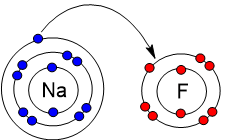
Ionic bond: Electrons are transferred, forming charged ions (e.g., Na+ and F-).

Example: Carbon Atom
The maximum number of bonds an atom can form equals the number of unpaired electrons in its valence shell. For carbon, with 4 valence electrons, it can form 4 covalent bonds.
Covalent, Ionic, and Hydrogen Bonds
Covalent Bonds
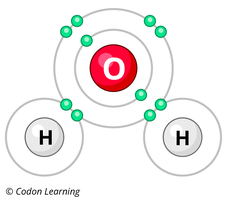
Covalent bonds involve the sharing of electron pairs between atoms. These bonds are strong and form the backbone of biological molecules.
Ionic Bonds
Ionic bonds form when electrons are transferred from one atom to another, resulting in the attraction between oppositely charged ions. These bonds are common in salts.
Hydrogen Bonds
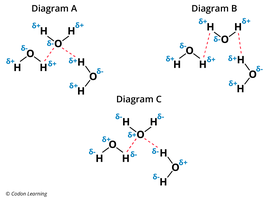
Hydrogen bonds are weak attractions between a partially positive hydrogen atom (in a polar covalent bond) and a partially negative atom (often oxygen or nitrogen) in another molecule. Hydrogen bonds are crucial for the properties of water and the structure of biological macromolecules.
Water: Structure and Properties
Structure of Water
A water molecule (H2O) consists of two hydrogen atoms covalently bonded to an oxygen atom. The bonds are highly polar due to oxygen's high electronegativity, resulting in partial charges (δ+ on H, δ- on O).
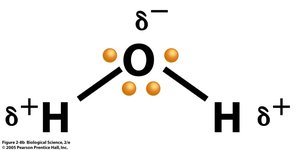
Hydrogen Bonding in Water
The partial charges allow water molecules to form hydrogen bonds with each other. These bonds are responsible for water's high cohesion, surface tension, and its ability to remain liquid at room temperature.
Polar and Nonpolar Molecules: Hydrophilic vs. Hydrophobic
Behavior in Water
Polar molecules (with polar covalent bonds) are hydrophilic (water-loving) and dissolve easily in water due to their ability to form hydrogen bonds with water molecules.
Nonpolar molecules (with nonpolar covalent bonds) are hydrophobic (water-fearing) and do not dissolve in water because they lack partial charges and cannot form hydrogen bonds with water.
Example: Carbon dioxide (CO2) is an exception; although it has polar bonds, its linear symmetry cancels out the charges, making it nonpolar and hydrophobic.
Biological Macromolecules
Four Classes of Biological Macromolecules
Life depends on four major classes of macromolecules, each with specific monomers:
Macromolecule | Monomer (Building Block) | Polymer Name |
|---|---|---|
Polysaccharides (Carbohydrates) | Monosaccharides | Polysaccharides |
Proteins | Amino acids | Polypeptides |
Nucleic acids | Nucleotides | DNA/RNA |
Lipids | Fatty acids & glycerol (not true polymers) | Triglycerides, phospholipids, etc. |
The interactions of these macromolecules with water are critical for their structure and function.
