 Back
BackChemistry of Life: Atoms, Elements, Bonds, and Water
Study Guide - Smart Notes
 Tailored notes based on your materials, expanded with key definitions, examples, and context.
Chemistry of Life
Atoms, Elements, and Subatomic Particles
The foundation of biological chemistry begins with understanding atoms, elements, and their subatomic structure. Atoms are the smallest units of matter, and elements are substances composed of only one type of atom. Living organisms are primarily composed of a few key elements, including hydrogen, carbon, nitrogen, and oxygen.
Matter: Anything that occupies space and has mass.
Element: A pure substance that cannot be broken down by ordinary chemical means.
Atom: The smallest unit of an element, consisting of a nucleus (protons and neutrons) and electrons in orbitals.
Subatomic Particles:
Proton: Positively charged particle in the nucleus.
Neutron: Neutral particle in the nucleus.
Electron: Negatively charged particle in orbitals around the nucleus.
Atomic Number: Number of protons in the nucleus.
Atomic Mass: Sum of protons and neutrons.
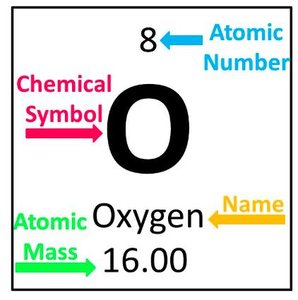
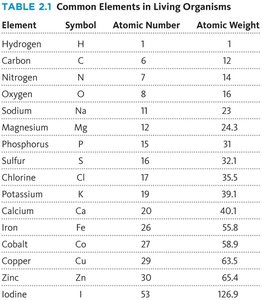
Atoms are composed of a nucleus containing protons and neutrons, surrounded by electrons in shells or orbitals. The arrangement of electrons determines chemical reactivity.
Electron Shells: Energy levels around the nucleus; first shell holds 2 electrons, second holds up to 8.
Valence Electrons: Electrons in the outermost shell, crucial for chemical bonding.
Isotopes and Radioactivity
Isotopes are atoms of the same element with different numbers of neutrons. Some isotopes are radioactive and have important biological and medical applications.
Isotope: Same number of protons, different number of neutrons.
Radioisotope: Unstable isotope that emits energy and particles.
Applications: Used in medical imaging, cancer treatment, and biological research.
Ions and Electrolytes
Ions are charged atoms or molecules formed by the loss or gain of electrons. Electrolytes are substances that dissociate into ions in water and are essential for cellular function.
Cation: Positively charged ion (e.g., Na+, K+).
Anion: Negatively charged ion (e.g., Cl-, PO43-).
Electrolyte: Substance that dissociates into ions in water.
Cations | Anions |
|---|---|
Sodium (Na+) | Chloride (Cl-) |
Potassium (K+) | Bicarbonate (HCO3-) |
Calcium (Ca2+) | Phosphate (PO43-) |
Magnesium (Mg2+) | Sulfate (SO42-) |
Chemical Bonds
Chemical bonds are forces that hold atoms together in molecules. The main types are covalent, ionic, and hydrogen bonds.
Covalent Bond: Sharing of electrons between atoms.
Nonpolar Covalent: Equal sharing (e.g., H2).
Polar Covalent: Unequal sharing (e.g., H2O).
Ionic Bond: Transfer of electrons, forming charged ions (e.g., NaCl).
Hydrogen Bond: Weak attraction between a hydrogen atom and an electronegative atom (e.g., in water and DNA).
Chemical Reactions
Chemical reactions involve the making and breaking of bonds between atoms. Key types include synthesis, hydrolysis, and redox reactions.
Synthesis (Dehydration Synthesis): Formation of larger molecules from smaller ones, with removal of water.
Hydrolysis (Decomposition): Breakdown of large molecules into smaller ones, requiring water.
Redox (Reduction-Oxidation): Transfer of electrons; reduction is gain of electrons, oxidation is loss.
Chemical Notation
Chemical notation is a shorthand used to represent elements, compounds, and reactions. It uses symbols, subscripts, and superscripts to convey information about atomic composition and charge.
Element Symbol: One or two letters (e.g., O for oxygen).
Subscript: Number of atoms in a molecule (e.g., H2O).
Superscript: Indicates ion charge (e.g., Na+).
Inorganic Compounds and Water
Acids, Bases, and pH
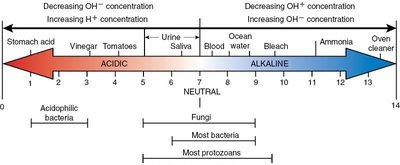
Acids and bases are substances that alter the concentration of hydrogen ions (H+) in solution. The pH scale measures acidity or alkalinity.
Acid: Releases H+ ions; proton donor.
Base: Releases OH- ions; proton acceptor.
pH: Negative logarithm of H+ concentration; scale from 0 (acidic) to 14 (basic).
Buffer: System that stabilizes pH by absorbing H+ or OH-.
Salts
Salts are formed by the reaction of acids and bases and dissociate in water to yield ions. They are important for various physiological functions and can be classified by their color and composition.
Salt-forming Anions | Formula | Salt-forming Cations | Formula |
|---|---|---|---|
Acetate | CH3COO- | Ammonium | NH4+ |
Carbonate | CO32- | Calcium | Ca2+ |
Chloride | Cl- | Iron | Fe2+, Fe3+ |
Hydroxide | OH- | Magnesium | Mg2+ |
Nitrate | NO3- | Potassium | K+ |
Phosphate | PO43- | Sodium | Na+ |
Sulfate | SO42- | Quaternary ammonium | Various |
Water: Properties and Biological Importance
Water is the most abundant molecule in living organisms and is essential for life. It acts as a universal solvent, participates in chemical reactions, and helps maintain cellular structure and function.
States: Exists as solid, liquid, and gas depending on temperature.
Solvent: Dissolves many substances due to its polarity.
Hydrogen Bonds: Responsible for cohesion, surface tension, and high specific heat.
Polarity: Water molecules have a partial positive and negative charge, making them polar.
Solutions: Isotonic, Hypertonic, and Hypotonic
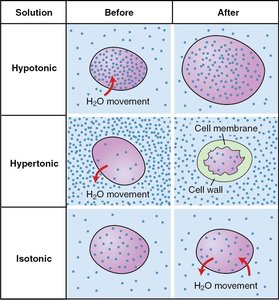
Cells interact with their environment through solutions that can be isotonic, hypertonic, or hypotonic, affecting water movement and cell volume.
Isotonic: Equal solute concentration inside and outside the cell.
Hypertonic: Higher solute concentration outside the cell; water moves out.
Hypotonic: Higher solute concentration inside the cell; water moves in.
Hydrophilic and Hydrophobic Compounds
Substances can be classified based on their interaction with water.
Hydrophilic: Water-loving, soluble in water.
Hydrophobic: Water-repelling, insoluble in water.
