 Back
Chemistry of Life: Bonds, Water, Functional Groups, and Biomolecules
Study Guide - Smart Notes
 Tailored notes based on your materials, expanded with key definitions, examples, and context.
Chemistry of Life
Polarity and Types of Chemical Bonds
Chemical bonds are fundamental to the structure and function of biological molecules. The polarity of molecules arises from differences in electronegativity, which is the ability of an atom to attract shared electrons. The type of bond formed depends on how electrons are distributed between atoms.
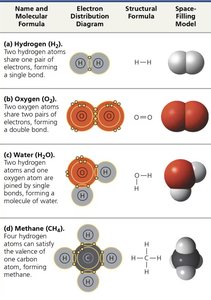
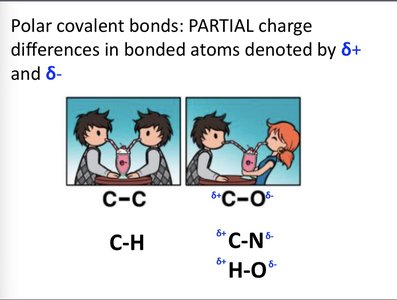
Covalent Bonds: Atoms share electrons to fill their valence shells. If sharing is equal, the bond is non-polar covalent; if unequal, it is polar covalent.
Ionic Bonds: Electrons are transferred from one atom to another, resulting in attraction between oppositely charged ions.
Electronegativity: Determines the type of bond; higher electronegativity means stronger electron pull.
Directionality: Polar molecules have directionality due to partial charges, while non-polar molecules do not.
Oxidation and Reduction: Oxidation is the loss of electrons; reduction is the gain of electrons.
Example: Water (H2O) is polar because oxygen is more electronegative than hydrogen, creating partial charges.
Properties of Water
Water is essential for life due to its unique properties, which arise from its polarity and hydrogen bonding.
Cohesion: Water molecules stick to each other due to hydrogen bonds.
Adhesion: Water molecules stick to other polar substances.
Density: Ice is less dense than liquid water, allowing it to float.
Solvent Properties: Water dissolves ionic and polar substances (hydrophilic), but not non-polar substances (hydrophobic).
Example: Salt and sugar dissolve in water, while oil does not.
pH and Acids/Bases
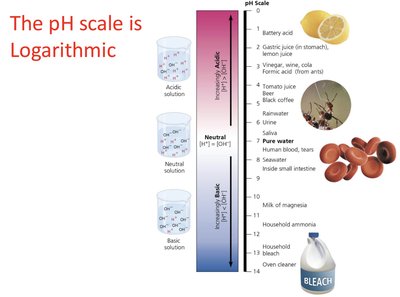
The pH scale measures the concentration of hydrogen ions (H+) in a solution, affecting biomolecule structure and function. The scale is logarithmic, with lower values being more acidic and higher values more basic.
Acids: Donate H+ ions, decreasing pH.
Bases: Accept H+ ions, increasing pH.
Buffers: Resist changes in pH.
Formula:
Biomolecules and Functional Groups
Functional Groups
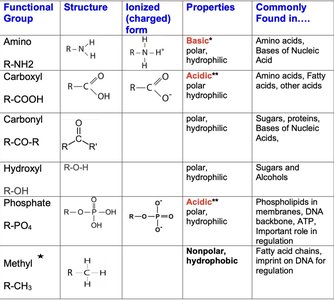
Functional groups are specific groups of atoms within molecules that participate in chemical reactions and determine the properties of biomolecules.
Amino (–NH2): Basic, polar, found in amino acids.
Carboxyl (–COOH): Acidic, polar, found in amino acids and fatty acids.
Carbonyl (–CO): Polar, found in sugars and proteins.
Hydroxyl (–OH): Polar, found in sugars and alcohols.
Phosphate (–PO4): Acidic, polar, found in DNA, ATP.
Methyl (–CH3): Nonpolar, hydrophobic, found in fatty acids.
Dehydration Synthesis and Biomolecule Structure
Biomolecules are formed by joining monomers through dehydration synthesis, which removes a water molecule to form a bond. This process is essential for building polymers such as proteins and nucleic acids.
Amino Acids: Monomers of proteins, joined by peptide bonds.
Protein Structure: Primary (sequence), secondary (hydrogen bonds), tertiary (side chain interactions), quaternary (multi-subunit).
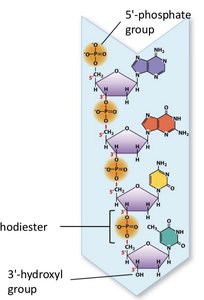
Nucleic Acids: Polymers of nucleotides, joined by phosphodiester bonds.
Directionality: DNA and RNA have 5' to 3' directionality, determined by the sugar-phosphate backbone.
Summary and Study Tips
Understand types of bonds and their properties.
Identify polarity and directionality in molecules.
Memorize functional groups and their roles.
Practice drawing molecular structures and identifying bond types.
Review pH, acids, bases, and buffer systems.
Study dehydration synthesis and its role in forming biomolecules.
Additional info: Academic context was added to clarify the structure and function of biomolecules, functional groups, and the importance of polarity and pH in biological systems.
