 Back
Chemistry of Life: Elements, Bonds, and Water
Study Guide - Smart Notes
 Tailored notes based on your materials, expanded with key definitions, examples, and context.
Chemistry of Life
Elements and Atomic Structure
The foundation of biological systems is their chemical makeup, which is composed of elements and their interactions. The main elements of focus in biology are hydrogen, carbon, nitrogen, phosphorus, and oxygen. These elements are essential for the structure and function of biomolecules.
Atoms are the smallest units of elements, consisting of protons (+1, nucleus), neutrons (0, nucleus), and electrons (-1, electron shell).
Atomic number: Number of protons in the nucleus.
Atomic mass: Sum of protons and neutrons.
In a neutral atom, the number of electrons equals the number of protons.
Valence electrons: Electrons in the outermost shell, determine chemical reactivity and bonding.
Atoms are most stable when their outer shell is full (usually 8 electrons).
Carbon is the most abundant element in cells, forming the backbone of organic molecules.
Covalent Bonding and HONC Elements
Chemical bonds are formed by interactions between valence electrons of atoms. Covalent bonds involve the sharing of electrons to achieve stability. The number of bonds an atom can form depends on the number of electrons it "wants" to fill its outer shell.
Covalent bonds: Atoms share electrons; denoted by a solid line.
Polar covalent bonds: Unequal sharing of electrons, resulting in partial charges.
Non-polar covalent bonds: Equal sharing of electrons, no charge difference.
Ionic bonds: Formed between oppositely charged ions.
The elements hydrogen, oxygen, nitrogen, and carbon (HONC) are fundamental to biological molecules. Their bonding properties are summarized below:
Element | Protons/Neutrons | Electrons | Inner Shell | Outer Shell | Wants | # Bonds |
|---|---|---|---|---|---|---|
H | 1P | 1e- | 1 | 1 | 1 more | 1 |
O | 8P 8N | 8e- | 2 | 6 | 2 more | 2 |
N | 7P 7N | 7e- | 2 | 5 | 3 more | 3 |
C | 6P 6N | 6e- | 2 | 4 | 4 more | 4 |
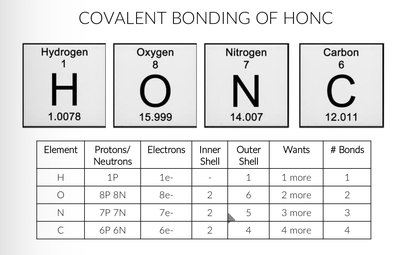
Example: Carbon forms four covalent bonds, allowing it to create complex molecules such as proteins, nucleic acids, and carbohydrates.
Types of Chemical Bonds
Atoms with incomplete outer shells interact to achieve stability, resulting in different types of chemical bonds:
Covalent bonds: Sharing of electrons between atoms.
Polar covalent bonds: Unequal sharing, leading to partial charges (e.g., water).
Non-polar covalent bonds: Equal sharing, no charge difference.
Ionic bonds: Transfer of electrons, forming charged ions.
Water: Structure and Properties
Water is a polar molecule due to the unequal sharing of electrons and its bent shape. The oxygen atom has partial negative charges, while the hydrogen atoms have partial positive charges. This polarity leads to hydrogen bonding between water molecules.
Hydrogen bonds: Weak attractions between the partially positive hydrogen of one molecule and the partially negative oxygen of another.
Cohesion: Water molecules stick together, aiding in transport in plants.
Adhesion: Water molecules cling to other substances.
Surface tension: Resistance to breaking the surface of water.
Example: Cohesion and adhesion allow water to move against gravity in plant vessels.
Kinetic and Thermal Energy
Energy is a fundamental concept in biology, especially in the context of molecular motion and temperature.
Kinetic energy: Energy of motion.
Thermal energy: Kinetic energy associated with the random movement of atoms or molecules.
Temperature: Represents the average kinetic energy of molecules in a substance.
Example: The temperature of water increases as the kinetic energy of its molecules increases.
Biomolecules and Cells
Biological systems are composed of four main types of biomolecules: lipids, nucleic acids, proteins, and carbohydrates. Cells are the basic units of life, and their chemical composition determines their structure and function.
Prokaryotic cells: Lack a nucleus, simpler structure.
Eukaryotic cells: Have a nucleus and complex organelles.
Example: DNA (a nucleic acid) is found in both prokaryotic and eukaryotic cells, but its organization differs.
Additional info: Expanded explanations of atomic structure, chemical bonds, and water properties were added for completeness and academic context.
