 Back
BackChemistry of Life: Foundations for Biology
Study Guide - Smart Notes
 Tailored notes based on your materials, expanded with key definitions, examples, and context.
Chemistry of Life
Building Blocks of Matter
The study of biology begins with understanding the chemical basis of life. Matter is anything that has mass and occupies space. The basic building blocks of matter are elements, which cannot be broken down by chemical means. Atoms are the smallest units of an element that retain its properties and bond together to form molecules.
Elements: Pure substances consisting of only one type of atom.
Atoms: Composed of subatomic particles: protons, neutrons, and electrons.
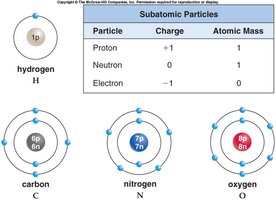
Subatomic Particles
Atoms are made up of three main subatomic particles, each with distinct properties:
Proton: Positively charged, found in the nucleus, atomic mass = 1.
Neutron: Neutral charge, found in the nucleus, atomic mass = 1.
Electron: Negatively charged, orbits the nucleus, atomic mass = 0.
Elements and the Periodic Table
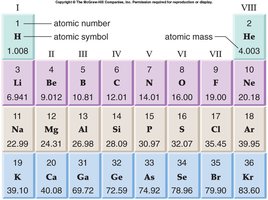
Each element is represented by an atomic symbol, atomic number (number of protons), and atomic mass (protons + neutrons). The periodic table organizes elements based on their properties and atomic structure.
Atomic Symbol: Abbreviation for the element (e.g., H for hydrogen).
Atomic Number: Number of protons in the nucleus.
Atomic Mass: Sum of protons and neutrons.
Isotopes
Isotopes are atoms of the same element with different numbers of neutrons, resulting in different atomic masses. Some isotopes are radioactive and decay over time, releasing energy. Radioactive isotopes are used in dating fossils, medical imaging, and cancer treatment.
Example: Carbon-12, Carbon-13, and Carbon-14 are isotopes of carbon.
Electron Configuration and Shells
Electrons determine the chemical properties of an atom. They occupy shells, or energy levels, around the nucleus. The first shell holds up to two electrons; subsequent shells hold up to eight. The arrangement of electrons, especially in the outermost shell, influences how atoms interact.
Shell: Region around the nucleus where electrons are likely found.
Octet Rule: Atoms tend to fill their outer shell with eight electrons for stability.
Molecules and Chemical Bonds
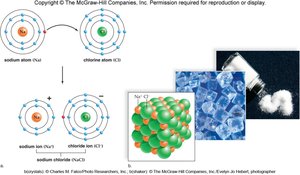
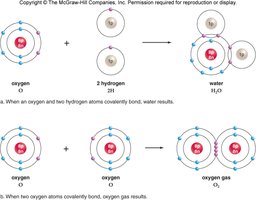
Molecules are formed when atoms bond together. The nature of these bonds depends on how atoms satisfy the octet rule:
Ionic Bonds: Atoms donate or accept electrons, forming ions. Oppositely charged ions attract each other.
Covalent Bonds: Atoms share electron pairs. If shared equally, the bond is non-polar; if unequally, it is polar.
Chemical Reactions
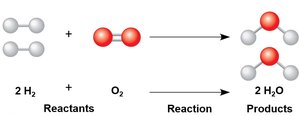
Chemical reactions involve the making and breaking of chemical bonds. Reactants are the starting substances, and products are the resulting substances. All chemical reactions are reversible, and equilibrium is reached when forward and reverse reaction rates are equal.
Example: Formation of water from hydrogen and oxygen.
Properties of Water
Polarity and Hydrogen Bonding
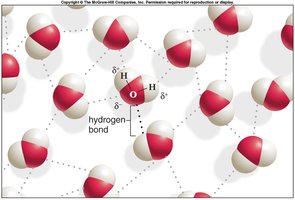
Water is a highly polar molecule due to unequal sharing of electrons between oxygen and hydrogen atoms. This results in partial charges and leads to hydrogen bonding, which is a weak attraction between a hydrogen atom and a negatively charged atom.
Polarity: Oxygen has a partial negative charge; hydrogen has a partial positive charge.
Hydrogen Bonds: Weak bonds that occur between water molecules.
Cohesion, Adhesion, and Surface Tension
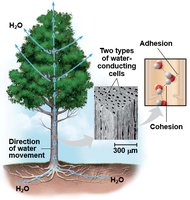
Hydrogen bonding gives water unique properties such as cohesion (water molecules stick to each other), adhesion (water molecules stick to other surfaces), and high surface tension (difficulty in breaking the surface of water).
Cohesion: Responsible for water transport in plants.
Adhesion: Helps water adhere to cell walls and other surfaces.
Surface Tension: Allows small objects to float on water.
Thermal Properties of Water
Water has a high specific heat, meaning it changes temperature slowly. It also has a high heat of vaporization, requiring much energy to convert from liquid to gas. These properties help stabilize temperatures in organisms and environments.
Specific Heat: Amount of heat needed to raise the temperature of 1g of water by 1°C.
Heat of Vaporization: Energy required to change water from liquid to vapor.
Density and Expansion Upon Freezing
Unlike most substances, water expands when it freezes, making ice less dense than liquid water. This allows ice to float, preventing bodies of water from freezing solid and supporting aquatic life.
Water as a Solvent
Water's polarity makes it an excellent solvent. It dissolves many substances, forming aqueous solutions. Hydrophilic substances interact with water, while hydrophobic substances do not.
Solution: Homogeneous mixture of solute and solvent.
Aqueous Solution: Water is the solvent.
Acids, Bases, and the pH Scale
Acids and Bases
Acids release hydrogen ions (H+), while bases accept hydrogen ions or release hydroxyl ions (OH-). Water can act as both an acid and a base.
The pH Scale
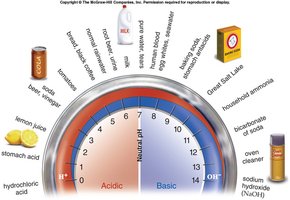
The pH scale measures hydrogen ion concentration, ranging from 0 (acidic) to 14 (basic), with 7 being neutral. It is a logarithmic scale; each unit change represents a tenfold change in H+ concentration.
Acidic: pH < 7
Basic: pH > 7
Neutral: pH = 7
Calculating pH Differences
Because the pH scale is logarithmic, a difference of one pH unit equals a tenfold difference in acidity or basicity. For example, lemon juice (pH 2) is 100 times more acidic than tomatoes (pH 4).
Formula:
Summary Table: Types of Chemical Bonds
Bond Type | Mechanism | Strength | Example |
|---|---|---|---|
Ionic | Electron transfer | Strong (in dry conditions) | NaCl (table salt) |
Covalent | Electron sharing | Strong | H2O (water) |
Hydrogen | Attraction between partial charges | Weak | Between water molecules |
Additional info: Academic context was added to clarify the role of water in biological systems, the importance of chemical bonds, and the calculation of pH differences.
