 Back
BackChordates: Structure, Evolution, and Diversity
Study Guide - Smart Notes
 Tailored notes based on your materials, expanded with key definitions, examples, and context.
LECTURE 12: Chordates: Key-Derived Characters and Evolutionary History
Overview of Chordate Diversity
Chordates are a major animal phylum distinguished by several unique anatomical features. Their evolutionary history is marked by the emergence of vertebrates, jaws, and adaptations for terrestrial life.
Chordates include vertebrates (animals with backbones) and two groups of invertebrate chordates: Cephalochordata (lancelets) and Urochordata (tunicates).
Key evolutionary innovations include the notochord, dorsal hollow nerve cord, pharyngeal slits, and post-anal tail.
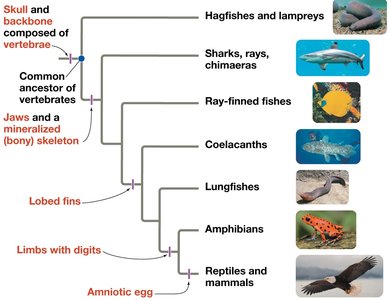
Vertebrates evolved additional features such as a backbone, jaws, and limbs with digits.
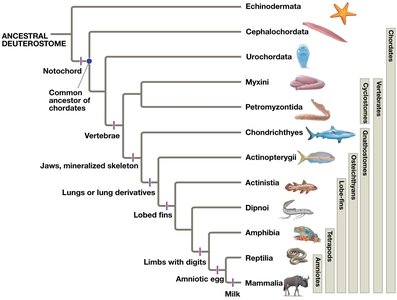
Phylogeny of Living Chordates
The phylogenetic tree of chordates illustrates the relationships among major groups and the sequence of evolutionary innovations.
Chordates are part of the Deuterostomia superphylum, which also includes echinoderms and hemichordates.
Major groups: Cephalochordata, Urochordata, Vertebrata (including jawless and jawed vertebrates).
Key innovations: notochord, vertebrae, jaws, lungs, lobed fins, limbs with digits, amniotic egg, and milk production.
Deuterostomia and Hemichordata
Deuterostome Development and Hemichordate Anatomy
Deuterostomes are defined by their embryonic development, where the blastopore becomes the anus. Hemichordates are "half chordates" sharing some chordate features.
Deuterostome traits: Enterocoelomates (coelom forms by budding from the archenteron).
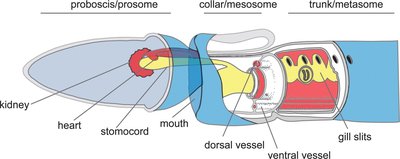
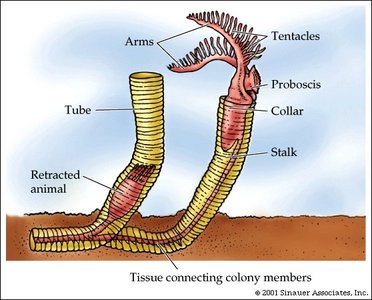
Hemichordata: Possess branchial openings (gill slits), a stomochord (rudimentary notochord), and both dorsal and ventral nerve cords.
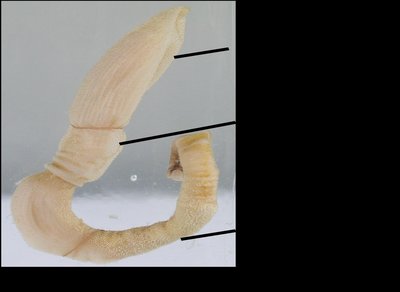
Anatomy divided into three regions: proboscis, collar, and trunk.
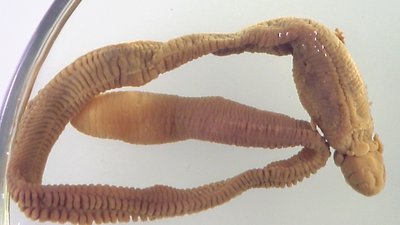
Hemichordate Diversity
Class Enteropneusta: Acorn worms, infaunal benthos, some species reach up to 2.5 meters.
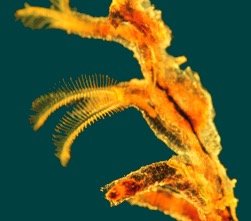
Class Hemichordata: Colonial tube-dwelling forms, body divided into three parts.
Chordate Derived Characters
Four Key Characters of Chordates
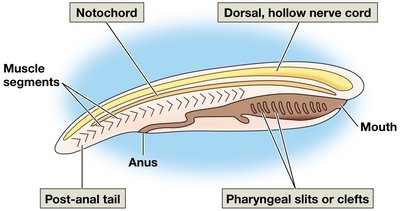
All chordates share four derived anatomical features, which may be present only during early development.
Notochord: Flexible, longitudinal rod providing skeletal support.
Dorsal, hollow nerve cord: Develops into the central nervous system (brain and spinal cord).
Pharyngeal slits or clefts: Grooves in the pharynx, function in feeding, gas exchange, or develop into head structures.
Muscular, post-anal tail: Contains muscles and skeletal elements, used for propulsion in aquatic species.
Notochord
The notochord is a defining feature of chordates, providing structural support and influencing development.
Located between the digestive tube and nerve cord.
In most vertebrates, replaced by a complex skeleton; remnants may persist.
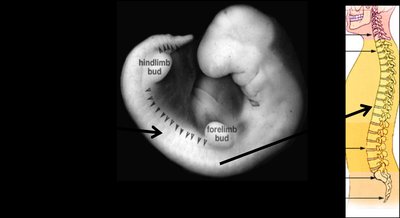
Dorsal, Hollow Nerve Cord
The nerve cord forms from ectoderm and becomes the central nervous system.
Develops into the brain and spinal cord in vertebrates.
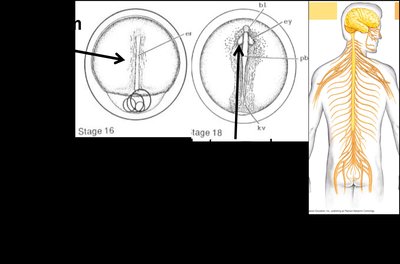
Pharyngeal Slits or Clefts
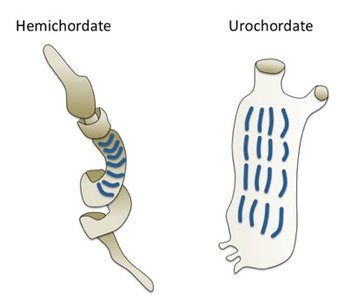
Pharyngeal slits are grooves in the pharynx that serve various functions across chordate groups.
Suspension feeding in invertebrate chordates.
Gas exchange (gills) in aquatic vertebrates.
In tetrapods, develop into parts of the ear, head, and neck.
Muscular, Post-Anal Tail
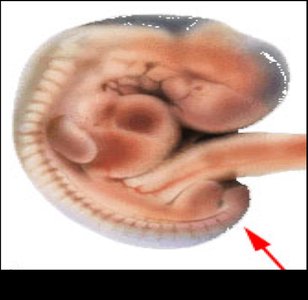
The post-anal tail is a muscular structure used for locomotion in many aquatic chordates.
Contains skeletal elements and muscles.
Reduced in many species during development.
Invertebrate Chordates: Cephalochordata and Urochordata
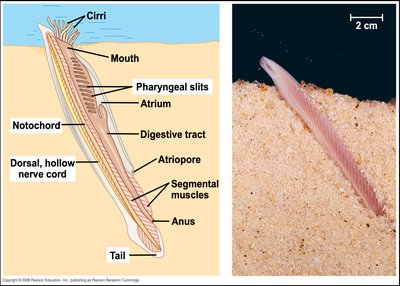
Cephalochordata (Lancelets)
Lancelets are marine suspension feeders that retain chordate features throughout life.
Bladelike shape, swim using muscle contractions.
Retain notochord, nerve cord, pharyngeal slits, and post-anal tail as adults.
Urochordata (Tunicates)
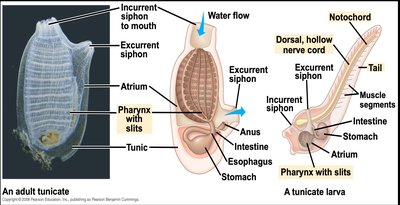
Tunicates are more closely related to vertebrates than lancelets.
Chordate features are most apparent in the larval stage.
Adults are sessile, filter-feeding sea squirts.
Larvae use tail muscles and notochord for swimming before settling.
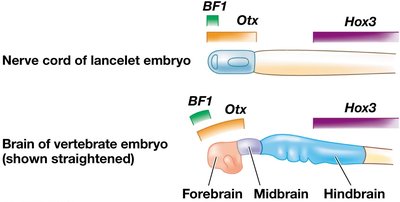
Adults have fewer Hox genes compared to vertebrates.
Early Chordate Evolution
Developmental Genes and Evolutionary Relationships
Ancestral chordates had a mouth, notochord, nerve cord, pharyngeal slits, and post-anal tail.
Developmental genes (Hox genes) control nerve cord and brain development in both lancelets and vertebrates.
Neural Crest and Vertebrate Innovations
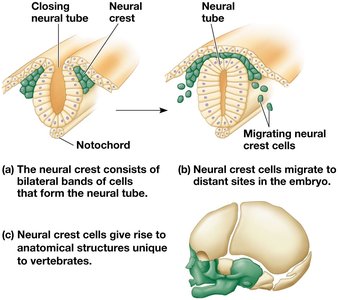
The neural crest is a unique vertebrate feature, giving rise to diverse anatomical structures.
Neural crest cells migrate and form teeth, skull bones, neurons, and sensory capsules.
Vertebrates have multiple sets of Hox genes, enabling complex nervous system and skeletal development.
Jawless Vertebrates: Hagfishes and Lampreys
Hagfishes (Myxini)
Hagfishes are jawless vertebrates with reduced vertebrae and a cartilaginous skull.
Retain notochord as a flexible rod.
Bottom-dwelling scavengers, produce slime for defense.
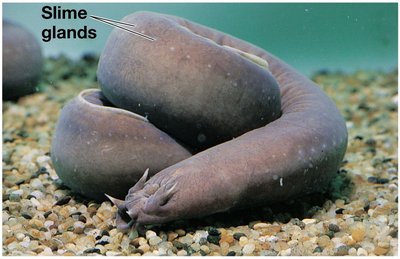
Lampreys (Petromyzontida)
Lampreys are jawless vertebrates with a notochord and cartilaginous skeleton.
Larvae live in streams; adults may be parasitic or free-living.
Parasitic lampreys feed on host fish blood and tissue.
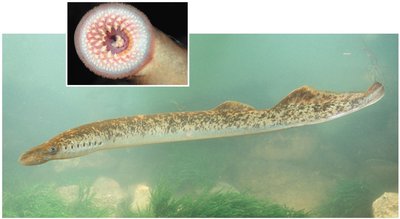
Early Vertebrate Evolution
Fossil Evidence and Key Innovations
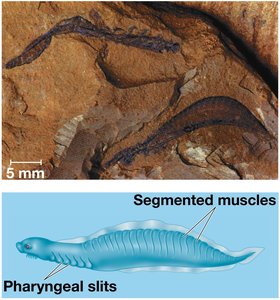
Fossils from the Cambrian explosion document the transition to vertebrates.
Haikouella: Primitive chordate with brain, eyes, and muscular segments.
Myllokunmingia: First chordate with a head, but lacking vertebrae.
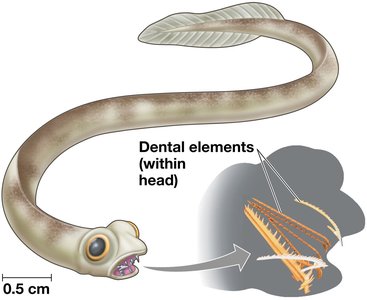
Conodonts: Early vertebrates with mineralized dental elements (first mineralized skeletal elements).
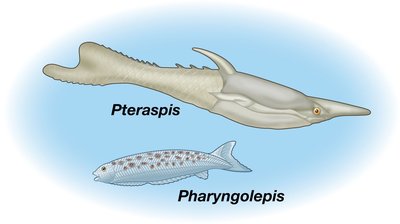
Jawless armored vertebrates used mineralized bone for protection.
Gnathostomes: Jawed Vertebrates
Evolutionary Advantages of Jaws
Gnathostomes are vertebrates with jaws, which provide significant evolutionary advantages.
Jaws evolved from skeletal rods supporting pharyngeal slits.
Enable gripping and slicing of food, facilitating active predation.
Gnathostome Innovations
Genome duplication (four sets of Hox genes).
Enlarged forebrain, enhanced senses (smell, vision).
Lateral line system for detecting vibrations in aquatic species.
Fossil Gnathostomes and Modern Lineages
Placoderms and Acanthodians
Early gnathostomes included armored vertebrates such as placoderms and acanthodians.
Placoderms: Extinct by 359 million years ago, ranged from less than 1 meter to over 10 meters.
Acanthodians: Radiated during 444–359 million years ago, extinct about 70 million years after placoderms.
Modern Gnathostome Lineages
By 420 million years ago, jawed vertebrates diverged into three surviving lineages:
Chondrichthyans: Sharks, rays, and relatives.
Ray-finned fishes: Actinopterygii.
Lobe-fins: Actinistia, Dipnoi, and tetrapods.
Chondrichthyans: Sharks, Rays, and Relatives
Chondrichthyan Anatomy and Diversity
Chondrichthyans have skeletons composed primarily of cartilage, often impregnated with calcium.
Includes sharks, skates, rays, and ratfishes (chimaeras).
Streamlined bodies, paired fins for maneuvering, oil in liver for buoyancy.
Continual swimming required for gas exchange.
Feeding and Reproduction
Largest sharks and rays are suspension feeders; most are carnivores.
Acute senses, spiral valve in digestive tract increases surface area.
Internal fertilization; embryos develop via oviparous, ovoviviparous, or viviparous methods.
Ray-Finned Fishes and Lobe-Fins
Ray-Finned Fishes (Actinopterygii)
Ray-finned fishes are the most diverse group of vertebrates, with over 27,000 species.
Bony endoskeleton, gills protected by operculum, swim bladder for buoyancy.
Covered by bony scales, mucus glands reduce drag, lateral line system detects vibrations.
Mostly oviparous with external fertilization.
Lobe-Fins (Actinistia, Dipnoi, Tetrapods)
Lobe-fins are characterized by fleshy, lobed paired fins.
Three surviving lineages: coelacanths, lungfishes, and tetrapods.
Coelacanths were thought extinct until rediscovered in 1938.
Lungfishes use both gills and lungs for gas exchange.
Summary Table: Major Chordate Groups and Key Features
Group | Key Features | Example |
|---|---|---|
Cephalochordata | Notochord, nerve cord, pharyngeal slits, post-anal tail | Lancelet |
Urochordata | Larval chordate features, adult filter-feeding | Tunicate |
Myxini | Jawless, slime glands, notochord | Hagfish |
Petromyzontida | Jawless, notochord, cartilaginous skeleton | Lamprey |
Chondrichthyes | Cartilaginous skeleton, jaws, paired fins | Shark |
Actinopterygii | Bony skeleton, ray fins, operculum | Trout |
Actinistia | Lobed fins, bony skeleton | Coelacanth |
Dipnoi | Lobed fins, lungs | Lungfish |
Amphibia | Limbs with digits, moist skin | Frog |
Reptilia | Amniotic egg, scales | Lizard |
Mammalia | Milk, hair | Mouse |
Key Terms and Concepts
Notochord: Longitudinal, flexible rod providing skeletal support.
Dorsal, hollow nerve cord: Develops into central nervous system.
Pharyngeal slits: Grooves in pharynx for feeding or gas exchange.
Post-anal tail: Muscular tail extending beyond anus.
Gnathostomes: Jawed vertebrates.
Chondrichthyans: Cartilaginous fishes (sharks, rays).
Osteichthyans: Bony fishes and tetrapods.
Lobe-fins: Fleshy, lobed paired fins.
Neural crest: Embryonic cells unique to vertebrates.
Important Equations and Concepts
Hox gene duplication: Key to vertebrate complexity.
Gas exchange: diffusion across gill membranes.
Buoyancy: Swim bladder volume regulates position in water column.
Summary
Chordates are defined by four key anatomical features and have diversified into a wide range of forms, from simple invertebrates to complex vertebrates. The evolution of jaws, limbs, and other innovations enabled the conquest of new ecological niches and the emergence of terrestrial vertebrates. Additional info: Some details about developmental genes and fossil evidence were inferred for completeness.
