 Back
BackChromatin Structure, Epigenetics, and Regulation of Gene Expression
Study Guide - Smart Notes
 Tailored notes based on your materials, expanded with key definitions, examples, and context.
Chromatin Structure and DNA Packaging
DNA Organization in Eukaryotic Chromosomes
Eukaryotic chromosomes contain linear DNA molecules that are tightly associated with proteins, forming a complex structure called chromatin. This organization allows the long DNA molecules to fit within the cell nucleus and plays a critical role in gene regulation.
Chromatin: The combination of DNA and proteins (mainly histones) that makes up the contents of the nucleus.
Chromatin exists in different states of packing, influencing gene accessibility and expression.
Euchromatin: Loosely packed chromatin, generally associated with actively transcribed genes.
Heterochromatin: Densely packed chromatin, typically transcriptionally inactive.
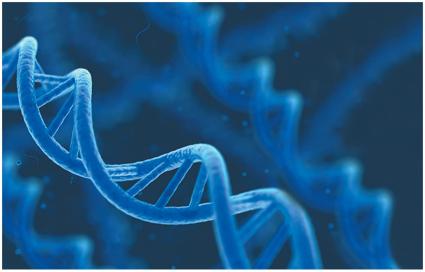
Levels of Chromatin Packing
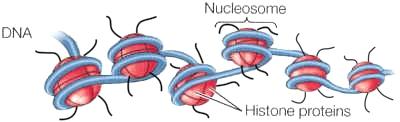
DNA is packaged through several hierarchical levels, with proteins called histones playing a central role in the first level of packing. The basic unit of chromatin structure is the nucleosome.
Histones: Positively charged proteins (rich in lysine and arginine) that DNA wraps around.
Each nucleosome consists of eight histone subunits, with DNA wrapped twice around this core.
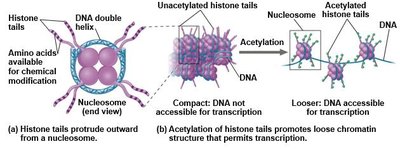
The N-terminal "tails" of histones protrude from the nucleosome and are sites for chemical modification.
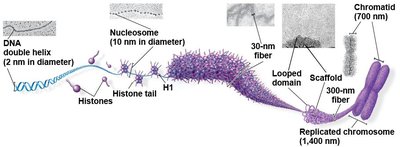
Chromatin undergoes further compaction to form higher-order structures, especially during cell division (mitosis and meiosis), resulting in highly condensed chromosomes.
Nucleosome and "Beads on a String" Structure
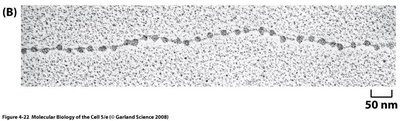
The nucleosome is often visualized as "beads on a string," where each bead represents a nucleosome and the string is the DNA connecting them. This structure is the first level of DNA compaction in eukaryotic cells.
Regulation of Chromatin Structure and Gene Expression
Chromatin Structure and Gene Regulation
The organization of chromatin is not only structural but also functional, as it regulates gene expression. Genes located in highly condensed chromatin are generally not expressed, while those in less condensed regions are accessible for transcription.
Chromatin structure can be dynamically altered to regulate access to DNA for transcription.
Histone Modifications
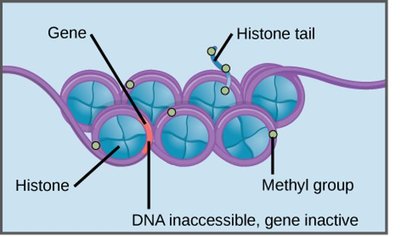
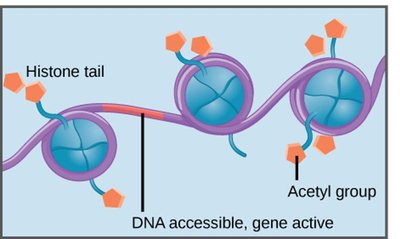
Chemical modifications to histones, especially their N-terminal tails, play a key role in regulating chromatin structure and gene expression. These modifications are reversible and include acetylation, methylation, phosphorylation, and others.
Histone acetylation: Addition of acetyl groups to lysine residues in histone tails, generally associated with open chromatin and active gene transcription.
Histone methylation: Addition of methyl groups, which can either activate or repress gene expression depending on the context.
DNA Methylation
In addition to histone modifications, DNA itself can be chemically modified. The most common modification is the addition of methyl groups to cytosine bases, which typically represses gene expression. DNA methylation patterns are heritable during cell division.
DNA methylation is a key mechanism of epigenetic regulation.
Methylation patterns are copied during DNA replication, ensuring that daughter cells inherit the same gene expression patterns.
Epigenetics and Epigenetic Inheritance
Epigenetics: Definition and Importance
Epigenetics refers to heritable changes in gene expression that do not involve changes to the underlying DNA sequence. The epigenome consists of chemical compounds and modifications that mark the genome and regulate gene activity.
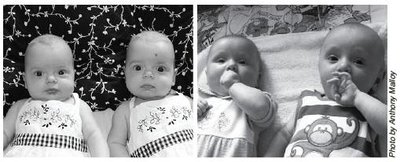
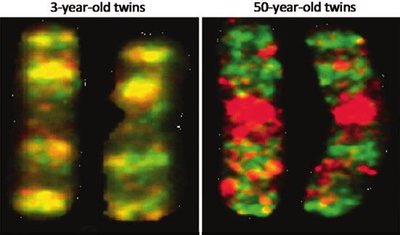
Environmental factors can influence the epigenome, leading to differences in gene expression even among genetically identical individuals (e.g., identical twins).
Epigenetic tags (such as methyl and acetyl groups) can be added or removed in response to environmental cues.
Epigenetic Inheritance
Epigenetic modifications can sometimes be passed to future generations, a phenomenon known as epigenetic inheritance. This means that traits can be inherited through mechanisms other than changes in the DNA sequence itself.
Epigenetic inheritance plays a role in development, disease, and adaptation to environmental changes.
Summary Table: Chromatin Structure and Regulation
Feature | Description | Effect on Gene Expression |
|---|---|---|
Euchromatin | Loosely packed chromatin | Transcriptionally active |
Heterochromatin | Densely packed chromatin | Transcriptionally inactive |
Histone Acetylation | Addition of acetyl groups to histone tails | Promotes gene expression |
DNA Methylation | Addition of methyl groups to DNA bases | Usually represses gene expression |
Epigenetic Inheritance | Transmission of chromatin modifications | Can affect gene expression in offspring |
