 Back
Chromosomal Basis of Inheritance and Chromosome Alterations
Study Guide - Smart Notes
 Tailored notes based on your materials, expanded with key definitions, examples, and context.
Chromosomal Basis of Inheritance; Chapter 12
Key Terminology
Wild-type: The most common phenotype observed in natural populations; considered the standard or "normal" form.
Mutant: Phenotypes that differ from the wild-type due to genetic changes.
Sex-linked genes: Genes located on sex chromosomes (X or Y in humans).
Linked genes: Genes located close together on the same chromosome and tend to be inherited together.
Unlinked genes: Genes located far apart on the same chromosome or on different chromosomes; assort independently.
Hemizygous: Having only one allele for a gene in a diploid organism (e.g., males are hemizygous for X-linked genes).
Sex Determination and Sex-Linked Inheritance
In humans, sex is determined by the presence of X and Y chromosomes. Genes located on these chromosomes exhibit unique inheritance patterns, especially those on the X chromosome (X-linked genes).
Y-linked genes: Found only on the Y chromosome; few in number and mostly related to male sex determination.
X-linked genes: Found on the X chromosome; affect both males and females but show distinct inheritance patterns due to males having only one X chromosome.
Inheritance of X-Linked Genes
X-linked recessive traits are more commonly expressed in males because they have only one X chromosome (hemizygous). Females must inherit two copies of the recessive allele to express the trait, while males need only one.
Examples of X-linked recessive disorders: Color blindness, Duchenne muscular dystrophy, Hemophilia.
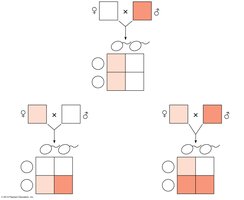
Why do X-linked traits mostly affect males? Males have only one X chromosome, so a single recessive allele on the X will result in the disorder. Females have two X chromosomes, so a recessive allele must be present on both to express the trait.
Monohybrid Punnett Squares for X-Linked Traits
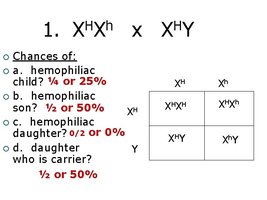
Punnett squares can be used to predict the inheritance of X-linked traits. For example, crossing a carrier female (XHXh) with a normal male (XHY) yields the following probabilities:
25% chance of a hemophiliac child
50% chance of a hemophiliac son
0% chance of a hemophiliac daughter
50% chance of a daughter who is a carrier
Linked and Unlinked Genes
Linked Genes
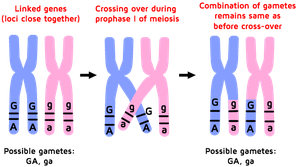
Linked genes are located close together on the same chromosome and tend to be inherited together. They do not assort independently unless crossing over occurs between them during meiosis.
Unlinked Genes
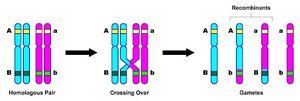
Unlinked genes are either on different chromosomes or far apart on the same chromosome. They assort independently during meiosis, following Mendel's law of independent assortment.
Alterations of Chromosome Number and Structure
Nondisjunction and Aneuploidy
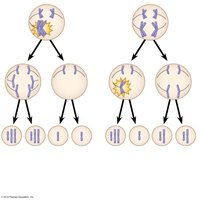
Nondisjunction is the failure of homologous chromosomes or sister chromatids to separate properly during meiosis. This results in gametes with abnormal numbers of chromosomes, leading to aneuploidy in offspring.
Aneuploidy: Condition where an organism has an abnormal number of a particular chromosome.
Monosomy: Only one copy of a chromosome (2n - 1).
Trisomy: Three copies of a chromosome (2n + 1).
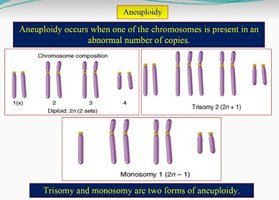
Examples of Aneuploidy
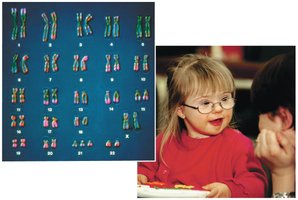
Down Syndrome (Trisomy 21): Caused by three copies of chromosome 21; associated with developmental delays and characteristic physical features.
Klinefelter Syndrome (XXY): Males with an extra X chromosome; may have reduced fertility and some female characteristics.
Turner Syndrome (XO): Females with only one X chromosome; typically infertile and may have other physical differences.
Trisomy X (XXX): Females with three X chromosomes; usually normal but may be taller than average.
Polyploidy
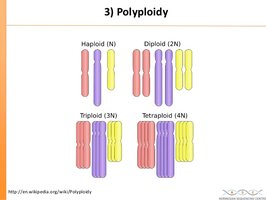
Polyploidy is the condition of having more than two complete sets of chromosomes. It is common in plants and can result in triploidy (3n) or tetraploidy (4n).
Alterations of Chromosome Structure
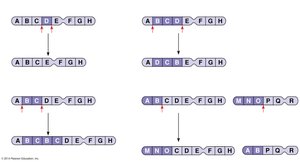
Chromosome breakage can lead to structural changes:
Deletion: Loss of a chromosomal segment.
Duplication: Repetition of a segment.
Inversion: Reversal of a segment within a chromosome.
Translocation: Movement of a segment to a nonhomologous chromosome.
Human Disorders Due to Chromosomal Alterations
Cri du chat syndrome: Caused by a deletion in chromosome 5; characterized by intellectual disability and a catlike cry.
Chronic myelogenous leukemia (CML): Caused by a translocation between chromosomes.
Summary Table: Types of Chromosomal Alterations
Type | Description | Example Disorder |
|---|---|---|
Aneuploidy | Abnormal number of chromosomes (monosomy, trisomy) | Down syndrome (Trisomy 21), Turner syndrome (XO) |
Polyploidy | More than two complete sets of chromosomes | Common in plants |
Deletion | Loss of a chromosome segment | Cri du chat syndrome |
Duplication | Repeat of a chromosome segment | Some developmental disorders |
Inversion | Reversal of a chromosome segment | Usually no major disorder, but can affect fertility |
Translocation | Segment moves to a nonhomologous chromosome | Chronic myelogenous leukemia (CML) |
Additional info: Chromosomal alterations can have profound effects on development and health. While many such changes are lethal, some result in viable individuals with characteristic syndromes. Plants are more tolerant of polyploidy than animals, and polyploidy is a major mechanism of speciation in plants.
