 Back
Chromosomal Basis of Inheritance and Chromosome Alterations
Study Guide - Smart Notes
 Tailored notes based on your materials, expanded with key definitions, examples, and context.
Chromosome Theory of Inheritance
Overview
The chromosome theory of inheritance states that genes are located at specific positions (loci) on chromosomes, and the behavior of chromosomes during meiosis explains inheritance patterns. This theory integrates Mendelian genetics with cytology, providing a physical basis for the transmission of genetic traits.
Genes are carried on chromosomes.
Chromosomes undergo segregation and independent assortment during meiosis, mirroring Mendel’s laws.
Sex Chromosomes and Sex-Linked Inheritance
Sex Chromosomes
Humans have two types of sex chromosomes: X and Y.
SRY gene on the Y chromosome is essential for male development (XY genotype).
The X chromosome contains about 1,100 genes, while the Y chromosome has only about 78.
Sex-Linked Genes
Sex-linked gene: A gene located on either sex chromosome (X or Y).
X-linked genes: Genes found on the X chromosome; males are hemizygous for these genes because they have only one X.
Y-linked genes: Genes found on the Y chromosome; only present in males.
Examples of X-Linked Disorders
Duchenne muscular dystrophy: X-linked recessive disorder causing progressive muscle weakness; affects 1 in 5,000 males in the U.S.
Hemophilia: X-linked recessive disorder characterized by the absence of proteins required for blood clotting; treated with protein injections.
Barr Body and X-Inactivation
In female mammals, one X chromosome in each somatic cell is inactivated and condenses into a Barr body.
XIST gene produces RNA that coats the X chromosome to be inactivated, initiating and regulating the process.
This leads to a mosaic pattern of gene expression in females (e.g., calico cats).
Linked Genes and Genetic Recombination
Linked Genes
Linked genes are located close together on the same chromosome and tend to be inherited together. This affects the expected ratios of offspring phenotypes.
Parental types: Offspring with phenotypes matching one of the parents.
Recombinant types: Offspring with new combinations of traits not found in either parent.
When 50% of offspring are recombinants, the genes are likely unlinked (assort independently).
Genetic Mapping
Genetic map: Ordered list of genetic loci along a chromosome.
Linkage map: Based on recombination frequencies; 1 map unit (centimorgan) = 1% recombination frequency.
The farther apart two genes are, the higher the probability of crossover and recombination.
Chromosomal Alterations
Types of Chromosomal Alterations
Deletion: Loss of a chromosome fragment, resulting in missing genes.
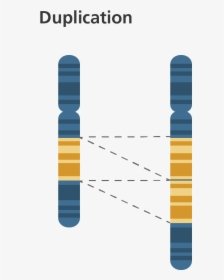
Duplication: Repetition of a chromosome segment due to attachment of a fragment to a sister or nonsister chromatid.
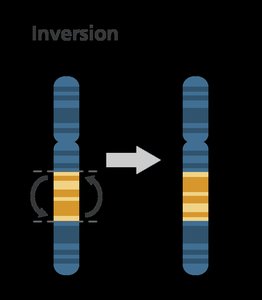
Inversion: A chromosome fragment reattaches to the original chromosome in reverse orientation, potentially altering phenotype.
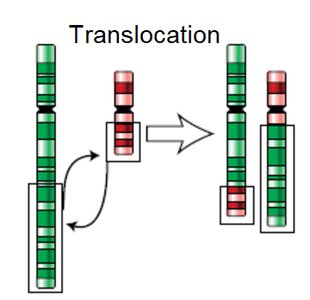
Translocation: A fragment joins a nonhomologous chromosome, which can disrupt gene function and lead to disorders.
Aneuploidy and Polyploidy
Aneuploidy: Abnormal number of chromosomes (extra or missing chromosomes).
Monosomic: 2n - 1 chromosomes (one missing).
Trisomic: 2n + 1 chromosomes (one extra).
Polyploidy: More than two complete sets of chromosomes (e.g., triploidy 3n, tetraploidy 4n); common in plants.
Human Disorders from Chromosomal Alterations
Down syndrome: Trisomy 21; causes developmental delays, characteristic facial features, and increased risk of certain diseases.
Klinefelter syndrome: XXY genotype in males; may cause sterility and some female characteristics.
Turner syndrome: Monosomy X (XO) in females; only known viable monosomy in humans.
Cri du chat: Deletion on chromosome 5; causes intellectual disability and distinctive cry.
Chronic myelogenous leukemia (CML): Caused by translocation between chromosomes 9 and 22 (Philadelphia chromosome).
Meiotic Errors and Nondisjunction
Nondisjunction
Nondisjunction is the failure of homologous chromosomes or sister chromatids to separate properly during meiosis, leading to gametes with abnormal chromosome numbers.
Meiosis I nondisjunction: Both homologs go to the same pole; results in two n+1 and two n-1 gametes.
Meiosis II nondisjunction: Sister chromatids fail to separate; results in two normal (n), one n+1, and one n-1 gamete.
Fertilization with abnormal gametes leads to trisomy (2n+1) or monosomy (2n-1).
Learning Goals and Applications
Key Skills
Predict genotype and phenotype ratios for crosses involving X-linked or Y-linked genes.
Contrast inheritance patterns of sex-linked versus autosomal genes.
Explain why X-linked disorders are more common in males (hemizygosity, lack of masking allele).
Interpret pedigrees for sex-linked traits.
Describe X-inactivation and its phenotypic consequences (e.g., mosaicism in females).
Explain gene linkage and predict genotype ratios for linked versus unlinked genes.
Use recombination frequency to estimate gene distances on chromosomes.
Describe how nondisjunction leads to aneuploidy and its consequences.
Formulas and Equations
Recombination frequency:
Map units (centimorgans):
