 Back
Chromosomal Basis of Inheritance and Chromosome Alterations
Study Guide - Smart Notes
 Tailored notes based on your materials, expanded with key definitions, examples, and context.
Chromosome Theory of Inheritance
Overview
The chromosome theory of inheritance states that genes are located at specific positions (loci) on chromosomes, and the behavior of chromosomes during meiosis explains inheritance patterns. This theory integrates Mendelian genetics with cytology, providing a physical basis for the transmission of genetic traits.
Genes are carried on chromosomes.
Chromosomes undergo segregation and independent assortment during meiosis, mirroring Mendel's laws.
Sex Chromosomes and Sex-Linked Inheritance
Sex Chromosomes
Humans have two types of sex chromosomes: X and Y.
SRY gene on the Y chromosome is essential for male development (XY genotype).
The X chromosome contains about 1,100 genes, while the Y chromosome has only about 78.
Sex-Linked Genes
Sex-linked gene: A gene located on either sex chromosome (X or Y).
X-linked genes: Genes located on the X chromosome; males are hemizygous for these genes because they have only one X.
Y-linked genes: Genes located on the Y chromosome; only present in males.
Inheritance Patterns
Autosomal genes: Located on chromosomes 1-22; inherited equally by both sexes.
Sex-linked genes: Inheritance patterns differ because females are XX and males are XY.
Fathers pass their X chromosome to all daughters and their Y to all sons; mothers pass an X to every child.
X-Linked Disorders
Duchenne muscular dystrophy: X-linked recessive disorder causing progressive muscle weakness; affects 1 in 5,000 males in the U.S.
Hemophilia: X-linked recessive disorder characterized by the absence of proteins required for blood clotting; treated with protein injections.
Males are more frequently affected by X-linked disorders because they have only one X chromosome and no second allele to mask a recessive mutation.
Females can be carriers and may show mild symptoms due to X-inactivation.
X-Inactivation and Barr Bodies
Mechanism and Consequences
In female mammals, one of the two X chromosomes in each somatic cell is randomly inactivated early in embryonic development. The inactivated X condenses into a Barr body and lies inside the nuclear envelope.
XIST gene: Produces RNA that coats the X chromosome to be inactivated, triggering chromatin modifications (DNA methylation, histone changes).
Results in a mosaic of cells expressing different X-linked alleles (e.g., calico cats).
Gene Linkage and Genetic Recombination
Linked Genes
Linked genes: Genes located close together on the same chromosome; tend to be inherited together.
Crossing over during meiosis can separate linked genes, producing recombinant offspring.
Genetic Recombination
Parental types: Offspring with phenotypes matching one of the parental phenotypes.
Recombinant types: Offspring with new combinations of traits not found in either parent.
When 50% of offspring are recombinants, the genes assort independently (unlinked).
Genetic and Linkage Maps
Genetic map: Ordered list of genetic loci along a chromosome.
Linkage map: Based on recombination frequencies; distance measured in map units (1 map unit = 1% recombination frequency).
The farther apart two genes are, the higher the probability of crossover and recombination.
Chromosomal Alterations
Types of Chromosomal Alterations
Deletion: Loss of a chromosome fragment, resulting in missing genes.
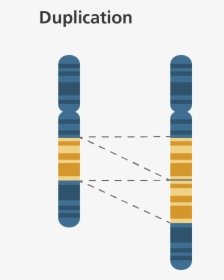
Duplication: Repetition of a chromosome segment.
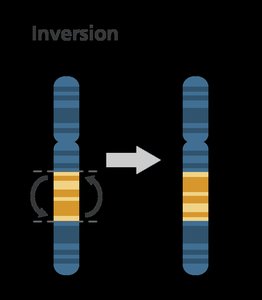
Inversion: A chromosome fragment reattaches in reverse orientation.
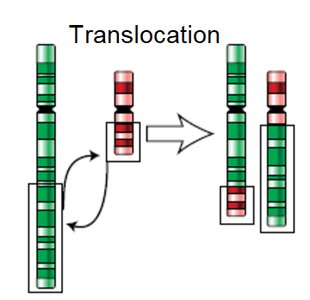
Translocation: A fragment joins a nonhomologous chromosome.
Consequences of Chromosomal Alterations
Can alter phenotypes and cause genetic disorders.
Cri du chat syndrome: Deletion on chromosome 5; causes severe developmental issues.
Chronic myelogenous leukemia (CML): Translocation between chromosomes 9 and 22 (Philadelphia chromosome).
Aneuploidy and Polyploidy
Definitions and Types
Aneuploidy: Abnormal number of chromosomes (extra or missing chromosomes).
Monosomic: 2n - 1 chromosomes (missing one chromosome).
Trisomic: 2n + 1 chromosomes (one extra chromosome).
Polyploidy: More than two complete sets of chromosomes (e.g., triploidy 3n, tetraploidy 4n); common in plants.
Human Aneuploid Conditions
Down syndrome: Trisomy 21; causes characteristic facial features, developmental delays, and increased risk of certain diseases.
Klinefelter syndrome: XXY genotype; affects males, causing sterility and some female characteristics.
Turner syndrome: Monosomy X (XO); only viable monosomy in humans, affects females.
Females with XXX have no unusual physical features but may have learning disabilities.
XYY males are typically normal.
Mechanisms of Chromosomal Nondisjunction
Nondisjunction in Meiosis
Nondisjunction: Failure of homologous chromosomes (meiosis I) or sister chromatids (meiosis II) to separate properly.
Results in gametes with abnormal chromosome numbers (n+1 or n-1).
Fertilization with a normal gamete leads to trisomy (2n+1) or monosomy (2n-1).
Learning Goals and Applications
Key Skills and Concepts
Predict genotype and phenotype ratios for crosses involving X-linked or Y-linked genes.
Contrast inheritance patterns of sex-linked and autosomal genes.
Explain why males are more often affected by X-linked disorders.
Interpret pedigrees involving sex-linked traits.
Describe X-inactivation and its phenotypic consequences.
Explain gene linkage and predict genotype ratios for linked versus unlinked genes.
Use recombination frequency to estimate physical distance between genes.
Describe how nondisjunction leads to aneuploidy.
Term | Definition | Example/Notes |
|---|---|---|
Wild type | Most common phenotype in natural populations | Red eyes in fruit flies |
Hemizygous | Having only one allele for a gene (e.g., X-linked genes in males) | Males for X-linked traits |
Barr body | Inactive X chromosome in female cells | Visible in nucleus |
Map unit | 1% recombination frequency | Measures gene distance |
