 Back
BackChromosomal Basis of Inheritance and Chromosome Structure
Study Guide - Smart Notes
 Tailored notes based on your materials, expanded with key definitions, examples, and context.
Chromosomal Inheritance
Overview of Chromosomal Inheritance
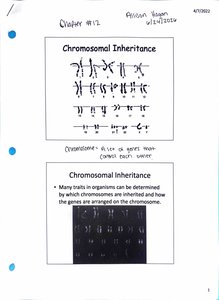
Chromosomal inheritance refers to the transmission of genetic material through chromosomes, which are structures composed of DNA and proteins. The arrangement and behavior of chromosomes during cell division determine how traits are inherited.
Chromosomes: Structures that carry genes; humans have 23 pairs.
Genes: Segments of DNA located on chromosomes that code for specific traits.
Inheritance: Traits are inherited based on the arrangement and segregation of chromosomes.
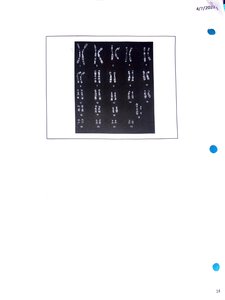
Example: The karyotype shows the organization of chromosomes in a cell.
Linked Genes and Genetic Maps
Linkage and Genetic Mapping
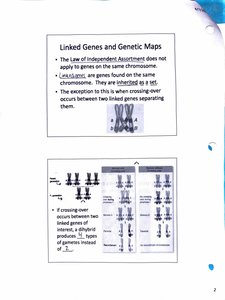
Linked genes are genes located on the same chromosome and tend to be inherited together. Genetic maps are constructed by analyzing the frequency of crossing-over between linked genes.
Law of Independent Assortment: Does not apply to genes on the same chromosome.
Linkage: Genes on the same chromosome are inherited as a set unless crossing-over occurs.
Crossing-over: Exchange of genetic material between homologous chromosomes during meiosis, which can separate linked genes.
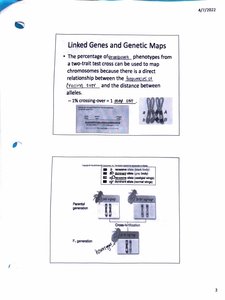
Genetic Maps: Created by calculating recombination frequencies; 1% crossing-over = 1 map unit (centimorgan).
Example: Dihybrid crosses can reveal linkage and recombination.
Sex Chromosomes and Sex Linkage
Human Sex Chromosomes
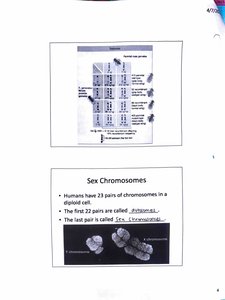
Humans have 23 pairs of chromosomes, with the last pair determining sex. The X and Y chromosomes carry genes that influence sexual development and other traits.
Autosomes: The first 22 pairs of chromosomes.
Sex Chromosomes: The 23rd pair; XX for females, XY for males.
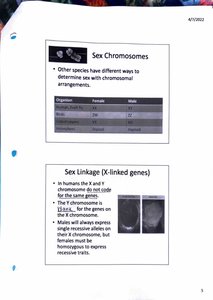
Other Species: Sex determination systems vary among organisms.
Sex Linkage (X-linked Genes)
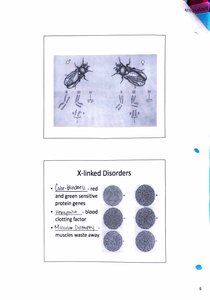
Sex-linked genes are located on the X or Y chromosomes. X-linked genes are more commonly expressed in males due to their single X chromosome.
X-linked Genes: Genes found on the X chromosome.
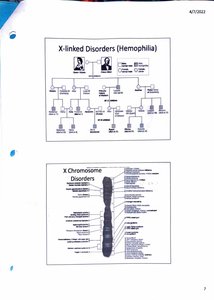
Expression: Males express recessive X-linked traits more frequently; females may be carriers.
Example: Disorders such as color blindness and hemophilia are X-linked.
Barr Bodies
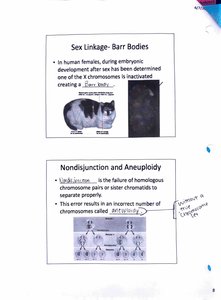
In female mammals, one X chromosome is inactivated during embryonic development, forming a Barr body. This ensures dosage compensation between males and females.
Barr Body: Inactive X chromosome in female cells.
Dosage Compensation: Equalizes expression of X-linked genes.
Nondisjunction and Aneuploidy
Nondisjunction
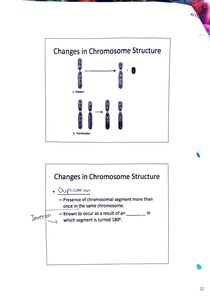
Nondisjunction is the failure of homologous chromosomes or sister chromatids to separate properly during meiosis, resulting in gametes with abnormal chromosome numbers.
Aneuploidy: Condition of having an abnormal number of chromosomes.
Monosomy: (2n-1) One chromosome missing from a pair.
Trisomy: (2n+1) One extra chromosome in a pair.
Common Examples: Turner syndrome (XO), Klinefelter syndrome (XXY), and other sex chromosome syndromes.
Sex Chromosome Syndromes
Abnormalities in sex chromosome number can lead to specific syndromes with characteristic symptoms.
Turner Syndrome (XO): Female with under-developed ovaries and secondary sex characteristics.
Klinefelter Syndrome (XXY): Male with under-developed testes and some female body characteristics.
Poly-X Females: More than two X chromosomes; extra Barr bodies present.
Jacob Syndrome (XYY): Males with an extra Y chromosome; often taller than average.
Polyploidy
Polyploidy is the condition where an individual has more than two complete sets of chromosomes. It is rare in animals but common in plants.
Polyploidy: More than two multiples of the haploid chromosome set.
Examples: Triploid (3n), tetraploid (4n), octoploid (8n).
Changes in Chromosome Structure
Types of Chromosomal Structural Changes
Chromosomal structure can be altered by several mechanisms, affecting gene expression and leading to genetic disorders.
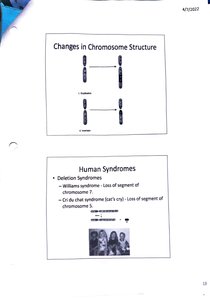
Deletion: Loss of a chromosome segment.
Translocation: Movement of a segment from one chromosome to another, non-homologous chromosome.
Duplication: Presence of a chromosome segment more than once in the same chromosome.
Inversion: Segment of chromosome is turned 180°.
Human Syndromes Associated with Chromosomal Changes
Specific syndromes are caused by structural changes in chromosomes, such as deletions.
Williams Syndrome: Loss of segment of chromosome 7.
Cri du chat Syndrome: Loss of segment of chromosome 5.
Summary Table: Chromosomal Disorders
The following table summarizes key chromosomal disorders discussed:
Disorder | Chromosomal Change | Symptoms |
|---|---|---|
Turner Syndrome (XO) | Monosomy X | Female, under-developed ovaries |
Klinefelter Syndrome (XXY) | Extra X chromosome | Male, under-developed testes |
Poly-X Female | More than two X chromosomes | Extra Barr bodies, tall stature |
Jacob Syndrome (XYY) | Extra Y chromosome | Tall male |
Williams Syndrome | Deletion of chromosome 7 | Distinct facial features, cardiovascular issues |
Cri du chat Syndrome | Deletion of chromosome 5 | Cat-like cry, intellectual disability |
Key Equations
Recombination frequency and genetic mapping:
Additional info: Academic context was added to clarify definitions, examples, and mechanisms for each topic. The notes are structured to provide a comprehensive overview suitable for exam preparation in General Biology.
