 Back
Chromosomal Basis of Inheritance: Study Guide and Key Concepts
Study Guide - Smart Notes
 Tailored notes based on your materials, expanded with key definitions, examples, and context.
Chromosomal Basis of Inheritance
Heredity and Genes
Heredity is the process by which genetic information is passed from parent organisms to their offspring. The basic unit of heredity is the gene, which is a segment of DNA located at a specific locus on a chromosome. The genome refers to the complete set of genetic information in an organism.
Gene: Segment of DNA coding for a protein.
Locus: Specific location of a gene on a chromosome.
Genome: Entire genetic content of an organism.
Chromosome Theory of Inheritance
The chromosome theory of inheritance states that Mendelian genes have specific loci on chromosomes, and chromosomes undergo segregation and independent assortment during meiosis. This theory explains how the behavior of chromosomes during meiosis accounts for Mendel’s laws.
Segregation: Homologous chromosomes separate during meiosis I.
Independent Assortment: Chromosomes assort independently during meiosis.
Historical Figures in Genetics
Gregor Mendel: Established laws of segregation and independent assortment.
Thomas Hunt Morgan: Provided evidence linking specific genes to chromosomes using Drosophila melanogaster (fruit fly).
Drosophila melanogaster as a Model Organism
Morgan used fruit flies for genetic studies due to their short generation time, high offspring number, and only four pairs of chromosomes. He distinguished between wild-type (normal) and mutant phenotypes.
Wild Type: Most common phenotype in a population.
Mutant Phenotype: Traits differing from wild type.
Sex Determination and Sex Chromosomes
Sex Determination Systems
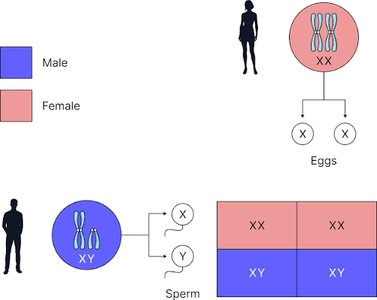
Sex determination in mammals is based on the XY chromosome system. Females are homogametic (XX), producing only X gametes, while males are heterogametic (XY), producing both X and Y gametes.
Homogametic: One type of sex chromosome in gametes (e.g., XX in females).
Heterogametic: Two types of sex chromosomes in gametes (e.g., XY in males).
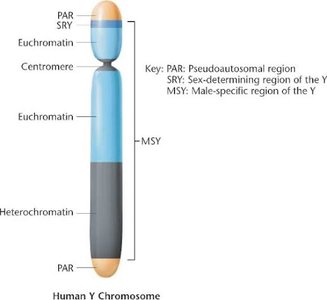
Human Y Chromosome Regions
The human Y chromosome contains several important regions:
SRY region: Sex-determining region, triggers male development.
MSY region: Male-specific region of the Y chromosome.
PAR region: Pseudoautosomal regions, homologous sequences on X and Y chromosomes.
Genetic Crosses and Test Crosses
Test Cross
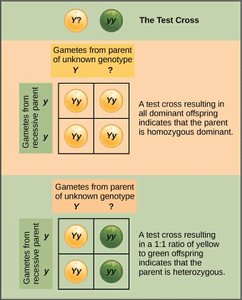
A test cross is used to determine the genotype of an organism displaying a dominant phenotype by crossing it with a homozygous recessive individual. The offspring ratios reveal the unknown genotype.
If all offspring show the dominant phenotype, the parent is homozygous dominant.
If offspring show a 1:1 ratio of dominant to recessive phenotypes, the parent is heterozygous.
Secondary Test Cross
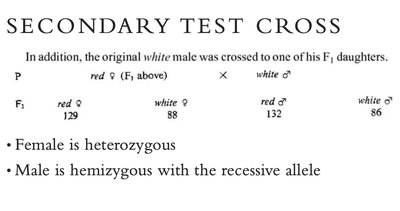
A secondary test cross involves crossing offspring from the initial test cross back to a homozygous recessive individual to confirm genetic makeup or map linked genes. This is often used in studies of sex-linked traits.
Female is heterozygous.
Male is hemizygous with the recessive allele.
Sex-Linked Genes and Disorders
Sex-Linked Genes
Genes located on sex chromosomes are called sex-linked genes. X-linked genes are found on the X chromosome. Males, having only one X chromosome, are more likely to express recessive X-linked disorders.
Carrier: Individual with one copy of a mutated gene, often asymptomatic.
X Inactivation: In females, one X chromosome is randomly inactivated, forming a Barr body.
Mosaicism: Heterozygous females may show mosaic expression of X-linked traits.
Linked Genes and Genetic Mapping
Linked Genes
Genes located close together on the same chromosome tend to be inherited together and are called linked genes. Linked genes do not assort independently, violating Mendel’s law of independent assortment.
Punnett squares assume independent assortment, but linked genes are inherited together.
Recombination frequency depends on the distance between genes.
Meiosis and Chromosomal Abnormalities
Meiosis Overview
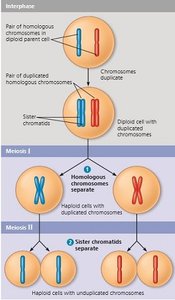
Meiosis is the process by which diploid cells produce haploid gametes. It involves two divisions: meiosis I (homologous chromosomes separate) and meiosis II (sister chromatids separate).
Crossing Over
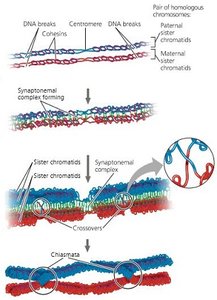
During meiosis, crossing over occurs between homologous chromosomes, resulting in genetic recombination. Four DNA strands break and rejoin, forming chiasmata.
Nondisjunction and Aneuploidy
Nondisjunction is the failure of homologous chromosomes or sister chromatids to separate properly during meiosis or mitosis. This results in aneuploidy, where offspring have an abnormal number of chromosomes.
Monosomic: One copy of a chromosome.
Trisomic: Three copies of a chromosome (e.g., Down syndrome).
Polyploidy: More than two complete sets of chromosomes, common in plants.
Chromosomal Mutations
Types of Chromosomal Mutations
Deletion: Removes a chromosomal segment.
Duplication: Repeats a segment, often harmful.
Inversion: Reverses orientation of a segment within a chromosome.
Translocation: Moves a segment from one chromosome to another.
Common Chromosomal Disorders
Human Syndromes
Down Syndrome: Trisomy 21.
Triplo-X Syndrome: XXX females.
Kleinfelter Syndrome: XXY males.
Jacobs Syndrome: XYY males.
Turner Syndrome: XO females.
Key Questions and Answers
What is a wild type? The most common phenotype in a population.
What process explains Mendel's Law of Segregation? Homologous chromosomes separating during meiosis I.
What determines sex in humans? The male gamete, which can contribute either an X or Y chromosome.
What is nondisjunction? An error in cell division causing chromosomes to move to the same side of the cell.
What is polyploidy? Condition with more than two complete sets of chromosomes.
What is an inversion? Chromosome segment reattaches in reverse direction.
Summary Table: Chromosomal Abnormalities
Abnormality | Chromosome Number | Symptoms |
|---|---|---|
Down Syndrome | Trisomy 21 (47) | Intellectual disability, characteristic facial features |
Turner Syndrome | XO (45) | Short stature, infertility |
Kleinfelter Syndrome | XXY (47) | Sexual underdevelopment, long limbs |
Triplo-X Syndrome | XXX (47) | Tall stature, menstrual irregularities |
Jacobs Syndrome | XYY (47) | Tall stature, speech problems |
Additional info: Polyploidy is common in plants and often results from hybridization. Most polyploid plants cannot interbreed with diploid relatives.
