 Back
Ch. 15
Study Guide - Smart Notes
 Tailored notes based on your materials, expanded with key definitions, examples, and context.
Mendelian Genetics and Chromosomal Inheritance
Mendel’s Peas and the Concept of Heredity
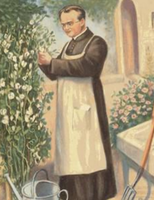
Mendel is recognized as the father of genetics for his pioneering work in the 1860s, where he studied various traits in pea plants to understand how characteristics are passed from parents to offspring. His experiments established the foundation for the laws of inheritance.
Key Point 1: Mendel studied traits such as flower color, pea color, and pea shape.
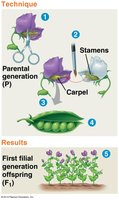
Key Point 2: He defined how traits are inherited using controlled crosses and careful observation.
Example: Mendel’s cross-pollination technique between pea plants with different traits.
Mendel’s Theories in Chromosomes
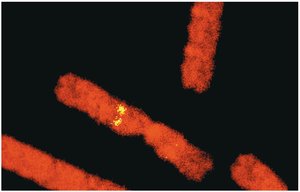
Modern genetics allows us to trace genes to specific chromosomes using fluorescent tags. The chromosome theory of inheritance links Mendel’s principles to the physical location of genes on chromosomes.
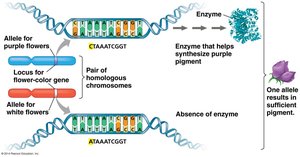
Key Point 1: Genes are located at specific positions called loci on chromosomes.
Key Point 2: Alternate forms of a gene are called alleles.
Example: The flower color gene in peas has alleles for purple and white flowers.
Inheritance and Meiosis
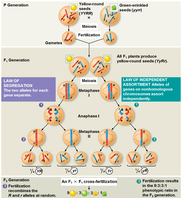
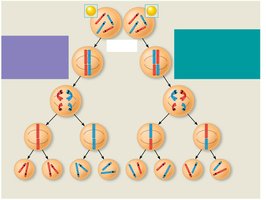
The process of meiosis explains how Mendel’s laws operate at the chromosomal level. The law of segregation and the law of independent assortment are illustrated by the behavior of chromosomes during meiosis.
Key Point 1: The law of segregation states that allele pairs separate during gamete formation.
Key Point 2: The law of independent assortment states that genes on different chromosomes assort independently.
Example: Dihybrid crosses in peas demonstrate independent assortment.
Chromosomal Basis of Inheritance
Morgan’s Work in Drosophila
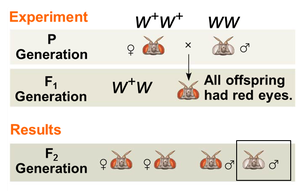
Thomas Hunt Morgan’s experiments with fruit flies (Drosophila melanogaster) provided evidence that genes are located on chromosomes and that some traits are linked to sex chromosomes.
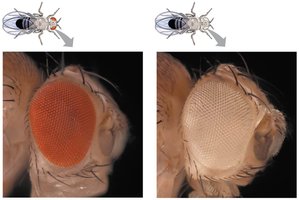
Key Point 1: Morgan studied traits such as eye color, noting wild-type (normal) and mutant phenotypes.
Key Point 2: He assigned symbols to alleles, with the wild-type allele receiving a '+' sign.
Example: White-eyed flies (mutant) vs. red-eyed flies (wild type).
Assigning Alleles with a Chromosome Pair
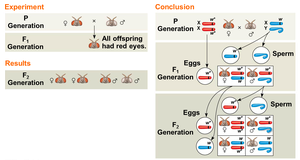
Morgan’s crosses between flies with different eye colors demonstrated that genes located on sex chromosomes have unique inheritance patterns.
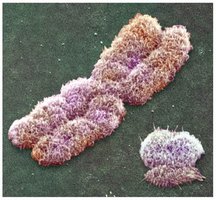
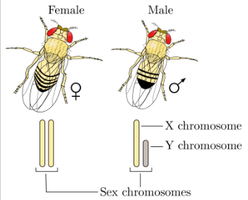
Key Point 1: Genes on sex chromosomes (X and Y) show distinct inheritance.
Key Point 2: The SRY gene on the Y chromosome determines male development.
Example: Crosses between white-eyed males and red-eyed females.
Sex Chromosomes and Sex-Linked Genes
Genes located on sex chromosomes are called sex-linked. X-linked genes are found on the X chromosome, while Y-linked genes are found on the Y chromosome. X-linked recessive disorders are more common in males due to their single X chromosome.
Key Point 1: X chromosomes carry many genes unrelated to sex; Y chromosomes mostly carry genes related to sex determination.
Key Point 2: Males are hemizygous for X-linked genes, so recessive traits are more easily expressed.
Example: Color blindness, Duchenne muscular dystrophy, and hemophilia are X-linked disorders.
Inheritance of X-Linked Genes
For X-linked recessive traits, females must inherit two copies of the allele to express the trait, while males need only one.
Key Point 1: Females are homozygous or heterozygous for X-linked alleles; males are hemizygous.
Key Point 2: X-linked traits are often observed in males.
Example: Color blindness inheritance patterns.
X Inactivation in Female Mammals
One X chromosome in each cell of female mammals is randomly inactivated, forming a Barr body. This can lead to mosaic phenotypes in heterozygous females.
Key Point 1: X inactivation ensures dosage compensation between males and females.
Key Point 2: If the dominant allele is silenced, a recessive X-linked allele may be expressed.
Example: Calico cats display mosaic fur coloration due to X inactivation.
Linkage and Genetic Recombination
Linked Genes
Genes located close together on the same chromosome tend to be inherited together and are called linked genes. However, linkage can be incomplete due to genetic recombination.
Key Point 1: Linked genes do not assort independently.
Key Point 2: Recombinant offspring display new combinations of traits.
Example: Body color and wing size in Drosophila are often inherited together.
Recombination of Unlinked Genes
Unlinked genes follow Mendel’s law of independent assortment, with a 50% recombination frequency for genes on different chromosomes.
Key Point 1: Separation during metaphase I of meiosis is random.
Key Point 2: Recombination frequency is used to map gene locations.
Recombination of Linked Genes
Crossing over during meiosis can produce recombinant types even for linked genes. The frequency of recombination increases with the distance between genes.
Key Point 1: Crossing over occurs between homologous chromosomes.
Key Point 2: Genetic maps are constructed using recombination frequencies.
Example: Map units indicate relative distance and order of genes.
Alterations of Chromosome Number and Structure
Non-disjunction and Aneuploidy
Non-disjunction occurs when homologous chromosomes fail to separate during meiosis, leading to abnormal chromosome numbers (aneuploidy).
Key Point 1: Polyploidy is the presence of extra sets of chromosomes.
Key Point 2: Aneuploidy includes monosomic (one chromosome) and trisomic (three chromosomes) conditions.
Example: Down syndrome is caused by trisomy 21.
Aneuploidy of Sex Chromosomes
Aneuploidy can affect sex chromosomes, resulting in syndromes such as Klinefelter (XXY) and Turner (X0).
Key Point 1: XXX females are typically healthy.
Key Point 2: Klinefelter syndrome affects males; Turner syndrome affects females.
Alterations of Chromosome Structure
Chromosome breakage can lead to structural changes such as deletions, duplications, inversions, and translocations.
Key Point 1: Deletions can cause disorders like cri du chat.
Key Point 2: Translocations can cause diseases such as chronic myelogenous leukemia (CML).
Exceptions to Mendelian Genetics
Epigenetics and Genomic Imprinting
Epigenetic changes affect gene expression without altering the DNA sequence. Genomic imprinting involves silencing genes depending on the parent of origin, often through DNA methylation.
Key Point 1: Imprinting is critical for embryonic development.
Key Point 2: Methylation of cysteine nucleotides silences genes.
Example: Some genes are only expressed if inherited from a specific parent.
Inheritance of Organelle Genes
Some genes are located in organelles such as mitochondria and chloroplasts. These genes are inherited maternally because the zygote’s cytoplasm comes from the egg.
Key Point 1: Mitochondrial and plastid genes are extranuclear.
Key Point 2: Mutations in cytoplasmic genes can cause disease.
Example: Mitochondrial disorders affect energy production.
Type of Chromosomal Alteration | Description | Example Disorder |
|---|---|---|
Aneuploidy | Abnormal number of chromosomes | Down syndrome (trisomy 21) |
Polyploidy | Extra sets of chromosomes | Common in plants |
Deletion | Loss of chromosome segment | Cri du chat syndrome |
Translocation | Segment moves to another chromosome | Chronic myelogenous leukemia |
Additional info: The notes expand on brief points to provide academic context, definitions, and examples for clarity and completeness.
