 Back
BackChromosomes and Cell Division: The Cell Cycle in Eukaryotes
Study Guide - Smart Notes
 Tailored notes based on your materials, expanded with key definitions, examples, and context.
Chromosomes and Cell Division
Introduction to Cell Division
Cell division is a fundamental process that distinguishes living organisms from nonliving matter. It is essential for reproduction, growth, and repair in both unicellular and multicellular organisms. The continuity of life depends on the ability of cells to divide and produce new cells, ensuring the propagation and maintenance of life.
Reproduction: Cell division allows organisms to produce offspring or new cells.
Growth and Repair: Multicellular organisms rely on cell division for development, growth, and the replacement of damaged or worn-out cells.
Example: Bone marrow continuously produces new blood cells to replace those lost through normal wear and tear.
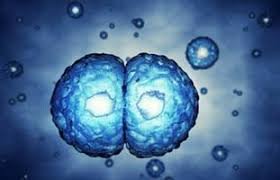
The Cell Cycle
The cell cycle is the series of events that take place in a cell leading to its division and duplication. It consists of two main phases: Interphase and the Mitotic (M) phase. Interphase is the period of cell growth and chromosome duplication, while the M phase includes mitosis and cytokinesis, resulting in the formation of two daughter cells.
Interphase: Comprises G1 (first gap), S (synthesis), and G2 (second gap) phases. Chromosomes are duplicated only during the S phase.
Mitotic (M) Phase: Includes mitosis (nuclear division) and cytokinesis (cytoplasmic division).
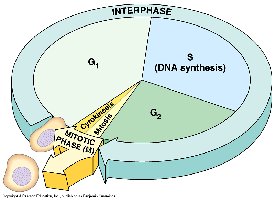
Phases of the Cell Cycle
Interphase accounts for about 90% of the cell cycle and is divided into three distinct phases. The cell grows during all three phases, but chromosome duplication occurs exclusively during the S phase.
G1 Phase: Metabolic activity and growth.
S Phase: DNA synthesis and chromosome duplication.
G2 Phase: Preparation for cell division, continued growth.
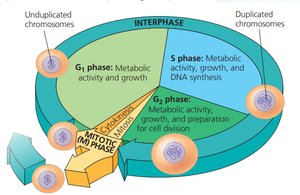
Cellular Organization of Genetic Material
The genetic information of a cell is known as its genome. In prokaryotes, the genome is typically a single DNA molecule, whereas eukaryotes possess multiple DNA molecules organized into chromosomes. Chromosomes are composed of chromatin, a complex of DNA and proteins, which changes its degree of condensation during cell division.
Chromatin: The material that makes up chromosomes, consisting of DNA and associated proteins.
Chromosome: A structure that carries genetic information, visible during cell division.
Genome: The complete set of genetic material in a cell.
Eukaryotic Cell Structure
Eukaryotic cells are characterized by a well-defined nucleus surrounded by a nuclear membrane, containing chromosomes. They also possess various organelles, each with specialized functions:
Mitochondria: Cellular energy exchangers.
Golgi Apparatus: Secretory device.
Endoplasmic Reticulum: Canal-like system of membranes.
Lysosomes: Digestive apparatus.
Chromosome Number in Eukaryotes
Each eukaryotic species has a characteristic number of chromosomes. Human somatic cells contain 46 chromosomes (two sets of 23), while gametes (sperm and eggs) have 23 chromosomes (one set), reflecting their role in sexual reproduction.
Somatic Cells: All body cells except reproductive cells; diploid (2n).
Gametes: Reproductive cells; haploid (n).
Example: Human somatic cells have 46 chromosomes; gametes have 23.
Distribution of Chromosomes During Eukaryotic Cell Division
During cell division, chromosomes are duplicated and distributed to daughter cells. Each chromosome consists of two sister chromatids joined at a centromere. The process ensures that each daughter cell receives an identical set of chromosomes.
Sister Chromatids: Identical copies of a chromosome connected by a centromere.
Centromere: The region where sister chromatids are joined.
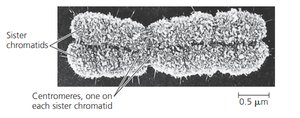
Table: Comparison of Cell Cycle Phases
Phase | Main Activity | Chromosome Status |
|---|---|---|
G1 | Cell growth, metabolic activity | Unduplicated |
S | DNA synthesis, chromosome duplication | Duplicated |
G2 | Preparation for cell division | Duplicated |
M (Mitosis & Cytokinesis) | Cell division | Distribution to daughter cells |
Key Equations
Chromosome number in somatic cells and gametes:
Somatic cells:
Gametes:
For humans:
Additional info: The cell cycle is tightly regulated by checkpoints to ensure proper division and prevent errors that could lead to diseases such as cancer.
