 Back
BackChromosomes, Meiosis, and Genetic Disorders: Study Notes
Study Guide - Smart Notes
 Tailored notes based on your materials, expanded with key definitions, examples, and context.
Chromosomes and Genes
Structure and Function of Chromosomes
Chromosomes are thread-like structures composed of a single molecule of DNA and associated proteins. They carry thousands of genes, which are the units of heredity and encode specific traits. Each gene is a sequence of DNA that determines a particular characteristic.
Chromosome: A DNA molecule with associated proteins, containing many genes.
Gene: A segment of DNA that encodes a trait.
Chromatin: The diffuse form of DNA and proteins found in the nucleus before condensation.
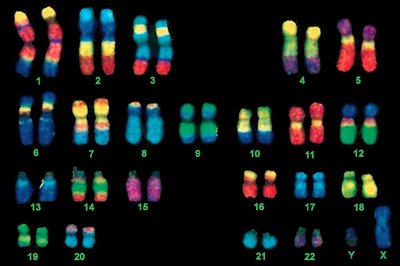
Chromosome Number and Types
Humans have two types of chromosomes: autosomes and sex chromosomes. Somatic cells are diploid (2n), containing two sets of chromosomes, while gametes are haploid (n), containing one set. Homologous chromosomes are pairs that carry the same genes but may have different alleles. The sex chromosomes (X and Y) are not homologous to each other.
Diploid (2n): Two sets of chromosomes (somatic cells).
Haploid (n): One set of chromosomes (gametes).
Autosomes: Non-sex chromosomes (pairs 1-22).
Sex Chromosomes: X and Y; females are XX, males are XY.
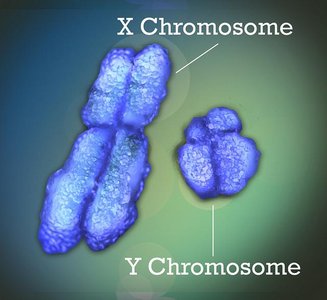
Sex Chromosomes and Sex Determination
Sex Chromosome Structure
The X chromosome is significantly larger than the Y chromosome and contains more genes. Sex determination in humans is based on the presence of the Y chromosome; individuals with XY are male, and those with XX are female.
Sexual Life Cycle and Meiosis
Overview of the Sexual Life Cycle
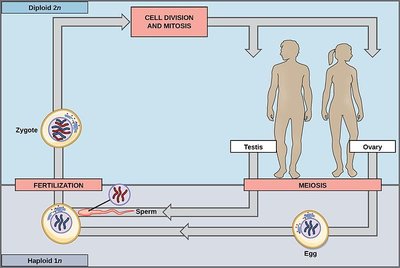
The sexual life cycle alternates between diploid and haploid stages. Fertilization restores the diploid state, while meiosis reduces the chromosome number to haploid in gametes. This cycle ensures genetic diversity and continuity of species.
Fertilization: Fusion of sperm and egg to form a zygote (diploid).
Meiosis: Cell division that produces haploid gametes.
Cell Division and Mitosis: Growth and maintenance of diploid cells.
Meiosis: Process and Stages
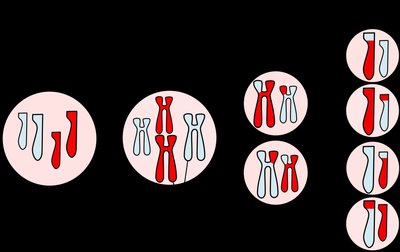
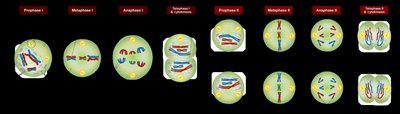
Meiosis consists of two consecutive divisions: Meiosis I and Meiosis II. It includes pairing and separation of homologous chromosomes, resulting in four haploid cells from one diploid cell. Key events include chromatin condensation, chromosome replication, and formation of tetrads.
Meiosis I: Homologous chromosomes separate.
Meiosis II: Sister chromatids separate.
Tetrad: Pair of duplicated homologous chromosomes.
Centromere: Region where sister chromatids are joined.
Locus: Specific location of a gene on a chromosome.
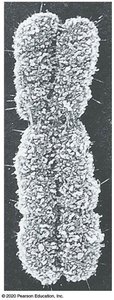
Genetic Diversity in Meiosis
Mechanisms of Genetic Diversity
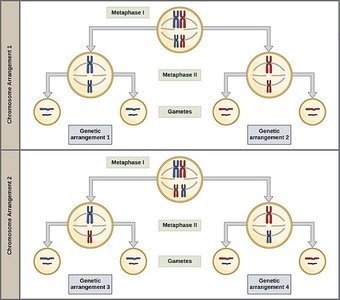
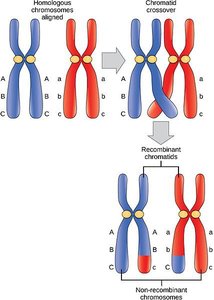
Meiosis increases genetic diversity through independent assortment, crossing over, and random fertilization. The number of possible gametes is determined by the formula , where n is the haploid number of chromosomes.
Independent Assortment: Random alignment of homologous chromosomes at metaphase I.
Crossing Over: Exchange of chromosome segments between nonsister chromatids during prophase I.
Random Fertilization: Any sperm can fertilize any egg, increasing genetic combinations.
Formula:
Example: In humans, , so possible gametes.
Chromosome Abnormalities: Nondisjunction and Aneuploidy
Nondisjunction
Nondisjunction is the failure of chromosomes to segregate properly during anaphase I or II of meiosis, or during mitosis. This results in gametes with abnormal numbers of chromosomes.
Aneuploidy: Abnormal number of chromosomes due to nondisjunction.
Loss of a chromosome: Usually not compatible with life, except for sex chromosomes.
Extra chromosome: Only certain chromosomes (X, Y, 13, 18, 21) are compatible with life.
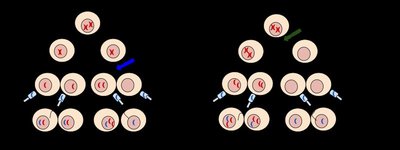
Sex Chromosome Aneuploidy
Sex chromosome aneuploidies result in various syndromes:
Turner Syndrome (XØ): Female, short stature, infertility, other complications.
Klinefelter Syndrome (XXY): Male, hypogonadism, infertility, ~1 in 500 male births.
XYY: Male, usually asymptomatic.
XXX: Female, mild neuropsychological and physical symptoms.
Down Syndrome (Trisomy 21)
Down syndrome is caused by trisomy of chromosome 21 and is the most common serious birth defect in the US. It is characterized by distinct physical features and increased risk of heart defects and Alzheimer's disease.
Incidence: 1 in 700 births.
Physical features: Round, flat face, skin fold at inner corner of eye, short stature.
Health risks: Increased risk of heart defects and Alzheimer's disease.
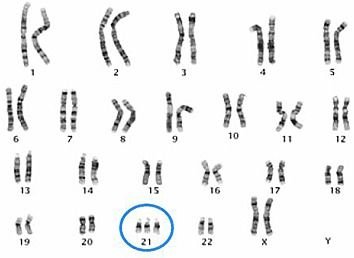
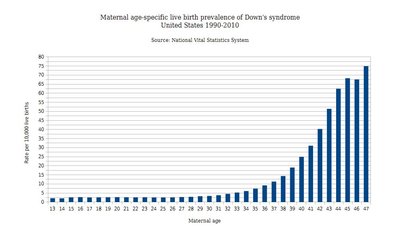
Maternal Age and Down Syndrome Risk
The risk of Down syndrome increases with maternal age. This is likely due to increased chances of nondisjunction during meiosis in older oocytes.
Summary Table: Chromosome Abnormalities
Type | Chromosome(s) Involved | Phenotype |
|---|---|---|
Turner Syndrome | XØ | Female, short stature, infertility |
Klinefelter Syndrome | XXY | Male, hypogonadism, infertility |
XYY | XYY | Male, asymptomatic |
XXX | XXX | Female, mild symptoms |
Down Syndrome | Trisomy 21 | Distinct facial features, heart defects, increased Alzheimer's risk |
Key Equations
Number of possible gametes:
Number of possible zygote combinations:
Example for humans: possible gametes; possible zygote combinations.
